DIGI-HEALTH MONITOR Calendar Week 34
DIGI-HEALTH MONITOR: Calendar Week 34, 2026
This week’s spotlight article
A new system combines single-incision and multi-incision surgery in one device, and is now gaining a foothold in Europe.
When a robot operates in the abdomen, it inserts its instruments through small incisions. In the common systems, each robotic arm gets its own incision, usually three or four spread across the abdomen. But there are also systems in which all instruments, and thus all arms, enter through a single incision, often through the navel, so that in the end barely a scar remains visible. This approach is gentler, but technically more demanding.
If a hospital wanted to offer both procedures, it previously had to purchase and maintain two separate devices, each with its own console and its own overhead. As a result, many clinics opted for just one of the two systems from the outset.
This is exactly where a Chinese manufacturer comes in. With the MSP2000, Edge Medical has developed what it says is the world’s first system to unite both procedures in a single platform, controlled from the same console (MassDevice, 2025).
It was installed at the National Institute of Oncology in Hungary, the country’s largest cancer center and the only comprehensive cancer center in Central and Eastern Europe certified by the Organisation of European Cancer Institutes. It is the first installation of this system outside China (VCBeat, 2026).
The development is best understood in the context of the market. The field of surgical robots has been dominated for more than two decades by the da Vinci system from the US manufacturer Intuitive. A Chinese system installed at a leading European center, bringing with it a technical innovation that did not exist in this form before, is a clear signal that this market could now be starting to shift. The step was made possible by CE certification under the EU Medical Device Regulation, which Edge Medical obtained in October 2025 (MedChina, 2025).
For all this context, a sober look at the current state is also worthwhile. So far, three procedures have been carried out with the system in Hungary, two prostate removals and one hysterectomy, each using the multi-incision variant. The assessments from the surgeons involved were positive, but they come from the users themselves and not from an independent study. And the genuinely novel single-incision variant has not yet been activated at all. This single installation is, in itself, a small step. But it shows that movement is coming into a market that, in the West, has long been dominated by a single provider.
Other articles from this week
Hackensack Meridian operationalizes AI governance and earns Joint Commission certification
Hackensack Meridian Health became the first U.S. health system to earn The Joint Commission’s Responsible Use of AI in Healthcare Certification, offering a concrete governance implementation rather than a single tool deployment. Its multidisciplinary governance structure spans clinical care, nursing, compliance, legal, academic programs, technology leadership, and patient/family representatives. Surveyors examined safety and efficacy evaluation processes, conducted staff tracers, reviewed documentation, and scrutinized vendor contracts. The system highlights three transferable components: multidisciplinary decision-making, an objective scoring framework for proposed AI applications, and explicit rules on vendor access to and reuse of patient data. Notably, governance extends to administrative AI, recognizing that back-office errors can still harm patients or disrupt access to care. While no clinical, financial, or workforce outcomes are attributed to the governance model itself, the certification represents a mature, independently verified operational process — a rare governance-focused Route A example with direct system-level replicability for other health systems building AI oversight infrastructure.
How IHH Singapore Saves 31,000 Admin Hours Yearly
IHH Healthcare Singapore, operator of four private hospitals and 50+ clinics, implemented a Patient Intelligence Centre (PIC) consolidating bed-management, OT scheduling, and SAP data into a near-real-time operational view. Unlike centralized hospital command centers, PIC uses a decentralized, mobile-first model pushing intelligence directly to frontline nurses and operations staff rather than a central control room. Nursing director Elaine Choo described previously heavy phone-based coordination now replaced by earlier visibility into demand and capacity. Piloted at Mount Elizabeth Hospital before scaling to all four hospitals by end-2025, PIC reportedly saves about 31,000 administrative hours annually — organization-reported. Governance is addressed directly: data validation, user-acceptance testing, access controls, and hospital-level operational autonomy. Leadership explicitly excludes autonomous clinical decision-making, reserving AI/predictive analytics for future phases contingent on defined benefit and governance maturity. This transparent, cautious phased approach combined with a genuinely novel decentralized architecture and quantified time savings makes it a strong operational implementation example.
Epic releases Care Everywhere diagnostic image exchange to tackle healthcare’s ‘CD problem’
Epic has released Care Everywhere Diagnostic Image Exchange across its network, letting clinicians at connected health systems pull full diagnostic-quality images (CT, X-ray, MRI) from other organizations via DICOMweb and FHIR standards, replacing the long-standing reliance on patient-carried CDs. Previously only written reports and lower-resolution reference images moved routinely between systems. Epic’s existing duplicate-order checks already prevent over 21,000 repeat scans annually; the new capability supplies the actual prior images into local PACS workflows. NYU Langone, importing roughly 15,000 studies monthly, provided real-world perspective on reduced friction and improved patient-matching. The initiative aligns with CMS “ditch the disc” efforts and TEFCA’s open-standards push at a national scale. No large-scale quantified clinical outcomes (e.g., diagnosis-time reduction) are yet reported, and challenges include large file sizes and uneven vendor adoption of open standards. The national interoperability alignment and concrete institutional example give it strong system-level relevance despite still-emerging outcome data.
WHOOP Expands Advanced Labs Offering to Non-Members, Adds GRAIL’s Multi-Cancer Detection Test
Fitness wearable maker WHOOP opened its Advanced Labs clinical testing service — combining Quest Diagnostics blood panels, clinician-reviewed results, and AI-generated insights — to non-members for the first time, with testing starting around $150. It simultaneously added GRAIL’s Galleri multi-cancer early detection blood test, available at nearly 2,000 Quest locations with results delivered directly into the WHOOP app. GRAIL’s VP of medical affairs frames this as extending early cancer detection to an already health-engaged population. WHOOP states, as company-reported figures, that roughly 80% of Advanced Labs users report a “meaningful health finding” and over half receive results warranting clinical follow-up — organization-reported, not independently validated. This continues WHOOP’s shift from fitness tracker toward consumer clinical health platform following prior medical-records syncing and clinician-consultation rollouts. The article notably does not address privacy governance, regulatory classification of the Galleri integration, or risks of consumer-directed cancer screening outside a traditional clinical relationship — a meaningful gap given the sensitivity of unsupervised cancer-detection results reaching consumers directly.
The Global Digi-Health Monitor is our weekly published newsletter featuring curated updates on the latest developments in digital health. With a focus on innovation and relevance, it brings together key news across topics such as AI in healthcare, wearables, telemedicine, cybersecurity, and more.
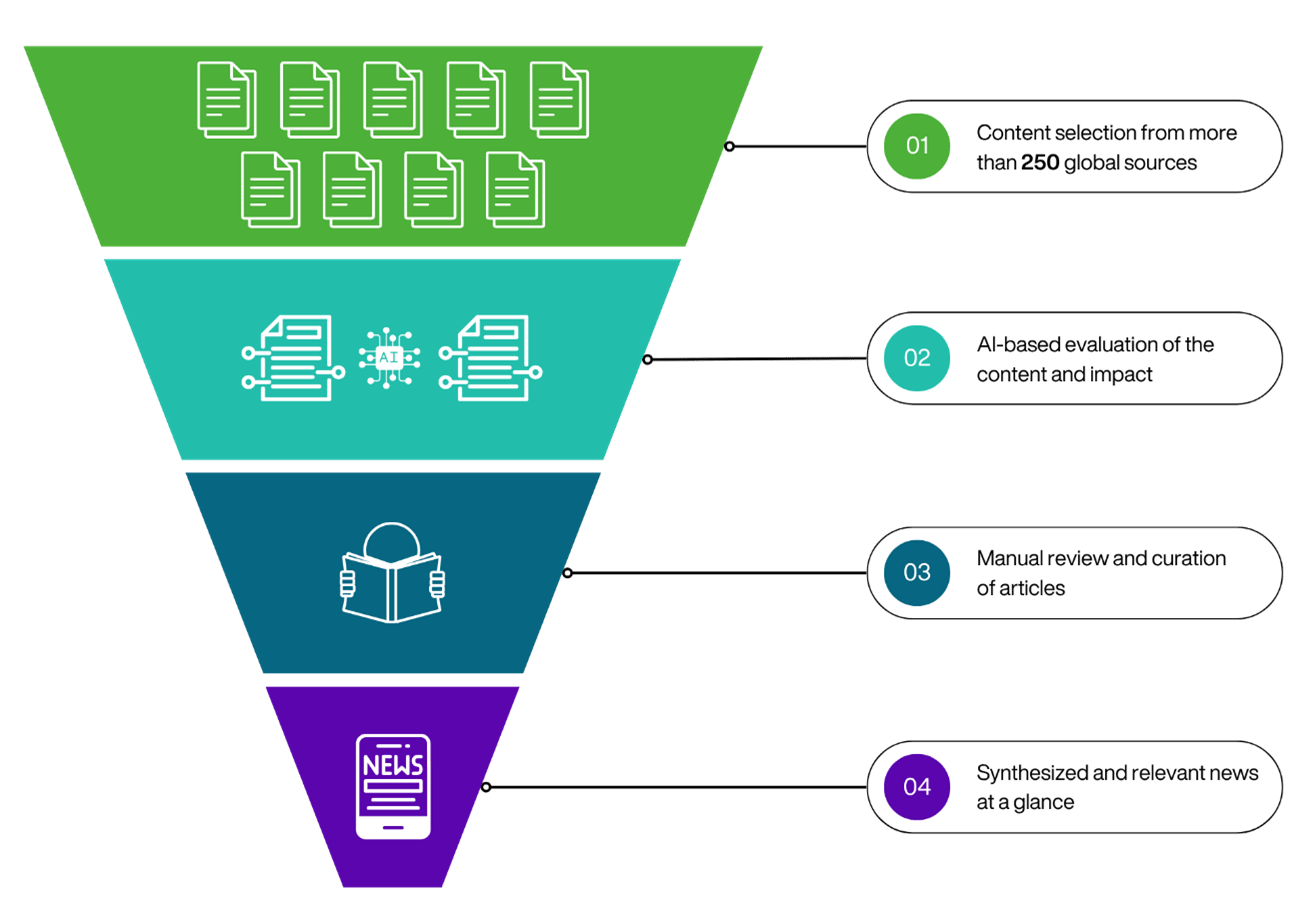
Our process is designed to be both scalable and selective. A broad network of over 250 global sources is continuously screened using six different AI tools. These tools help surface relevant content, which is then passed through a multi-step filtering and evaluation process that emphasizes innovation and impact.
In the final stage, selected articles are reviewed and curated by our team before being published. The result is a dynamic, well-structured view of what truly matters in the digital health ecosystem. This way you always stay ahead of the curve.