DIGI-HEALTH MONITOR Calendar Week 32
DIGI-HEALTH MONITOR: Calendar Week 32, 2026
Spotlight article
When AI leaves the screen
Anyone who has been to a restaurant recently may have already seen it: a small, quirky robot that carries the food to the table, dodges people and chairs on its way, takes the dirty dishes back with it on the return trip, and can even play the right tune for special occasions like birthdays.
What you tend to notice far less is that such systems also exist in healthcare. While the public debate revolves almost entirely around generative AI, meaning systems that produce text, images or answers, this second category has long since established itself. It is called physical AI. These are systems that perceive their surroundings, make a decision and then act in the real, physical space.
And these systems are not new. In the US, the robot Moxi (Diligent Robotics) operates in more than 25 hospitals, transporting medications and lab samples, using elevators on its own, and has now completed more than a million deliveries (https://www.therobotreport.com/diligent-robotics-completes-300000-pharmacy-deliveries-with-moxi/). In Europe, the Danish UVD Robots-robot moves autonomously through patient rooms and disinfects them with UV light. The European Commission itself procured 300 of these robots for hospitals in more than ten EU countries (https://digital-strategy.ec.europa.eu/en/news/european-commission-procurement-triggers-wider-deployment-innovative-disinfection-robots-across). And in German care facilities, the social robot Navel (navel robotics GmbH) is in use, rolling through the corridors, engaging residents in conversation and contributing to cognitive activation (https://www.altenheim.net/studie-roboter-navel-hat-potenzial-muss-aber-technisch-besser-werden/).
What is striking is what these examples have in common. In every case, the robot takes on a clearly defined, recurring task with low clinical risk and measurable benefit. Transport, disinfection, activation. The autonomous robot doctor is explicitly not the goal, at least not any time soon. For now it is about autonomy per individual task, meaning one clearly defined action rather than the entire procedure (Filippo Filicori, Northwell Health, 2026).
But this is exactly where the difference from generative AI lies, one that is rarely named. If a chatbot gives a wrong answer, a human eventually notices and corrects it. Once a machine moves in the same room as a patient, and as healthcare professionals too, its timing, its distance and its movements directly determine their safety and trust.
The leap from advisory to acting AI is therefore of a fundamentally different kind. In physical space there is no window for corrections, so a mistake happens in the very moment it occurs. And because these robots have long been driving through the corridors, questions of safety, oversight and liability are everywhere. But what does that actually look like in practice? What rules already apply today to a robot that moves in the same room as a patient? Who decides when such a system is safe enough, and who is watching when something goes wrong? Perhaps that is precisely where the real task of the coming years lies, in asking these questions in the first place.
Other articles
Gloucestershire Hospitals Implements Twinkle and BadgerDiaries to Enhance Pediatric and Neonatal Care
Gloucestershire Hospitals NHS Foundation Trust implemented two specialized digital applications within women’s and children’s services. Twinkle supports the care of children and young people with diabetes by giving clinical teams structured access to real-time patient information, reducing manual processes, improving clinical decision support, and facilitating outcome monitoring. The trust also introduced BadgerDiaries, a secure digital baby diary that provides families with information about their baby’s care and supports communication with clinical teams. Operationally, replacing separate systems with a consistent platform simplified the trust’s digital estate and improved staff consistency. The trust board reported financial savings compared to the previous arrangement, though the amount and evaluation method were not disclosed. Governance includes secure family communication, structured patient-data management, and support for national reporting. While the report lacks details on consent, access controls, or clinical outcome measures, it highlights how specialized applications can improve workflow and communication.
FMOL Health First to Deploy Epic’s AI Charting Tool in Emergency Departments, Reducing Documentation Burden
FMOL Health in Baton Rouge, Louisiana, became the first Epic client to deploy the vendor’s ambient AI charting tool, internally called “Chart with Art,” in its emergency departments. The tool passively listens to patient-provider encounters and automatically drafts clinical notes for physician review and signature, directly addressing the documentation burden that contributes to clinician burnout. Early reporting indicates reductions in physician documentation time and administrative workload, alongside measurable improvements in patient satisfaction, as clinicians can now maintain better eye contact and active listening during consultations. FMOL Health was also among the first five Epic clients to pilot this ambient scribe in ambulatory settings. The deployment contextualizes Epic’s broader AI ecosystem, with FMOL’s early ED adoption serving as a real-world reference point for large-scale AI documentation integration across acute care settings.
Emory Healthcare Deploys AI Sensor System for Patient Fall Prevention
Emory Healthcare deployed an AI-enabled sensor system from VirtuSense Technologies at Emory University Hospital Midtown to predict patient falls, providing 30–65 seconds of advance warning when high-risk patients attempt to leave their beds. Nurses monitor virtually from a control center at Emory Saint Joseph’s Hospital, communicating directly with patients and alerting floor nurses. The system achieved a 20% decrease in falls overall and a 91% reduction in falls with injury. Emory also uses related AI tools for sepsis and readmission risk prediction, imaging review (e.g., pulmonary embolism detection), and outbound AI voice agents for chronic-condition follow-up, all under human oversight. Governance includes evaluation systems and a radiologist serving as chief AI officer to ensure technology remains problem-driven and clinician-centered. The program illustrates practical inpatient safety gains that can scale across a major academic health system, with further expansion underway.
Precision Oncology at NYU Langone: AI Platform Solavia Enhances Clinical Decision-Making
NYU Langone Health and Dana-Farber Cancer Institute jointly developed Solavia, a suite of oncology analytics tools designed as a clinical decision support platform integrated directly into the electronic health record. Solavia went live at NYU Langone on June 30, 2026, enabling oncology care teams to review evidence, biomarkers, and treatment guidance without leaving their existing EHR workflows. The platform aims to reduce unwarranted variation in cancer care pathways and make precision medicine more actionable at the point of care. Dr. John Leonard, chief of hematology and medical oncology at NYU Langone’s Perlmutter Cancer Center, emphasized that Solavia provides “evidence-based, context-aware guidance” to personalize and coordinate cancer treatment. Both institutions are now establishing rigorous governance frameworks to ensure algorithmic accuracy, fairness, and clinical validity. Next steps include expanding digitized pathways and conducting implementation-science research to assess Solavia’s impact on treatment decisions, time-to-therapy, and patient survival outcomes.
The Global Digi-Health Monitor is our weekly published newsletter featuring curated updates on the latest developments in digital health. With a focus on innovation and relevance, it brings together key news across topics such as AI in healthcare, wearables, telemedicine, cybersecurity, and more.
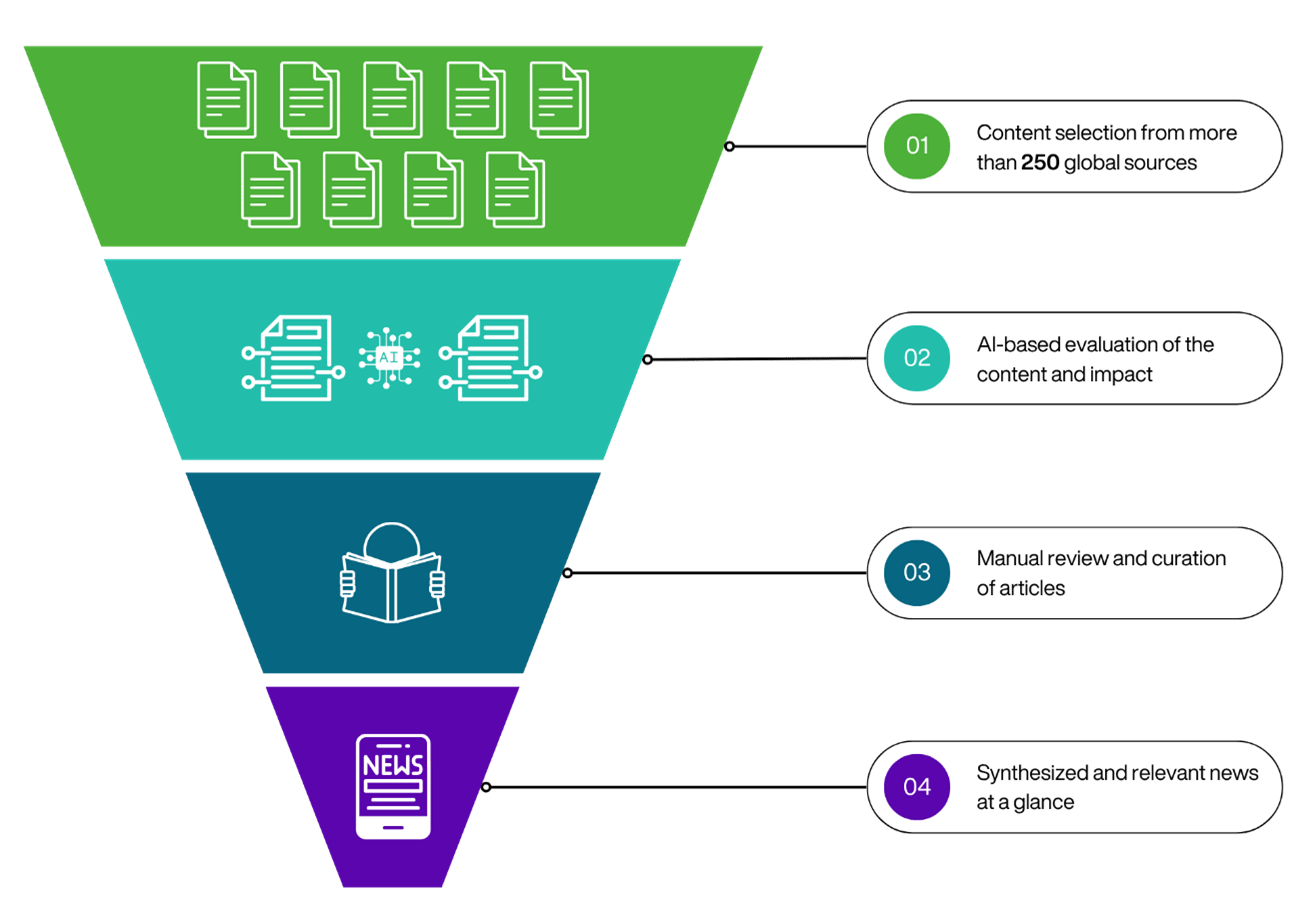
Our process is designed to be both scalable and selective. A broad network of over 250 global sources is continuously screened using six different AI tools. These tools help surface relevant content, which is then passed through a multi-step filtering and evaluation process that emphasizes innovation and impact.
In the final stage, selected articles are reviewed and curated by our team before being published. The result is a dynamic, well-structured view of what truly matters in the digital health ecosystem. This way you always stay ahead of the curve.