DIGI-HEALTH MONITOR Calendar Week 33
DIGI-HEALTH MONITOR: Calendar Week 33, 2026
Spotlight article
How an AI model supports pathologists in difficult cancer decisions
With stage two bowel cancer, the tumour is removed surgically. The question that follows is who needs additional chemotherapy and who does not. It can prevent a relapse, but it puts considerable strain on the body. And because it is still hard to predict whose cancer will come back, this is a particularly tricky call.
This is exactly where a research group at La Trobe University in Australia comes in. Their AI model, called SÉMIL, analyses ordinary tissue slides, the kind produced in any routine diagnosis, and estimates the risk of relapse from them.
The starting point is what is known as the invasive front of the tumour, the zone where the cancer cells push into the surrounding tissue. How this front looks is considered an important indicator of prognosis, but it is difficult to assess with the naked eye. Study lead Francis Magisson describes the core problem like this: the invasive front is a well-known prognostic factor, but it is judged by the human eye, and pathologists do not always agree on it.
It is precisely this disagreement that the team wants to reduce with its model. To do so reliably, the model was trained on images and, in addition, on written descriptions of the tissue slides, which improved its accuracy on cases it had never seen before.
In a validation involving more than 1,220 patients across three independent groups, the model reliably predicted relapse-free survival over five years. Those classified as high risk had roughly twice the risk of relapse, independent of the established clinical factors. The assessment was most accurate when AI and pathologist arrived at the same result. The tool is meant to complement the experts’ judgement and add an objective, reproducible layer to it.
As promising as this sounds, an important caveat remains. The results come from a retrospective analysis of already known cases. The team explicitly does not yet name any clinical pilot, regulatory approval or timeline for routine use, and whether the treatment decisions derived from it actually lead to better outcomes still has to be tested. The path from a statistically convincing model to a decision made on a real patient is a long one. The direction, however, is a promising one. A prognosis that until now depended heavily on the individual observer could become a little more objective, and all without additional tissue samples or costly extra tests.
Other articles
5 lessons from Mayo Clinic’s more than 500 AI models
Mayo Clinic has deployed over 500 AI models across its clinical organization, combining frontline innovation with formal governance, workforce development, and post-deployment oversight. Clinicians identify workflow problems, while models undergo research protocols, institutional review, and evaluation by Mayo’s AI implementation team for evidence strength, safety, operational ownership, and performance monitoring. A concrete example is AI-assisted radiation-treatment planning for head and neck cancer, which reduced physicist and radiation oncologist workload by 75%. Mayo also launched a voluntary AI upskilling program for 20,000 employees in 2025. A failed generative-AI medical-record summarization project highlighted model dependency and vendor-lock-in risks. While outcomes are organization-reported and patient outcomes are not detailed, the scale, governance, and lessons from both success and failure make this a standout article.
AI Triage Moves From Experiment to Front Door of Health Care
Mount Sinai Health System implemented “Check Symptoms & Get Care”, an AI-powered digital triage platform across its websites and patient app to address unscheduled care requests. The conversational AI guides patients through symptom-based questionnaires, providing care-level recommendations (primary care, telemedicine, or emergency) with direct scheduling links. Clinicians oversee recommendations via validation studies, ensuring alignment with professional assessments. In its first year, the platform recorded 60,000+ visits, with 22,000 completed triage sessions (80% completion rate). 71% of interactions occurred outside business hours, and 26% on weekends, addressing critical access gaps. Reported outcomes (organization-validated) include a System Usability Scale score of 85.5, with >75% of users rating the tool 8/10 or higher. Clinical alignment between AI and physician assessments ranged from 88% to 96%. Only 38% of users initially selected the same care level as the AI, demonstrating potential for appropriate redirection. Challenges include EHR integration and workflow fragmentation. Governance ensures human oversight, with final triage decisions remaining with clinicians. Scaling plans include expansion across specialties and deeper integration into care pathways.
Cleveland Clinic Prescription Drones Go Live As Zipline’s U.S. Deliveries Hit 70% Of Its Daily Volume
Cleveland Clinic placed a long-term autonomous drone prescription-delivery service into operation in partnership with Zipline. Pharmacy technicians at the Beachwood Administrative Campus load eligible non-controlled, non-refrigerated maintenance medications into a secure drop box; an electric drone retrieves the package, flies to the patient’s address within a five-mile radius, and lowers a tethered pod from up to 300 feet without landing. Patients enrolled in the health system’s home-delivery program can opt in at no extra cost and track deliveries via the patient portal. First flights occurred in the preceding days, with the program described as the first sustained U.S. health-system prescription-drone service. Expansion is planned for additional sites and payloads (lab samples, medically tailored meals, supplies). The service addresses access and convenience while reducing in-person pharmacy trips. Measured clinical or financial outcomes beyond operational feasibility and patient convenience were not reported. Safety, airspace, weather, and regulatory constraints remain relevant to scaling. The implementation demonstrates concrete physical logistics technology entering routine pharmacy workflow under clinician/staff oversight.
Patients are consulting AI before their physicians
Patients are increasingly using consumer AI chatbots to interpret laboratory results, imaging reports, medical records, and wearable-device information before consulting a clinician. A 2026 KFF poll indicates that ~33% of U.S. adults use AI chatbots for health advice, and 19% use them to interpret medical tests or lab results. This represents an emerging patient-facing workflow rather than a formal health-system deployment: patients independently generate questions or interpretations and then bring them into clinical encounters. The trend highlights a shift in patient behavior, with AI acting as a preliminary step in the care journey. However, the article does not detail specific organizations, outcomes, or governance frameworks, and the evidence is survey-based rather than tied to a structured implementation. The system-level significance lies in its impact on clinician-patient interactions, as clinicians may need to address or correct AI-generated interpretations, adding complexity to visits. The article underscores the need for patient education on AI limitations and the potential for both empowerment and misinformation.
The Global Digi-Health Monitor is our weekly published newsletter featuring curated updates on the latest developments in digital health. With a focus on innovation and relevance, it brings together key news across topics such as AI in healthcare, wearables, telemedicine, cybersecurity, and more.
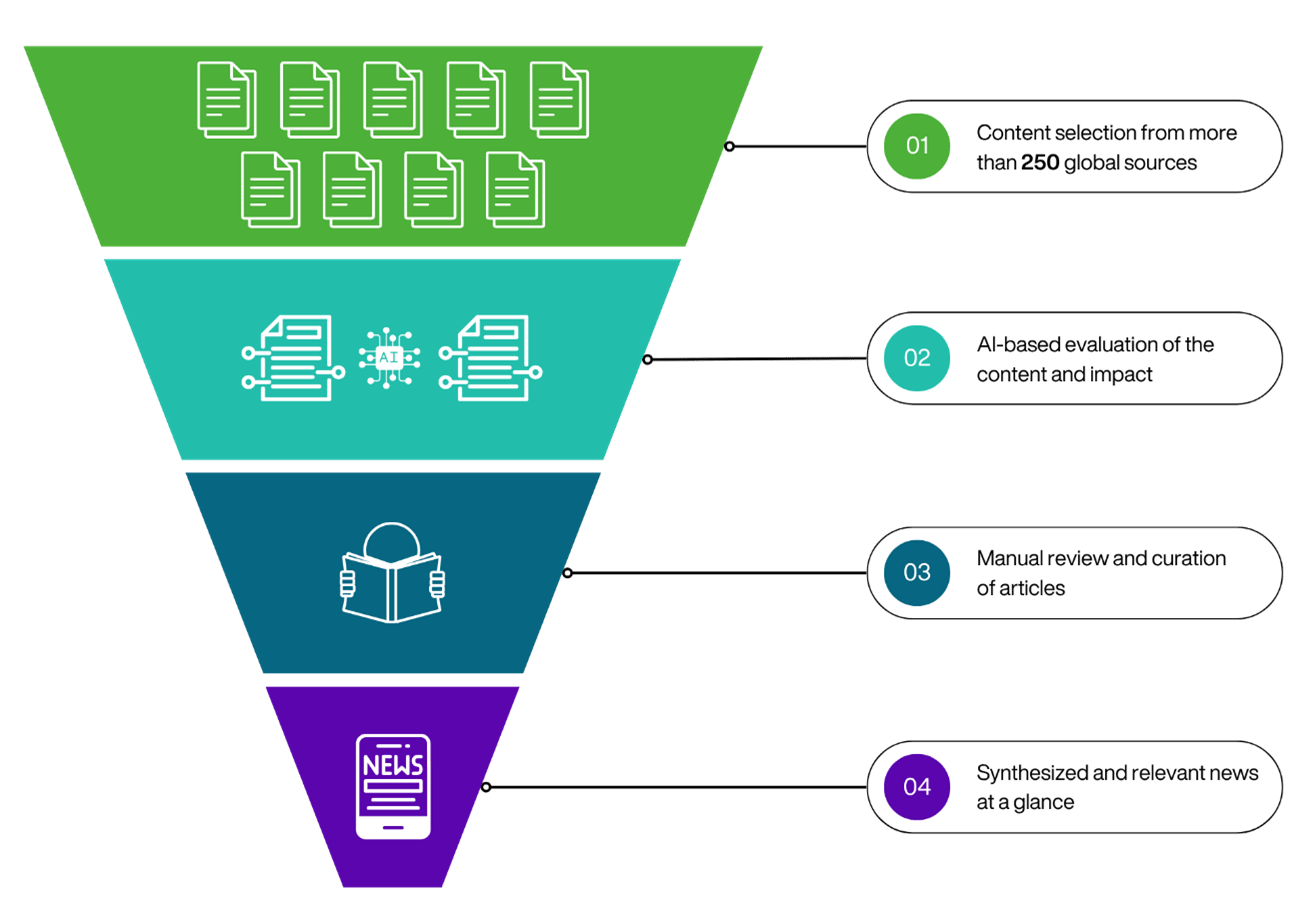
Our process is designed to be both scalable and selective. A broad network of over 250 global sources is continuously screened using six different AI tools. These tools help surface relevant content, which is then passed through a multi-step filtering and evaluation process that emphasizes innovation and impact.
In the final stage, selected articles are reviewed and curated by our team before being published. The result is a dynamic, well-structured view of what truly matters in the digital health ecosystem. This way you always stay ahead of the curve.