DIGI-HEALTH MONITOR Calendar Week 30
DIGI-HEALTH MONITOR: Calendar Week 30, 2026
ECU Health Deploys Autonomous AI Agents Inside Epic
ECU Health, a nine-hospital academic system in rural eastern North Carolina, has rolled out two autonomous AI agents within its Epic EHR. One assists transfer-center staff by matching patient needs against a hospital-capabilities grid and generating transfer recommendations, cutting manual chart review by roughly 20 hours a week with no detected hallucinations. The second drafts discharge-round summaries for about 160 case managers system-wide; after early feedback criticized overly long outputs, an overnight prompt fix pushed satisfaction to 75 percent by day two. Nurses and case managers retain final decision authority throughout. Governance includes strict access controls, audit logging, and a firm ban on patient-facing use. The system’s candor about early missteps — and its acknowledgment that it must now own agent maintenance — makes this a rare, transparent look at agentic AI’s real-world growing pains.
HCA Healthcare’s Blueprint for Scaling AI System-Wide
HCA Healthcare has detailed how a 750-person, physician-led digital transformation team is scaling AI across its hospital network. Priority areas include nurse scheduling, supply chain, and clinical documentation, with ambient speech recognition and intelligent staffing tools cutting scheduling time from hours to minutes across more than 1,000 nursing departments. Clinicians retain full authority over medical decisions and note sign-off, with AI positioned strictly as documentation support. Governance is a central theme: secure interoperable infrastructure, pre-deployment validation, and continuous post-implementation monitoring aim to ensure safety and ethical alignment. Legacy data silos and workflow friction remain challenges, tackled through standardization and change management. Next steps include extending agentic automation into acute care and refining metrics that capture both financial returns and clinician well-being — a systemic view of AI scaling rather than a single case study.
NHS App AI Triage Cuts GP Phone Queues by 29%
A pilot at Wealden Ridge Medical Partnership in Sussex tested an AI triage tool embedded in the NHS App, which conducts adaptive symptom interviews, can request photos, and produces structured summaries for clinicians — with every case reviewed by a human before follow-up. The result: a 29 percent drop in phone queue volume, easing practices’ early-morning call surges. A GP partner described the tool as sequencing information, not replacing judgment. NHS England plans to expand to over 200,000 London patients within a year, ahead of full national rollout by April 2028, alongside ambient transcription tools projected to free capacity for 9,000+ extra daily A&E consultations. However, an MHRA commission found 61–73 percent of respondents view current regulatory frameworks as insufficient — a reminder that oversight is lagging behind deployment speed at national scale.
Fixing Workflows First: How Graybill Medical Group Cut No-Shows and Costs
Graybill Medical Group, a 94-year-old, physician-led practice in North San Diego County, redesigned front-office operations before adding AI — not the other way around. COO Jamie Reddick first pinpointed bottlenecks in calls and scheduling, then introduced a hybrid AI/live-agent system from vendor Third Way Health that handles routine tasks while freeing staff for cases needing empathy and judgment. Reported outcomes: a 50 percent cut in front-office costs (about $3 million saved), a no-show rate drop from 5.1 to 3.9 percent year-over-year, and shorter wait times. The case reinforces a broader 2026 lesson: AI succeeds when built on prior workflow redesign, not deployed as a first step. Reddick frames the approach as replicable for other independent practices facing staffing pressure — though the piece stops short of detailing formal data-privacy governance around the vendor relationship.
DaVita Connects Billions of Data Points to Improve Kidney Care
DaVita’s Center Without Walls platform integrates clinical, operational, and patient-generated data — over one billion data points annually across roughly 30 million treatments — to support complex kidney care. Connected home-dialysis devices transmit readings between visits, letting care teams spot emerging risks without waiting for scheduled appointments, while AI summarizes labs, hospitalization histories, and clinical notes. Predictive models flag patients at risk of discontinuing home dialysis, giving clinicians early, explainable alerts. Physicians remain responsible for interpreting data and choosing interventions. DaVita reports better coordination and earlier problem detection, though no quantified changes in continuation rates, admissions, or cost are yet available. A working group on AI literacy and human-centered design underpins governance. The strongest takeaway here is the implementation model itself — embedding insights into existing workflows rather than adding new dashboards — rather than proven outcomes.
The Global Digi-Health Monitor is our weekly published newsletter featuring curated updates on the latest developments in digital health. With a focus on innovation and relevance, it brings together key news across topics such as AI in healthcare, wearables, telemedicine, cybersecurity, and more.
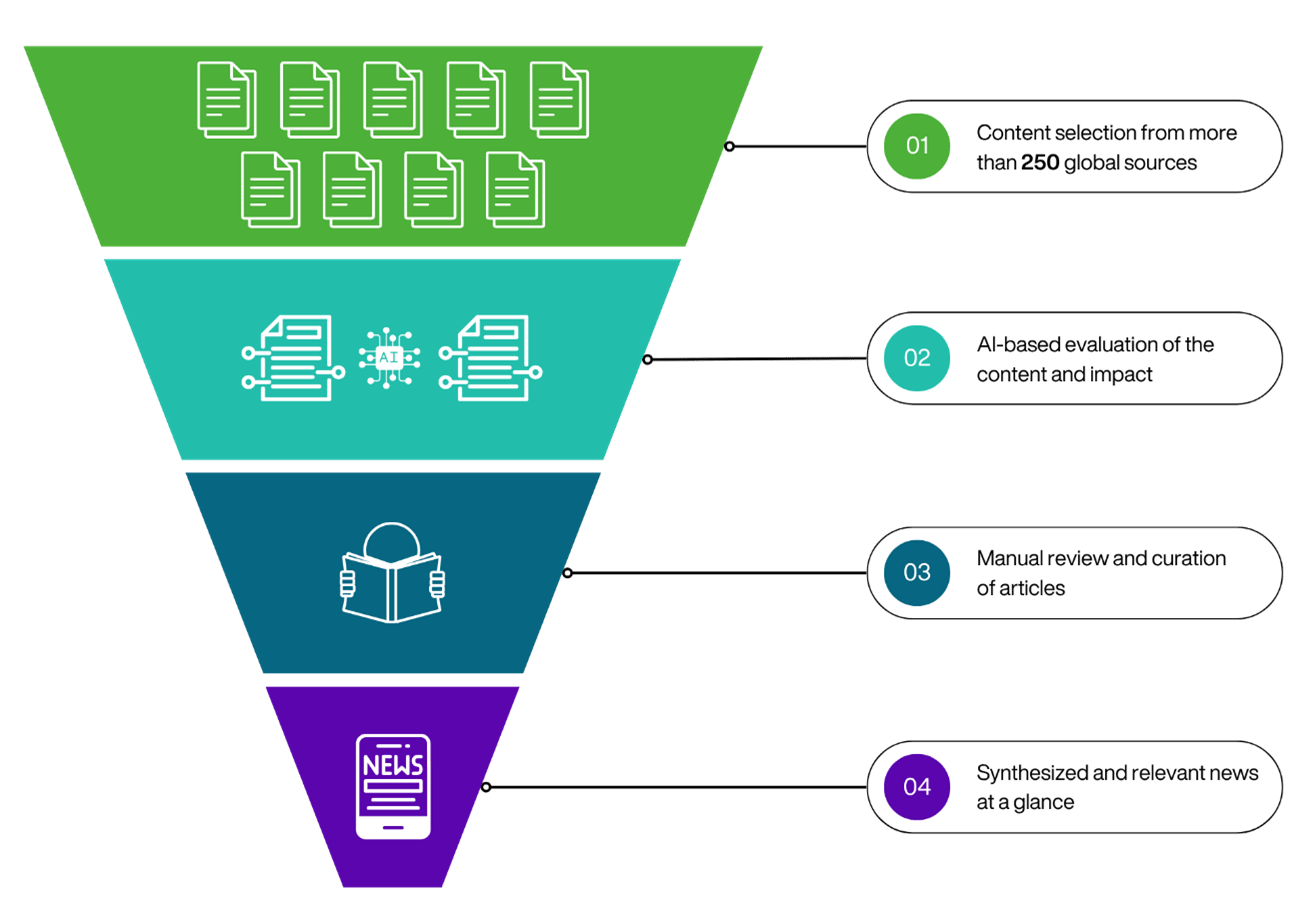
Our process is designed to be both scalable and selective. A broad network of over 250 global sources is continuously screened using six different AI tools. These tools help surface relevant content, which is then passed through a multi-step filtering and evaluation process that emphasizes innovation and impact.
In the final stage, selected articles are reviewed and curated by our team before being published. The result is a dynamic, well-structured view of what truly matters in the digital health ecosystem. This way you always stay ahead of the curve.