DIGI-HEALTH MONITOR Calendar Week 29
DIGI-HEALTH MONITOR: Calendar Week 29, 2026
National Heart Centre Singapore Deploys CARDIA-GM AI Platform to Rapidly Quantify Heart-Attack Damage on Cardiac MRI
The National Heart Centre Singapore (NHCS), with funding from the National Health Innovation Centre Singapore and collaboration from the National University Heart Centre Singapore, developed CARDIA-GM, a machine-learning platform that analyzes cardiac MRI scans to detect and quantify scarred heart muscle tissue and microvascular obstruction (MVO)—markers strongly tied to a patient’s risk of future cardiac events. Trained on roughly 2,500 MRI scans from about 350 patients, with ground-truth annotations manually delineated by researchers and adjudicated by senior specialists for difficult cases, the model was independently validated on more than 900 scans from over 150 heart-attack patients supplied by collaborators in China, some followed clinically for up to 10 years.
Published in the Journal of Cardiovascular Magnetic Resonance, results showed consistent accuracy across hospitals, scanner types, and patient populations, with prognostic value comparable to expert human assessment and strong inter/intra-observer reproducibility. The platform compresses an analysis that previously took up to an hour into 30–60 seconds. Cardiologist A/Prof Tan Ru San said faster, more reliable results should encourage more MRI referrals and better identification of high-risk patients needing intensified monitoring or rehabilitation. Remaining hurdles include integration with MRI scanners, reporting systems, and EMRs, plus regulatory approval as software-as-a-medical-device. NHCS plans multi-centre validation on roughly 1,000 additional patients across Singapore and overseas sites before broader clinical rollout. This is a high-impact, clinically validated AI deployment with clear scalability.
NUH Expands Wearable Smartwatch Monitoring After Pilot Detects Vital-Sign Changes Two Hours Earlier
Singapore’s National University Hospital (NUH) ran a month-long pilot, led by the Department of Surgery in collaboration with surgical ward nurses, operations staff, and NUS Medicine researchers, fitting post-surgical inpatients with HSA-approved vital-signs smartwatches to test continuous monitoring against routine hourly or four-hourly nursing checks. Across 30 patients per study arm, the wearable identified 14 low-blood-pressure episodes, two hypertensive episodes, one bradycardia event, and one desaturation event—each caught up to two hours before scheduled manual observations—with zero critical events missed and every abnormal reading escalated per existing clinical protocols after nurse confirmation on standard equipment.
Patient experience data showed only 7% of smartwatch patients attributed night-time disruptions to vitals checks, versus 17% under conventional monitoring. Nurses reported reduced time on repetitive tasks, and NUH now plans to integrate smartwatch data directly into its Epic EMR, cutting per-check documentation time from roughly two minutes to about 40 seconds. Clinicians, including A/Prof Asim Shabbir and Nurse Manager Lim Pooi See, framed the technology as augmenting rather than replacing bedside judgment. NUH aims to cover up to 10% of suitable inpatient vitals monitoring with wearables over the coming year, expanding cautiously to other patient groups while evaluating clinical suitability by care setting. The initiative is evidence-based, scalable, and governed by existing clinical protocols.
Midlands leads the way on ambient voice technology
NHS England’s Midlands region has established a single procurement route for Heidi’s ambient voice technology, covering 1,239 GP practices and over 70,000 clinicians across 15 acute and community trusts. The generative AI system records patient and clinician conversations, converting them into draft notes, letters, and structured documentation, with clinicians reviewing and validating all outputs before entry into patient records or use for referrals. Pilot results from Dudley demonstrate an 80% reduction in documentation time in a same-day emergency care unit, creating capacity equivalent to one junior doctor, while a six-month rheumatology correspondence backlog was reduced from 180 to 14 days. A Walsall practice serving over 8,000 patients has used the system since 2024, with GPs reporting less after-hours paperwork, better eye contact, and improved patient engagement.
Governance includes a clinical safety case, compliance assessment, business case, and evidence base, with patient consent obtained at the start of consultations and clinicians retaining responsibility for note accuracy. Next steps involve wider regional deployment, extending from GPs and non-medical prescribers to nursing staff. Challenges include transcription errors, incomplete clinical context, inappropriate coding, and the handling of recorded conversations, requiring ongoing oversight. The initiative is highly scalable and addresses a critical administrative burden in primary care, with clear potential for national replication.
Humber and North Yorkshire shares digital diagnostics progress and next steps for acute providers
The Humber and North Yorkshire Collaboration of Acute Providers has implemented AI-assisted fracture detection at hospitals in York, Scarborough, Scunthorpe, and Grimsby. More than 45,000 examinations have been processed during the pilot, with annotated images generated in near real time and displayed through existing picture archiving and communication system (PACS) workflows. The AI acts as a second reader rather than an autonomous diagnostic service, with emergency-department clinicians remaining responsible for interpreting the image, assessing the patient, and deciding on further imaging, treatment, or referral.
A clinical audit of 500 emergency cases found a sensitivity of 96.3%, specificity of 77.8%, a negative predictive value of 97.3%, and overall accuracy of 84.6%. The high sensitivity and negative predictive value may support earlier identification and prioritisation, particularly for less-experienced clinicians and during high-demand or out-of-hours periods. The lower specificity is a limitation, as false-positive findings can generate unnecessary imaging, admissions, and follow-up appointments. The programme therefore combines deployment with continuing clinical validation rather than treating model accuracy as settled. Planned work includes refining workflows, obtaining structured feedback from emergency teams, evaluating performance in specific pathways (e.g., suspected hip fractures), and considering expansion to additional trusts. Regional leaders have also secured £500,000 for digital diagnostics and are seeking larger multi-year investment for supporting imaging infrastructure. This is a live, large-scale AI deployment with robust clinical oversight and clear next steps for expansion.
Cottage Health Scales AI-Assisted Virtual Care and Patient Safety Platform Enterprise-Wide After Successful Pilot
Cottage Health, a nonprofit hospital system serving California’s Central Coast, is expanding its partnership with hellocare.ai to deploy an AI-assisted virtual care and patient-safety platform across all inpatient units, following completion of a pilot that demonstrated measurable improvements in patient safety, clinical workflows, and patient engagement. The enterprise rollout adds AI-powered fall-detection/prevention and pressure-injury prevention tools alongside Virtual Care and Patient Engagement modules, plus MyChart Bedside TV integration, bringing Epic’s patient portal to in-room screens via hellocare.ai’s Intelligent Hospital Room platform—Cottage was among the first health systems live with this specific integration.
CIO Ganesh Persad framed the goal as consolidating multiple point solutions (virtual nursing/sitting, patient engagement, ambient documentation) into one integrated environment to reduce vendor complexity and strengthen interoperability. Clinical governance is preserved: AI flags risk signals such as fall likelihood for staff to act on, rather than intervening autonomously, keeping nurses and care teams in the decision loop. The release cites qualitative pilot gains in safety and workflow but does not disclose specific quantitative metrics, a notable transparency gap. Next steps involve full enterprise deployment across Cottage’s hospitals, with hellocare.ai continuing to expand virtual nursing, ambient documentation, and Hospital-at-Home capabilities into the platform. This is a live, enterprise-wide deployment with clear potential for scalability in inpatient settings.
The Global Digi-Health Monitor is our weekly published newsletter featuring curated updates on the latest developments in digital health. With a focus on innovation and relevance, it brings together key news across topics such as AI in healthcare, wearables, telemedicine, cybersecurity, and more.
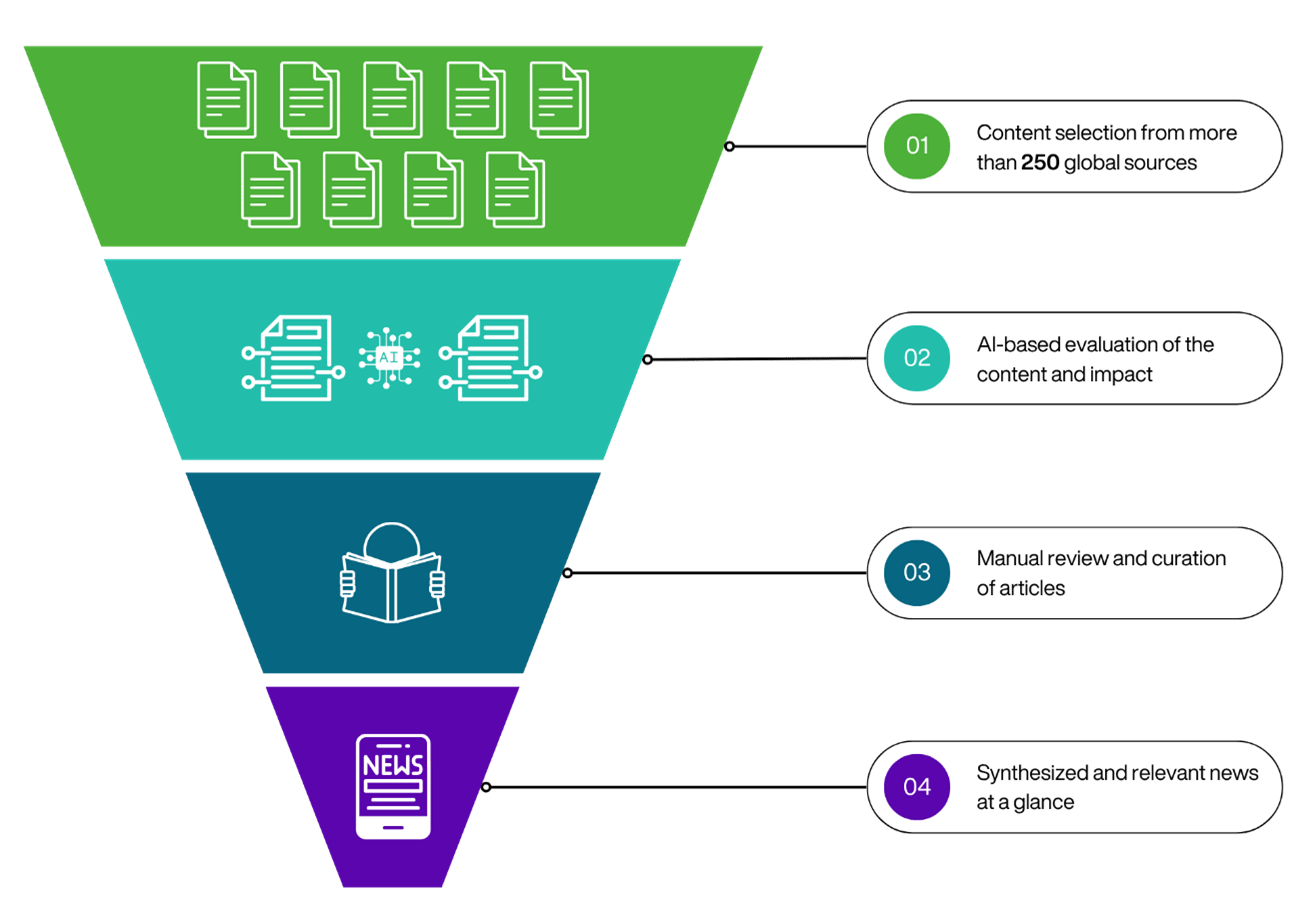
Our process is designed to be both scalable and selective. A broad network of over 250 global sources is continuously screened using six different AI tools. These tools help surface relevant content, which is then passed through a multi-step filtering and evaluation process that emphasizes innovation and impact.
In the final stage, selected articles are reviewed and curated by our team before being published. The result is a dynamic, well-structured view of what truly matters in the digital health ecosystem. This way you always stay ahead of the curve.