DIGI-HEALTH MONITOR Calendar Week 27
DIGI-HEALTH MONITOR: Calendar Week 27, 2026
Adopting VR in community senior services
Resthaven Marion Community Services in South Australia completed a 10-week pilot trial of virtual reality technology to support rehabilitation therapies for senior adults, in partnership with Adelaide-based developer Add-Life Technologies. The trial involved up to 25 participants from Parkinson’s and Falls and Balance groups, using VR headsets with hand-tracking capability for balance, coordination, mobility, and hand-eye coordination exercises. The VR platform captured movement data including range of motion and flexibility measurements, generating mobility reports for clinician review. Participants reported feeling calmer, more motivated, or mentally refreshed after sessions, with increased engagement observed among previously less active users. Occupational therapist Sam Hearn notes the data may help clinicians monitor progress and inform treatment planning. Resthaven emphasizes VR enhances but cannot replace conventional therapies. The organization is considering continued VR use based on trial outcomes, with a companion app tracking full-body movements under development to extend clinical monitoring capabilities. Privacy and governance followed appropriate standards for the pilot, with plans to address scalability and broader adoption challenges.
Hartford HealthCare launches PatientGPT to help patients understand medical records and lab results
Hartford HealthCare introduced PatientGPT, an AI-powered chatbot built into its patient portal to give patients a personalized way to interpret lab results, ask questions based on their own medical records, summarize clinician conversations, flag potential treatment interactions, and set up virtual or in-person appointments. Developed with K Health and launched in beta in March before broader rollout, the system requires patients to manually grant permission for data use, with Hartford HealthCare describing it as HIPAA-compliant, secure, private, and patient-controlled. Clinicians remain central as the chatbot cannot prescribe medications or recommend specific treatments; built-in escalation pathways direct patients toward in-person or virtual appointments when further evaluation is needed. Early reported usage includes 8,300 conversations with 6,000 unique patients. Hartford HealthCare expects to roll the tool out to more than 1 million patients within four to six weeks and is working on multilingual access. Patient-experience outcomes include better-prepared patients entering appointments with more informed questions, while provider-side benefits include summarized context before visits.
Virtual nurse discharges see 72% cut in readmissions compared to traditional methods
A multi-center study published in npj Digital Medicine evaluated virtual nursing discharge across nine hospitals in the southeastern United States, comparing 4,662 virtual discharges against a matched cohort of 4,662 traditional in-person discharges over two years. Trained virtual nurses—licensed RNs—conducted post-discharge education, medication reconciliation, and care transition coaching via secure video calls, replacing or supplementing bedside staff. Results demonstrated a 72% relative reduction in 30-day emergency department readmissions (3.7% in the virtual group vs. 13.3% in the traditional group), with consistent benefits across urban academic centers and rural community hospitals. Challenges included ensuring patient access to reliable internet and video-capable devices, which some sites addressed through loaner tablet programs. Governance and privacy measures adhered to HIPAA-compliant platforms with end-to-end encryption, and all virtual interactions were documented directly in the EHR. Clinician satisfaction remained high, with virtual nurses reporting improved work-life balance and reduced burnout. Next steps involve expanding the model to additional surgical and medical specialties and integrating predictive analytics to identify which patients benefit most from virtual versus in-person discharge planning.
The Greater Manchester hospital where AI could help save lives ‘before a crisis occurs’
Tameside & Glossop Integrated Care NHS Foundation Trust in Greater Manchester deployed a predictive AI tool to identify emergency department patients at high risk of unplanned return visits within 30 days of discharge. The model ingests routinely collected data—demographics, triage acuity, presenting complaints, long-term condition registries, and prior attendance histories—and generates a risk score in real time during the clinical workflow. Rather than automating decisions, the tool flags high-risk individuals to a multidisciplinary team (hospital clinicians, community nurses, social care coordinators, and mental health practitioners), who convene weekly to co-design personalized community support packages. Early internal audits revealed a 33–50% reduction in emergency readmissions among the flagged cohort, translating to dozens of avoided hospital stays per month. The trust emphasized that AI supplements—not supplants—clinical reasoning, with all recommendations reviewed by senior physicians before care plan changes. Data governance is stringent: the model runs on an on-premise secure server with anonymized training data, and patients are informed of the AI’s use during registration. Lessons learned include the need for continuous algorithm calibration to seasonal population shifts and the importance of investing in community-based resources to act on the AI’s alerts. Next steps involve expanding the tool to outpatient clinics and integrating social determinants of health data for finer risk stratification.
Mayo Clinic Implements Robust Governance for Over 100 Clinical AI Applications to Ensure Safe Deployment
Mayo Clinic established an executive-led oversight process reviewing every clinical AI application before staff use, having evaluated over 100 in the past year alone. The governance framework assesses complexity, setting, performance and safety, training, workflow integration, privacy and security, and lifecycle management, with complex or time-urgent tools requiring proactive human review. This supports safe integration of tools like Stanford-style EHR-embedded LLMs while mitigating risks such as automation bias, deskilling, hallucinations, or over-reliance. The approach balances innovation with safety, enabling tools that improve outcomes without compromising care quality. Clinicians maintain a central role with appropriate guardrails. Addressed challenges include hallucinations, over-reliance, and privacy concerns. Next steps involve ongoing monitoring and expansion of responsible AI use to improve outcomes across the organization. The framework demonstrates an organizational-level adoption model yielding scalable, low-risk implementation that can serve as a template for other health systems, emphasizing that AI remains human-directed for now.
The Global Digi-Health Monitor is our weekly published newsletter featuring curated updates on the latest developments in digital health. With a focus on innovation and relevance, it brings together key news across topics such as AI in healthcare, wearables, telemedicine, cybersecurity, and more.
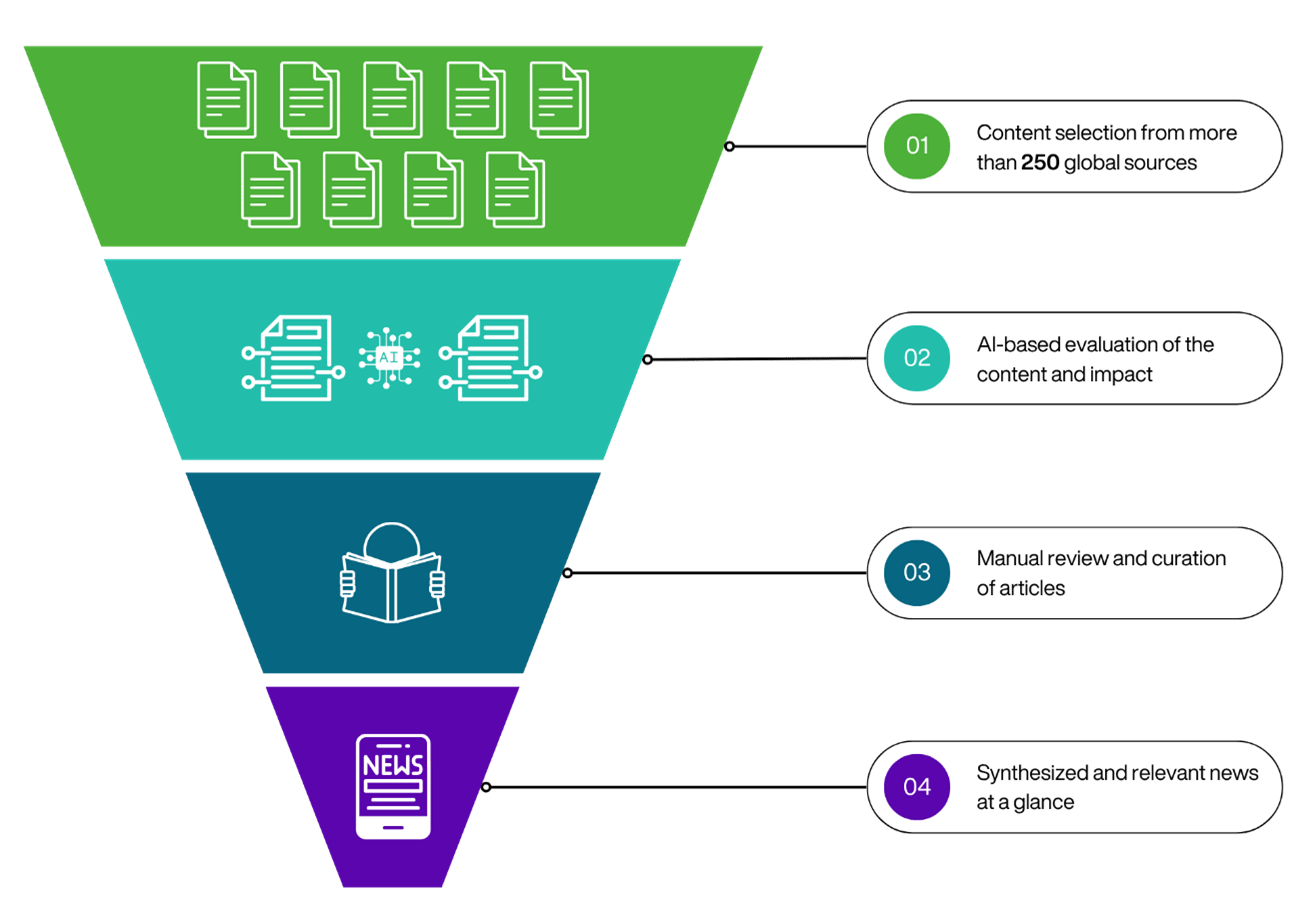
Our process is designed to be both scalable and selective. A broad network of over 250 global sources is continuously screened using six different AI tools. These tools help surface relevant content, which is then passed through a multi-step filtering and evaluation process that emphasizes innovation and impact.
In the final stage, selected articles are reviewed and curated by our team before being published. The result is a dynamic, well-structured view of what truly matters in the digital health ecosystem. This way you always stay ahead of the curve.