DIGI-HEALTH MONITOR Calendar Week 26
DIGI-HEALTH MONITOR: Calendar Week 26, 2026
Boston Children’s Hospital automation program
Boston Children’s Hospital, led by Chief Innovation Officer John Brownstein, PhD, deployed a comprehensive intelligent automation program with over 50 robotic process automations (RPA) eliminating repetitive administrative tasks across all departments, saving 30,000+ work hours in H1 2026. Each automation undergoes rigorous time measurement: pre-implementation manual effort is recorded, post-implementation savings are calculated, and regained capacity is redirected to higher-value clinical or research activities. Parallelly, the hospital operates an internal, data-protection-compliant OpenAI GPT instance, with ~33% of staff using it daily, saving 2–3 hours/week per active user. A key challenge was employee reluctance to learn new tools—a “Catch-22” where skill acquisition would itself free up time. To ensure governance, a dedicated training team offers department-specific roadshows, office hours, and prompt libraries. While back-office tasks are rapidly automated, clinical applications involving direct patient contact proceed cautiously, with partnerships with OpenAI and OpenEvidence ensuring only evidence-based, validated models are used. Next steps include building an “intelligence infrastructure” linking AI to Epic EHR for deep operational insights into capacity, safety, and outcomes.
OUH receives national funding for major AI projects
Oxford University Hospitals (OUH) secured £8 million from the National Institute for Health and Care Research to fund AI projects aimed at reducing NHS waiting times and improving patient care. The SAMURAI-CT study evaluates AI-assisted interpretation of head CT scans across four NHS emergency departments, assessing whether AI can accelerate diagnosis of urgent intracranial pathology and reduce discharge times. SMART-XR explores autonomous chest X-ray reporting to alleviate clinical workload, while SWIFT LUNG tests an AI tool for lung cancer prediction. Led by the Oxford Clinical Artificial Intelligence Research team, the SAMURAI program systematically evaluates AI across the entire clinical translation pathway—from ethical, governance, and data infrastructure to clinician performance and real-world impact. Co-director Dr. Alex Novak underscored the framework’s role in enabling safe, effective, and scalable AI adoption across the NHS. The projects involve real clinicians, patients, and workflows, with explicit governance and data protection measures. Next steps include expanding the evaluation framework and scaling successful interventions nationally.
Italian Hospital Deploys ‘Alter-Ego’ Robot in Live Trial for ALS Patient Care
Maugeri Hospital in Milan, with the Italian Institute of Technology and University of Pisa, is conducting a live trial of the 1.2-meter-tall “Alter-Ego” robot in its neuromotor rehabilitation department for ALS patients. The robot—designed with expressive eyebrows—performs tasks such as substituting for remotely working doctors, delivering water to patients, and guiding them to treatment. Since April 2026, real patients like 31-year-old Daniel Senna have used it, transmitting pain levels via a chest-mounted screen with data instantly sent to ward nurses. Department director Christian Lunetta reported initial patient apprehension gave way to high satisfaction due to thoughtful design. The robot delegates repetitive tasks to free human staff for relationship-building. Currently remote-controlled, it will operate autonomously from July. Neurologist Rachele Piras noted it reduces caregiver burdens, allowing them to “revert to simply being a companion, mother or daughter.” The project explores robotic assistance limits in wards, with potential home care applications. Manuel Catalano (IIT) highlighted AI’s role in accelerating robotics, though significant training remains for independent operation. The trial involves real patients, clinicians, and structured oversight.
AI Helped Diagnose 18 Children Whose Rare Diseases Left Doctors Stumped
Boston Children’s Hospital’s Manton Center for Orphan Disease Research used OpenAI’s o3 Deep Research in a real diagnostic workflow for children with previously undiagnosed rare diseases, where conventional genomic analyses had failed. Researchers analyzed 376 genomes from undiagnosed patients, with the model helping identify 18 new diagnoses—including neurodevelopmental and neuromuscular disorders, early psychoses, and sudden unexpected death cases. The ~5% additional diagnostic yield was deemed clinically significant given prior unsuccessful analyses. The tool is positioned as an accelerator for reanalysis and hypothesis generation, not an autonomous replacement for clinical expertise. Experts warned against consumer self-diagnosis, stressing its role in supporting medical and scientific teams. For clinical organizations, the case demonstrates how multimodal AI and LLM-supported research can reduce diagnostic backlogs and deliver answers sooner in highly specialized pathways. While governance, routine embedding, and economic details are less comprehensive than in operational implementations, the clinical impact is concrete. Next steps include further validation, integration into clinical workflows, and exploration of additional use cases for complex, undiagnosed conditions.
. Essex Partnership digital tool improves leg wound and ulcer care
Essex Partnership University NHS Foundation Trust introduced BlueDop technology—a wireless Doppler probe combined with tablet support—in its Tissue Viability Service for assessing leg ulcers and hard-to-heal wounds. The intervention directly targets a specialized outpatient and community-based setting where vascular assessment quality strongly influences treatment pathways. Previously, such examinations required patients to lie flat for up to 30 minutes while wearing a tight cuff, often causing pain and anxiety. BlueDop enables faster, more comfortable assessments, providing a more complete picture of blood flow to inform effective treatment decisions. Reported outcomes include quicker assessments, greater patient comfort, reduced anxiety, and—per specialist nurses—faster recovery due to earlier, more precise therapy initiation. Clinicians remain central, as the technology supplements rather than replaces specialist nursing assessment or treatment planning. While lacking quantified before-after data, the case offers concrete insight into a real, frontline implementation with immediate patient benefits and clear transferability to other wound and vascular services. Next steps involve expanding use to additional clinics and refining the technology based on user feedback.
The Global Digi-Health Monitor is our weekly published newsletter featuring curated updates on the latest developments in digital health. With a focus on innovation and relevance, it brings together key news across topics such as AI in healthcare, wearables, telemedicine, cybersecurity, and more.
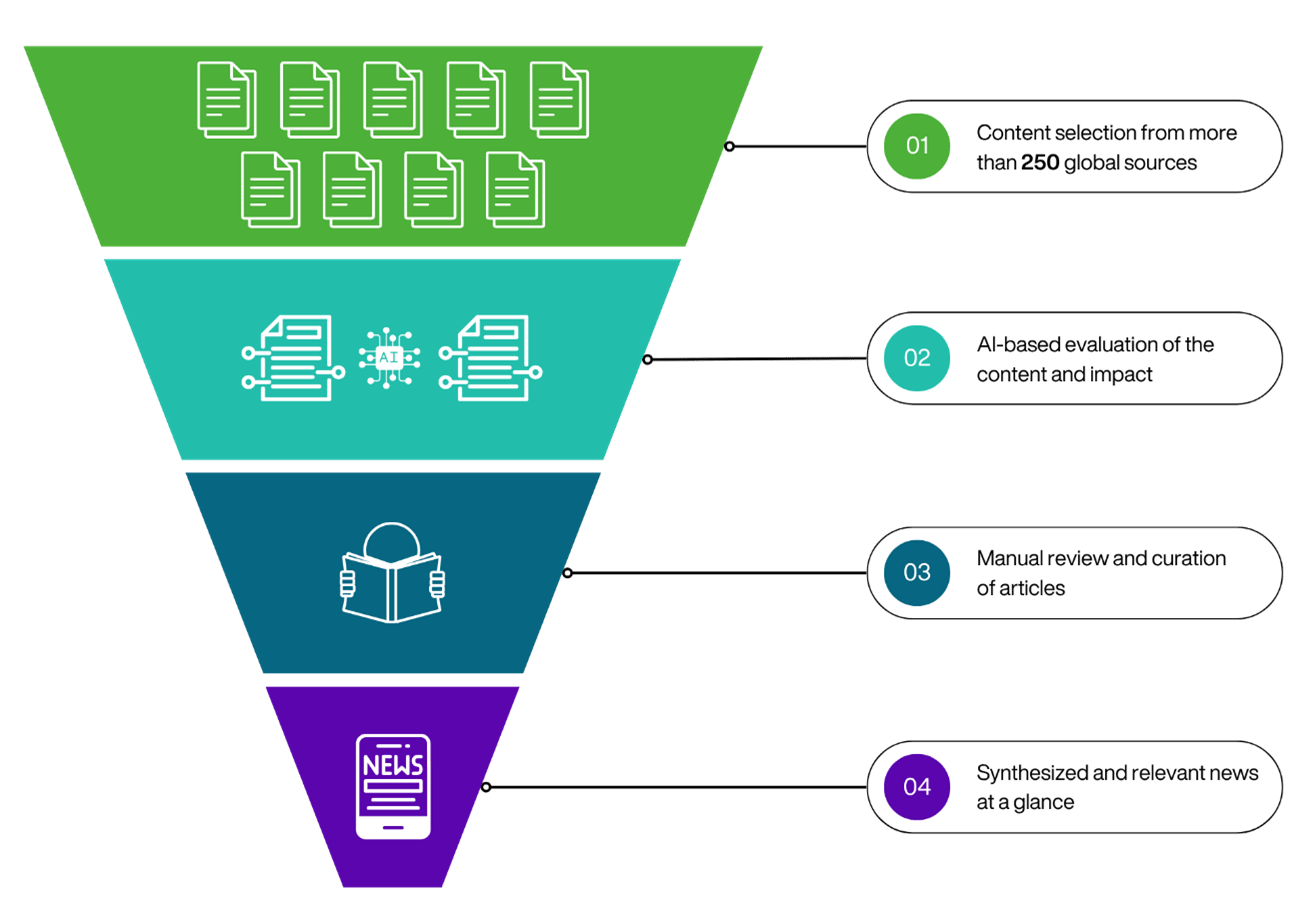
Our process is designed to be both scalable and selective. A broad network of over 250 global sources is continuously screened using six different AI tools. These tools help surface relevant content, which is then passed through a multi-step filtering and evaluation process that emphasizes innovation and impact.
In the final stage, selected articles are reviewed and curated by our team before being published. The result is a dynamic, well-structured view of what truly matters in the digital health ecosystem. This way you always stay ahead of the curve.