DIGI-HEALTH MONITOR Calendar Week 25
DIGI-HEALTH MONITOR: Calendar Week 25, 2026
AdventHealth embeds precision cancer screening into routine care across 57 hospitals
AdventHealth implemented GRACE (Genomics Risk Assessment for Cancer and Early Detection) as a systemwide precision-screening workflow across its 57 hospitals, embedding AI-driven risk assessment directly into routine mammography workflows. Breast imaging visits trigger a short patient questionnaire, AI-supported breast density analysis via Volpara Scorecard, and risk processing through Lunit Risk Pathways, with results automatically pushed into Epic so clinicians need not leave existing workflows. High-risk patients are routed to nurse navigators, genetic counseling, supplemental imaging (MRI or ultrasound), and personalized surveillance plans. AdventHealth reports that 99.5% of eligible patients now receive structured risk assessment, high-risk identification increased by 28%, and all identified high-risk patients are contacted by a high-risk nurse navigator. The program addresses the challenge of providing consistent cancer risk assessment across a large, multi-hospital system while maintaining clinician oversight. Implementation lessons include ensuring reliability across many sites, the necessity of EHR integration, and continuous updating as clinical guidelines and AI tools evolve. The operational redesign, rather than a standalone AI tool, ensures seamless adoption and scalability.
CommonSpirit Health Scales AI for Cancer Screening and Stroke Care, Reducing Administrative Burden and Improving Detection Rates
CommonSpirit Health, one of the largest nonprofit Catholic health systems in the U.S., deployed AI tools across radiology, imaging, and risk stratification workflows to address workforce gaps and improve early detection rates. For cancer screening (breast, colon, and lung), robotic process automation integrated with EHR data automatically calculates personalized patient risk based on age, health history, and family factors, then flags high-risk cases for physician-approved screenings, addressing complex and varying guidelines that are difficult for humans to track at scale. Reported outcomes include up to 50% year-to-date increases in cancer screening rates in some areas, helping close care gaps and enabling earlier detection. For acute stroke care, the system uses AI platforms like RapidAI, Brainomix, or Viz.ai to analyze imaging at community hospitals, immediately transferring results to stroke centers, activating teams faster, and supporting treatment pathway decisions. Radiologists review every study, with AI flagging abnormalities and prioritizing cases to reduce missed findings from fatigue. Ambient scribing, used at scale by peer systems, cuts documentation burden. Challenges include ethical governance, bias mitigation, and avoiding over-reliance, with a strict “human-in-the-loop” design. Next steps involve further scaling, predictive analytics for personalized care, and partnerships like Truveta for large-scale de-identified data research.
Skin Analytics extends NHS-used skin cancer AI pathway to smartphone-compatible clinical use
Skin Analytics’ DERM system has been used for six years across 24 NHS hospitals, assessing more than 230,000 patients and identifying over 20,000 cancers, with every detection validated against histopathology. The workflow operates as a digital triage pathway for suspected skin cancer: lesions are photographed, low-concern cases can be autonomously discharged, and suspicious lesions are escalated for clinical review. The smartphone-compatible certification expands access to this proven pathway while maintaining clinical oversight. Existing NHS deployments support autonomous discharge of up to 40% of urgent suspected skin cancer referrals, freeing dermatology capacity for higher-risk cases. Clinicians remain central for review, confirmation, and treatment. Governance and risk management include regulatory classification, safe integration into NHS pathways, referral redesign, and careful monitoring as assessment expands into pharmacies, primary care, and community settings. The certification builds on a foundation of real-world outcomes with substantial patient volume, demonstrating scalability and operational impact. The system addresses a critical need in dermatology, where demand often outstrips capacity, by efficiently triaging low-risk cases and ensuring high-risk patients receive timely attention.
UPMC trial finds remote monitoring after sepsis does not reduce readmissions without better care-response design
UPMC and University of Pittsburgh researchers conducted the ACCOMPLISH trial, a large real-world randomized study enrolling 1,286 adults discharged after hospitalization for sepsis or lower respiratory tract infection. The trial compared four remote patient monitoring (RPM) models with usual care, finding that none of the RPM models significantly reduced 30-day readmissions compared to standard follow-up. While the FDA-cleared wearable devices successfully provided continuous monitoring and improved patient adherence to follow-up appointments, the technology’s signals did not reliably identify impending readmissions. Clinical response speed and appropriateness proved just as critical as the monitoring itself. Clinicians, nurse practitioners, social workers, and nursing teams participated in different response models, yet no configuration outperformed usual care. UPMC’s existing robust transitional care infrastructure may have further diminished the incremental benefit. The study’s primary lesson is that RPM works best as part of a comprehensive recovery program integrating technology with clinical pathways, patient education, medication management, and regular clinician check-ins. This evidence-based approach offers valuable guidance for health systems considering RPM for high-risk populations, demonstrating that technology alone cannot address complex clinical challenges like sepsis recovery.
King Faisal Specialist Hospital Reports 25% Diagnostic Accuracy Improvement with Radiology AI
At HLTH Europe 2026 in Amsterdam, King Faisal Specialist Hospital & Research Centre (KFSH) presented a case study of its internally developed applied radiology AI ecosystem, built through its Centre for Healthcare Intelligence. The tools, integrated into daily imaging workflows, analyze medical images to support radiologists in detecting cancers and cardiovascular disorders, reporting a 25% improvement in diagnostic accuracy and an 18% reduction in misdiagnosis rates. This directly enhances early detection and treatment planning. The AI models are embedded within clinical decision-support pathways, ensuring radiologists remain the final arbiters of diagnosis. The ecosystem also aids patient-flow management and resource optimization, functioning as a holistic operational tool. Governance involves continuous validation against local patient demographics to avoid algorithmic bias. Challenges include clinician resistance to over-reliance on AI and the high computational cost of running large imaging models. The next phase includes expanding the model set to more complex neurological imaging and sharing implementation blueprints with other Middle Eastern health systems to standardize AI adoption, though formal peer-reviewed outcome data has not yet been published outside the conference proceedings.
The Global Digi-Health Monitor is our weekly published newsletter featuring curated updates on the latest developments in digital health. With a focus on innovation and relevance, it brings together key news across topics such as AI in healthcare, wearables, telemedicine, cybersecurity, and more.
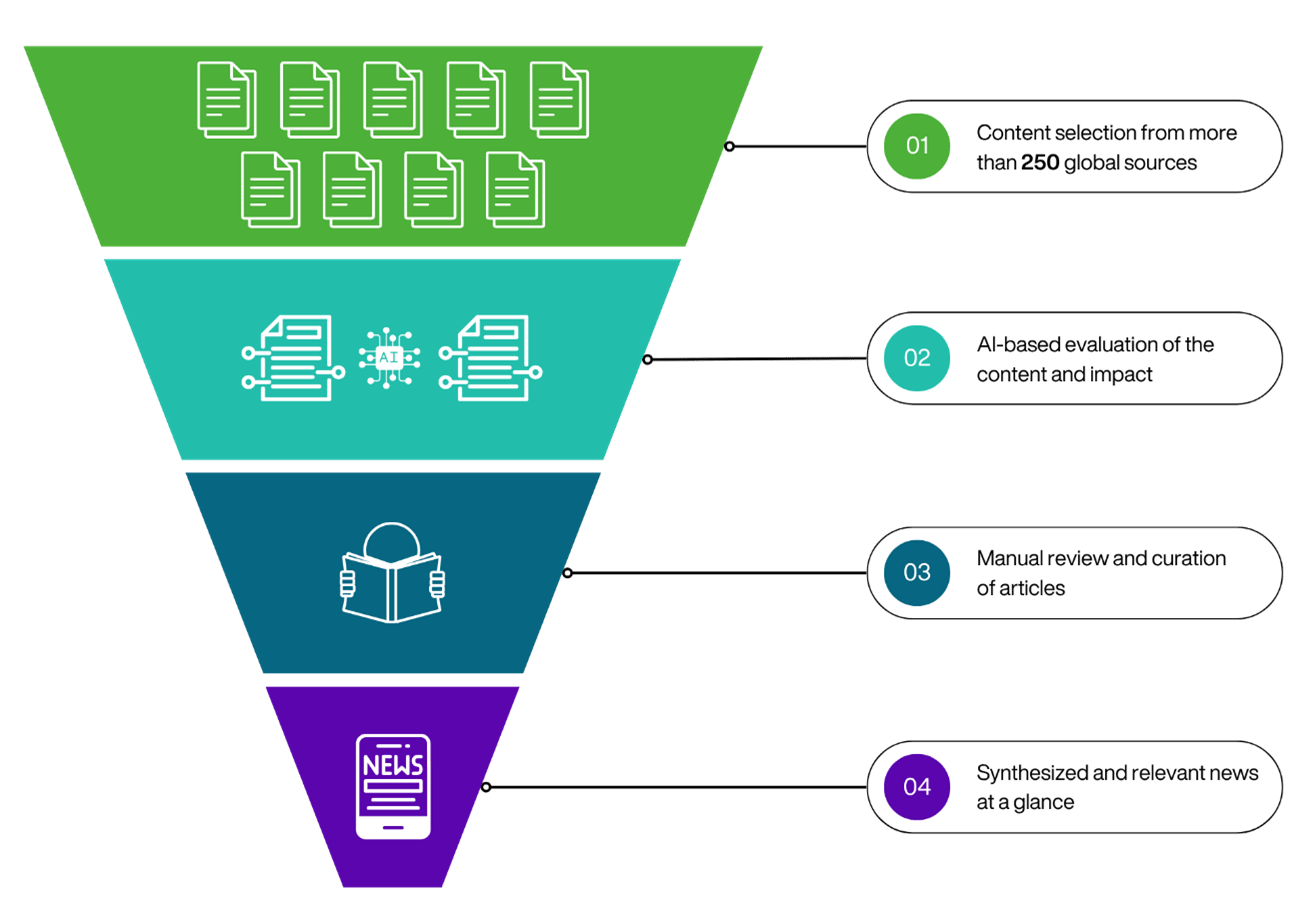
Our process is designed to be both scalable and selective. A broad network of over 250 global sources is continuously screened using six different AI tools. These tools help surface relevant content, which is then passed through a multi-step filtering and evaluation process that emphasizes innovation and impact.
In the final stage, selected articles are reviewed and curated by our team before being published. The result is a dynamic, well-structured view of what truly matters in the digital health ecosystem. This way you always stay ahead of the curve.