DIGI-HEALTH MONITOR Calendar Week 21
DIGI-HEALTH MONITOR: Calendar Week 21, 2026
Philips Consortium Chosen for Region Stockholm Hospital-at-Home Initiative
A consortium led by Philips, including Swedish digital health company Cuviva and Nordic healthcare technology specialist Vingmed, was selected to support Region Stockholm’s first region-wide hospital-at-home initiative, serving 2M+ residents and up to 15,000 patients annually under an eight-year agreement. The program combines advanced remote monitoring (ECG, oxygen saturation, blood pressure, pulse oximetry) with digitally connected care pathways, enabling continuous home monitoring for patients with complex or chronic conditions. Data is securely transmitted in near real time to a regional clinical dashboard, with video consultations, secure chat, and structured care pathways to detect early signs of deterioration. Cuviva provides the secure IT platform, while Vingmed supplies and manages clinical devices. The initiative addresses rising demand from an aging population, workforce shortages, and equitable access in urban and remote communities. Challenges include device deployment logistics, hardware calibration, and integrating secure data streams across primary and secondary care EHRs. Governed under Region Stockholm’s centralized healthcare coordination framework, the next steps involve analyzing initial outcomes and expanding to post-acute and pediatric cohorts.
Can Predictive Analytics Help Reverse North Texas’ Maternal Health Crisis?
Dallas and Tarrant counties face a severe obstetric complication (SOC) rate of 4.1%—nearly double the national average—with 5.6% of African American mothers experiencing complications vs. 3.1% of white non-Hispanic mothers. The Parkland Center for Clinical Innovation (PCCI) launched the Maternal Outcomes Monitoring System (MOMS), a publicly available predictive dashboard forecasting SOC and NICU admissions up to 12 months in advance at the census tract and ZIP code level. MOMS blends clinical data with non-medical drivers of health (NMDOH), including health literacy, housing instability, unemployment, and transportation access. The goal is to reduce SOC by 20% over three years through the North Texas Maternal Health Accelerator, enabling healthcare systems, public health organizations, and nonprofits to shift from reactive to proactive prevention. Interventions are tailored by neighborhood risk data, such as expanded transportation, telecare, or prenatal education. Iron supplementation during early pregnancy was identified as a high-impact intervention for reducing excessive bleeding, which accounts for 60% of SOC in the region. PCCI President Steve Miff noted: “For the first time ever, we can see where risk is riding down to the neighborhood level and act before a mother shows up in crisis.”
Mayo Clinic and Bayesian Health co-develop new AI-powered solution to expand palliative care access and improve patient outcomes
Mayo Clinic and Bayesian Health co-developed an AI-driven clinical intelligence platform integrated into Mayo’s EHR to identify hospitalized patients with unmet palliative care needs in real time. The tool generates a hospital-wide “heat map” of high-risk patients based on signals like pain, caregiver stress, psychosocial needs, or goals-of-care conversations, rather than relying solely on disease-specific criteria. Bedside clinicians receive interpretable guidance and streamlined referral orders, reducing manual clicks while preserving physician decision authority. A randomized clinical trial at Mayo Clinic demonstrated a 44% increase in timely palliative care referrals, a 25% reduction in 60-day readmissions, and a 28% reduction in 90-day readmissions, alongside improved patient quality of life. A human-in-the-loop layer allows a palliative care team member to monitor outputs in real time, adjusting for staffing and census pressures. A key lesson was the importance of relationship-building: when the model made recommendations without prior groundwork, clinicians were skeptical. The AI continuously learns from clinician feedback and local patient populations, improving accuracy over time. This is Mayo’s first collaboration to use AI across the entire care process in a complex hospital setting, with potential to scale to health systems with smaller specialty teams, using data to advocate for program growth while preserving the humanity of palliative care.
Apollo Hospitals Enters Next Phase of Digital Transformation
Apollo Hospitals Group, one of India’s largest private hospital chains (75+ facilities, 10,000+ beds), opened its 76th hospital in Hyderabad in May 2026 as a next-generation AI-integrated smart hospital, serving as a replicable template for the broader network. The facility runs on the same unified MedMantra HIS/EMR platform as existing hospitals, ensuring data continuity and network-wide interoperability. What distinguishes it is the layering of AI-assisted clinical tools—including diagnostic imaging interpretation, AI-augmented documentation, and workflow automation—on top of the shared digital backbone, alongside robotic and minimally invasive surgery equipment. Over the past two years, Apollo allocated 3.5% of its digital spend to AI, with plans to increase this share. Institutional validation partnerships include an MoU with Roche Diagnostics India to integrate the Navify Algorithm Suite (connecting EMR, LIS, and HIS) and a collaboration with Monash University to test clinical AI algorithms against Apollo’s 200M+ de-identified patient records. The Hyderabad hospital is a proof-of-concept for the integrated smart hospital model, with plans to roll it out to new facilities. Clinicians work within AI-augmented workflows, though specific outcome metrics are not yet reported. The primary risk is maintaining model accuracy and workflow alignment across a geographically distributed network.
From Fragmented Data to Stage 6: How St. Luke’s Rebuilt Its Analytics Future
St. Luke’s-Boise Medical Center transformed its analytics environment from a fragmented, outsourced system to a coordinated, system-wide data strategy, moving from HIMSS Stage 0 (2020) to Stage 6 with plans for Stage 7 certification. The implementation integrated Epic data, dashboards, enterprise reporting, and analytics tools into routine clinical and operational decision-making, involving physicians, clinicians, informatics teams, operational leaders, analysts, and supply-chain specialists. A concrete clinical use case was postoperative venous thromboembolism (VTE) prevention, where teams strengthened EHR decision support, screening, and dashboard-based monitoring, resulting in a 35.5% decline in VTE rates (2023–2024) among Phase 1 surgical specialties, avoiding ~30 cases annually and $750,000 in treatment costs. The same infrastructure reduced acceptable ship-quantity SKUs from 5,050 to 4,193, improving purchasing standardization. The main challenge was overcoming silos and building trust in data quality. The next step is Stage 7 certification, marking a shift from analytics improvement to a mature, embedded operating model. This case highlights how data-driven transformation can yield clinical, operational, and financial benefits in a unified framework.
The Global Digi-Health Monitor is our weekly published newsletter featuring curated updates on the latest developments in digital health. With a focus on innovation and relevance, it brings together key news across topics such as AI in healthcare, wearables, telemedicine, cybersecurity, and more.
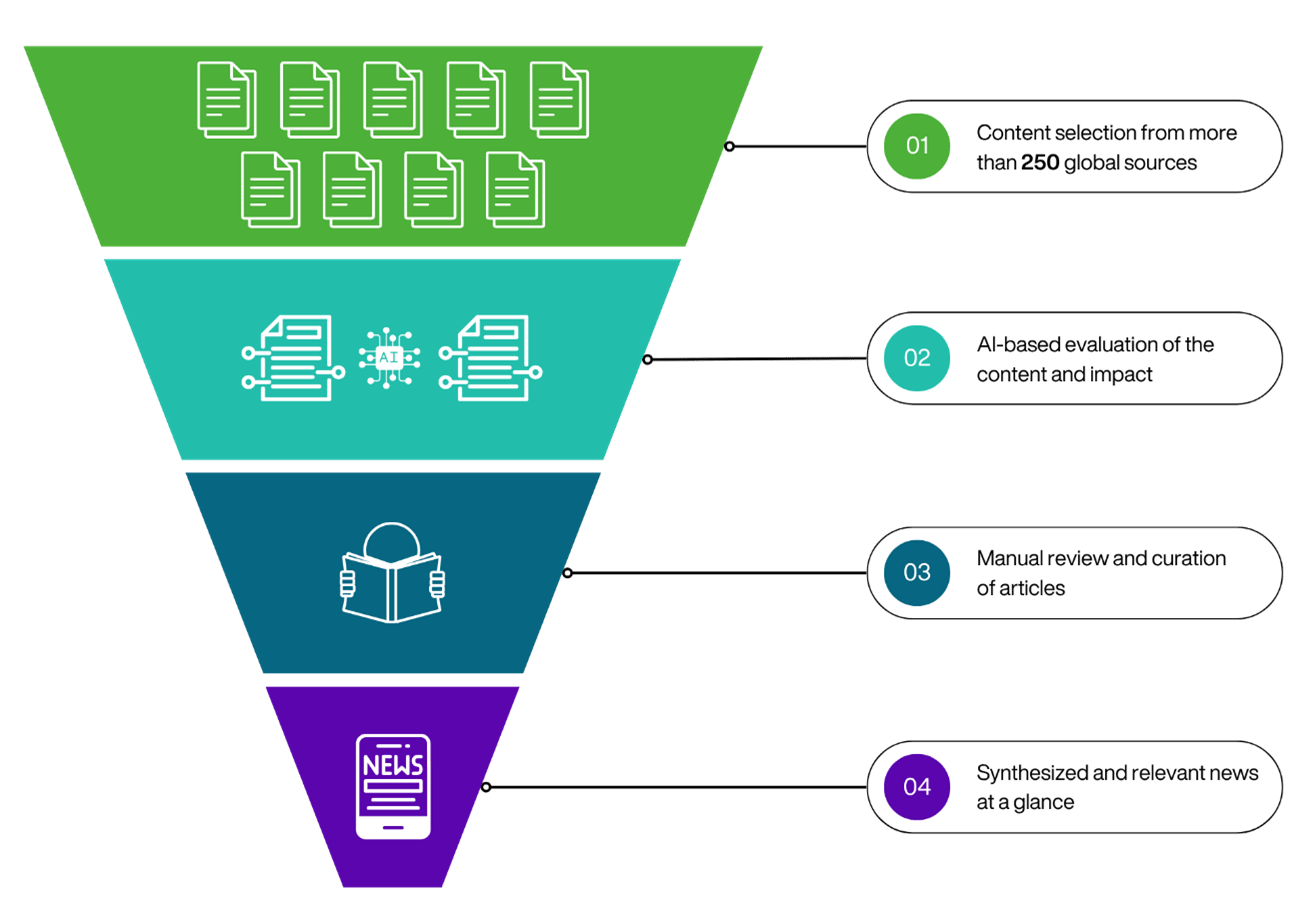
Our process is designed to be both scalable and selective. A broad network of over 250 global sources is continuously screened using six different AI tools. These tools help surface relevant content, which is then passed through a multi-step filtering and evaluation process that emphasizes innovation and impact.
In the final stage, selected articles are reviewed and curated by our team before being published. The result is a dynamic, well-structured view of what truly matters in the digital health ecosystem. This way you always stay ahead of the curve.