DIGI-HEALTH MONITOR Calendar Week 20
DIGI-HEALTH MONITOR: Calendar Week 20, 2026
UChicago Medicine to Implement Smart Hospital Platform
UChicago Medicine is rolling out the Artisight smart hospital platform system-wide and installing more than 1,800 devices across patient rooms, recovery rooms and operating rooms. An expansion to a new 575,000 square-foot cancer care pavilion is planned starting in April 2027. The platform combines computer vision, voice recognition and real-time location services into an end-to-end sensor infrastructure integrated with the electronic health record and other third-party systems.
Three prioritized initial scenarios include real-time operating room visibility, virtual nursing monitoring and automatic fall detection with direct notification to the nursing unit. CIO Yeman Collier explains the decision to skip a pilot phase by pointing to the need to replace fragmented point solutions with a unified architecture and reduce administrative burden systematically. Artisight cites experience from around 500 other US hospitals with fall rate reductions of up to 78 percent, four times more on-time discharges, time savings of more than 25 minutes per admission or discharge and 30 minutes less administrative work per nursing shift. In one case, a wrong-site amputation was prevented, and in another, nursing turnover dropped by 75 percent within six months. Iterative co-development with clinical teams, integration into existing workflows and governance issues such as privacy, consent and audit remain central success and risk factors.
Sarasota Memorial IDs Lung Cancers Earlier with Analytics Platform
Sarasota Memorial Health Care System in Florida has implemented the Eon analytics platform to detect incidental pulmonary nodules in radiology reports earlier and to track them longitudinally. The platform analyzes inpatient and outpatient radiology reports, extracts relevant findings, incorporates patient-specific risk factors and supports guideline-aligned follow-up. Clinical staff from radiology, pulmonology, oncology and navigation review the findings, manage patient outreach and coordinate surveillance through a dedicated lung nodule clinic. The workflow change is substantial, with identified incidental findings increasing from one or two per week to about 170 per week. The reported outcomes are clinically meaningful. In 2025, 75 percent of lung cancers diagnosed through the screening and incidental early-detection program were identified at Stage I or II, well above state and national benchmarks.
Follow-up adherence reached 87 percent among screening patients and 92 percent among high-risk patients. The case shows that analytics alone is not sufficient. Sarasota Memorial also required governance, care pathways, dedicated staffing and longitudinal tracking to convert earlier detection into earlier diagnosis and treatment. Next steps include extending the approach to additional finding types and deeper data integration across service lines.
Fraser Health named runner-up in Gartner awards
Fraser Health in British Columbia has developed an AI-enabled decision support platform through its Centre for Advanced Analytics, Data Science and Innovation. The platform is designed as reusable infrastructure rather than a single AI pilot. It supports daily patient demand forecasting, physician scheduling, patient flow planning, surge forecasting, workforce simulation, patient trajectory modelling, funding scenario analysis and quality risk monitoring. Frontline physicians and operational leaders use the system to compare scenarios and make staffing and scheduling decisions while retaining clinical and managerial responsibility.
Reported results include daily demand forecasts with around 90 percent accuracy, wait time reductions of up to 50 percent and two to three hours saved per physician per week, which equates to roughly 20,000 hours per year. The innovation lies in moving beyond predictive analytics into decision intelligence and simulation. The central lesson is that AI becomes significantly more useful when embedded into operational planning, governance routines and cross-functional collaboration rather than treated as isolated model deployment. The article, however, provides fewer details on privacy and risk controls than other implementation cases. Next steps involve extending decision intelligence into additional operational and clinical planning domains.
TeleSpecialists Expands Digital Healthcare Access Across Rural Communities Nationwide
TeleSpecialists, a US provider of teleneurology and telepsychiatry services, is expanding its programs at rural hospital systems in Georgia, Louisiana and California to make stroke and acute neurological care available around the clock. According to the company, board-certified neurologists connect via video link in under three minutes, are integrated into existing clinical workflows and enter orders directly into the host hospital’s electronic health record. Participating facilities can thus shift a step of care that previously often required complex patient transfers into their own emergency department. Concrete implementation data come from Hendry Regional Medical Center in Clewiston, Florida, a 25-bed critical access hospital that has used the model for several years. Between 2022 and 2025, it achieved Joint Commission Acute Stroke Ready Certification, reduced door-to-needle time by 30 percent and reached a Get With The Guidelines Stroke composite score of 95.1 percent. According to the American Stroke Association, stroke mortality rates in rural areas are up to 30 percent higher than in urban ones, which is structurally attributed to limited specialist access. TeleSpecialists has worked with more than 400 partner hospitals since 2014 and has supported over 1.5 million patients. Challenges include sustainable reimbursement, technical integration with heterogeneous EHR landscapes, multi-state licensing and continuous availability. The press release character lowers the rating relative to editorial coverage
One practice fixed a broken rev cycle model, and now gets cash in 12 days instead of 90
Televero Behavioral Health, a telemedicine behavioral health practice, redesigned its revenue cycle and care operations workflow around AdvancedMD, an Azure-based business intelligence layer and AI-enabled automation. The practice replaced fragmented tools for telehealth, EHR, scheduling and billing and brought revenue cycle management in-house. The platform supports intake, scheduling, documentation, treatment planning, charge capture, claims, payments and patient portal interactions. Automation is used for variance detection, compliance auditing, patient journey analysis, voice-based appointment reminders and prioritization of exceptions.
Clinical and administrative staff remain involved in documentation, patient care and oversight while the technology reduces administrative friction. Reported outcomes include cash conversion of 12 days, cash positivity within 90 days of bringing billing in-house, a 97 percent first-time claim approval rate and 90 percent collection at the point of service. The case is particularly relevant for digital health operators because it shows that measurable ROI often depends on upstream workflow design, clean data, eligibility checks and exception-based human intervention rather than on software selection alone. Clinical scalability beyond a single practice remains an open question, as does generalization across payer mixes and behavioral health subspecialties.
The Global Digi-Health Monitor is our weekly published newsletter featuring curated updates on the latest developments in digital health. With a focus on innovation and relevance, it brings together key news across topics such as AI in healthcare, wearables, telemedicine, cybersecurity, and more.
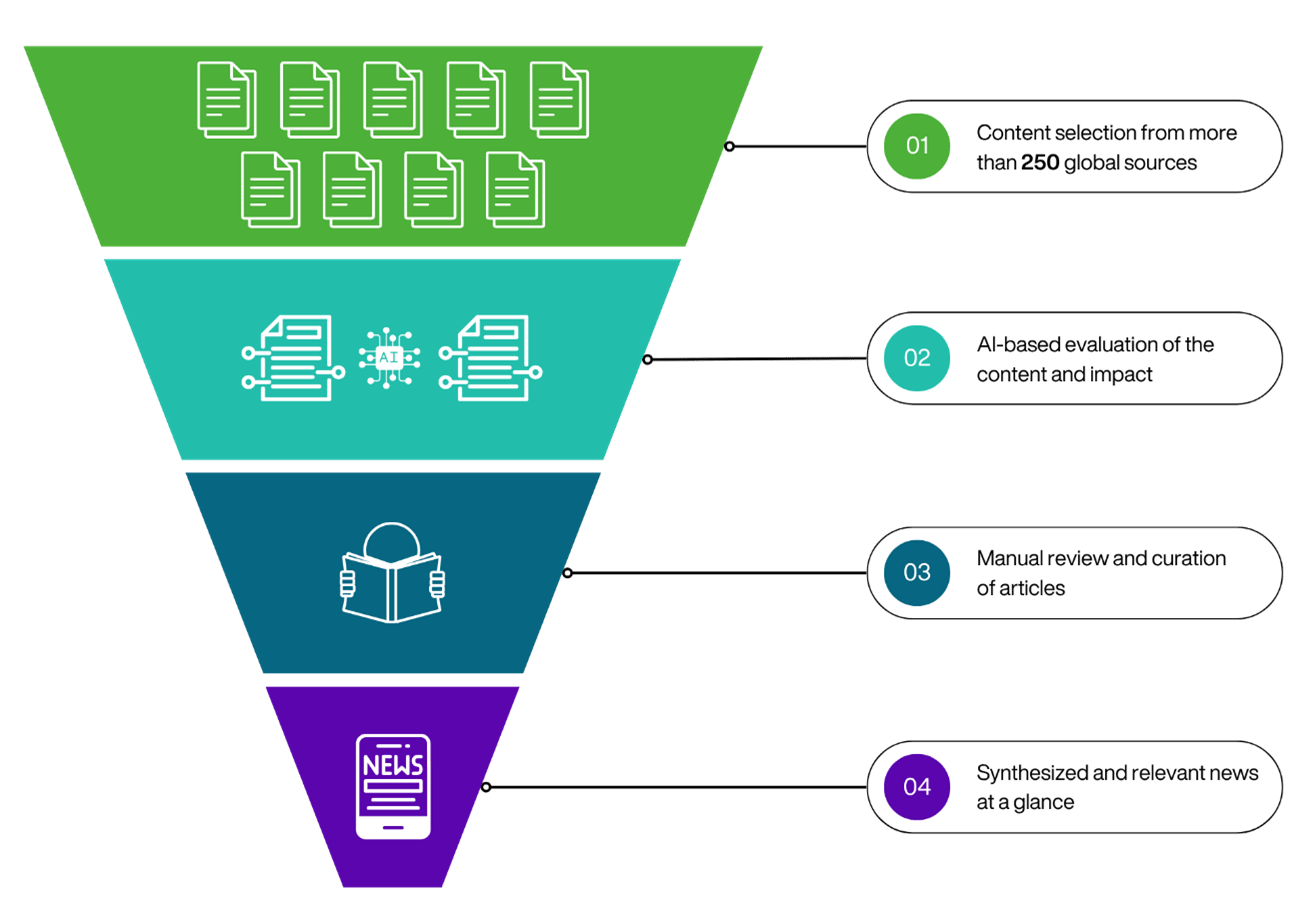
Our process is designed to be both scalable and selective. A broad network of over 250 global sources is continuously screened using six different AI tools. These tools help surface relevant content, which is then passed through a multi-step filtering and evaluation process that emphasizes innovation and impact.
In the final stage, selected articles are reviewed and curated by our team before being published. The result is a dynamic, well-structured view of what truly matters in the digital health ecosystem. This way you always stay ahead of the curve.