DIGI-HEALTH MONITOR Calendar Week 19
DIGI-HEALTH MONITOR: Calendar Week 19, 2026
Implementation of Autonomous Robotic Echocardiography for Rural Diagnostic Access
A research team led by Concordia University deployed an AI-driven robotic system capable of performing cardiac ultrasounds (echocardiograms) without a specialist sonographer. The objective is to provide high-quality cardiac diagnostics in underserved or rural regions where specialist availability is a barrier. The system consists of a robotic arm holding an ultrasound probe, controlled by a deep reinforcement learning algorithm.
In a departure from traditional training, the AI model was trained in an advanced simulation environment created by generative AI, learning precise imaging angles and pressure requirements through step-by-step feedback. In practical tests using a training model of the heart, the system produced standard diagnostic images more quickly and accurately than human operators working via remote tele-robotic control. This automation standardizes scan quality and eliminates inter-operator variability common in manual sonography while reducing physical strain on staff. While researchers emphasize the need for further validation with diverse patient bodies, the successful pilot demonstrates a path toward autonomous bedside imaging. Governance remains strict, requiring clinical sign-off for final diagnoses, but the robotic execution of the scan itself is now a proven clinical reality. Next steps include expanding validation studies and exploring additional autonomous imaging applications.
Tech-enabled preventive healthcare improves tele-dentistry follow-through for lower-income preschool children
National University Hospital (NUH) in Singapore, in collaboration with Care Corner Singapore, PAP Community Foundation Sparkletots Preschool, NUS Dentistry, and academic partners, implemented a tele-dentistry model within the HEADS-UPP programme for children from lower-income families. NUH nurses and case management officers visit preschools, capture intraoral images, and collect parent-reported caries-risk information. A paediatric dentist reviews the material remotely and produces a personalised dental report with annotated images, risk level, and prioritised follow-up recommendations.
Clinicians remain central to diagnosis and escalation, while preschool staff, social workers, and health teams support trust-building, parent engagement, and follow-through. Outcomes are substantial: among children with dental caries, 57.5% received specialist follow-up four to six months later, compared with 13.3% in an earlier NUHS study of similar families. Moderate-to-high risk classification fell from 93.3% to 75.6% after personalised reports and guidance. Governance is framed as “tech-enabled” rather than “tech-replaced”, with human judgement retained for sensitive social and care decisions. Next steps include AI-assisted dental screening, video-based tele-coaching, risk-based pathways, and tools for educators. The model demonstrates how technology can bridge access gaps in preventive care for vulnerable populations.
The Five-Year Longitudinal Assessment of the Hospital-at-Home Model: Clinical Superiority and Financial Recalibration
A landmark five-year longitudinal study by investigators at the University of Iowa’s Carver College of Medicine and College of Public Health provides definitive validation of the Hospital-at-Home (HaH) model. The study analyzed records of ~4,200 HaH Medicare patients compared to a matched cohort of 11,700 peers treated in traditional hospitals. The objective was to evaluate whether acute care at home could maintain clinical safety while addressing rising inpatient costs under the CMS Acute Hospital Care at Home (AHCAH) waiver.
Findings indicate HaH care is “considerably better” across critical metrics, including significantly lower in-hospital mortality rates and reduced emergency department utilization within 30 days of discharge. While index hospitalization costs were higher due to home-based technology deployment, these were offset by substantially lower post-discharge costs, leading to a reduction in total 30-day healthcare spending. The technology implementation utilized remote patient monitoring (RPM) sensors and centralized virtual operations centers providing 24/7 oversight. Governance risks include siloed and uneven adoption, concentrated in large academic centers in the Northeast and South, which may worsen health inequities for rural populations lacking access to digital infrastructure. Lessons emphasize the clinical and financial viability of HaH but call for broader, equitable scaling to avoid exacerbating disparities. Next steps include policy adjustments to support wider adoption and addressing digital divide barriers.
How Reid Health uses AI to save time, improve retention and elevate patient experience
Reid Health, a community hospital system in Richmond, Indiana, implemented generative AI via Abridge (through a HelloCare.ai partnership) for real-time clinical documentation of clinician-patient conversations, integrated with Epic EHR. This was combined with smart hospital features in every inpatient room since 2024, including Epic-synced digital whiteboards, virtual nursing, and virtual sitting capabilities. The primary goal was to restore clinician joy and purpose by reducing after-hours documentation burden.
Clinicians use ambient AI during encounters; the system listens and generates notes in real time, which providers review and finalize (often same-day). This keeps physicians and nurses focused on bedside care rather than keyboards. Reported outcomes include saving 10–12 minutes per clinical note on average, achieving an 86% same-day note completion rate, and a sharp reduction in after-hours work. Patient experience improved, with Google reviews highlighting innovation in a smaller system. Workforce benefits were notable: better retention and strong interest from new nursing graduates seeking placements due to more meaningful bedside time and improved work-life balance. Challenges addressed include clinician adoption in a resource-constrained rural setting and ensuring technology augments rather than disrupts care. Governance emphasizes human oversight of AI outputs, with lessons highlighting that success stems from viewing tech as a tool to reclaim time for human connection. Next steps include developing a “playbook” for other rural systems and further scaling digital tools.
The Global Digi-Health Monitor is our weekly published newsletter featuring curated updates on the latest developments in digital health. With a focus on innovation and relevance, it brings together key news across topics such as AI in healthcare, wearables, telemedicine, cybersecurity, and more.
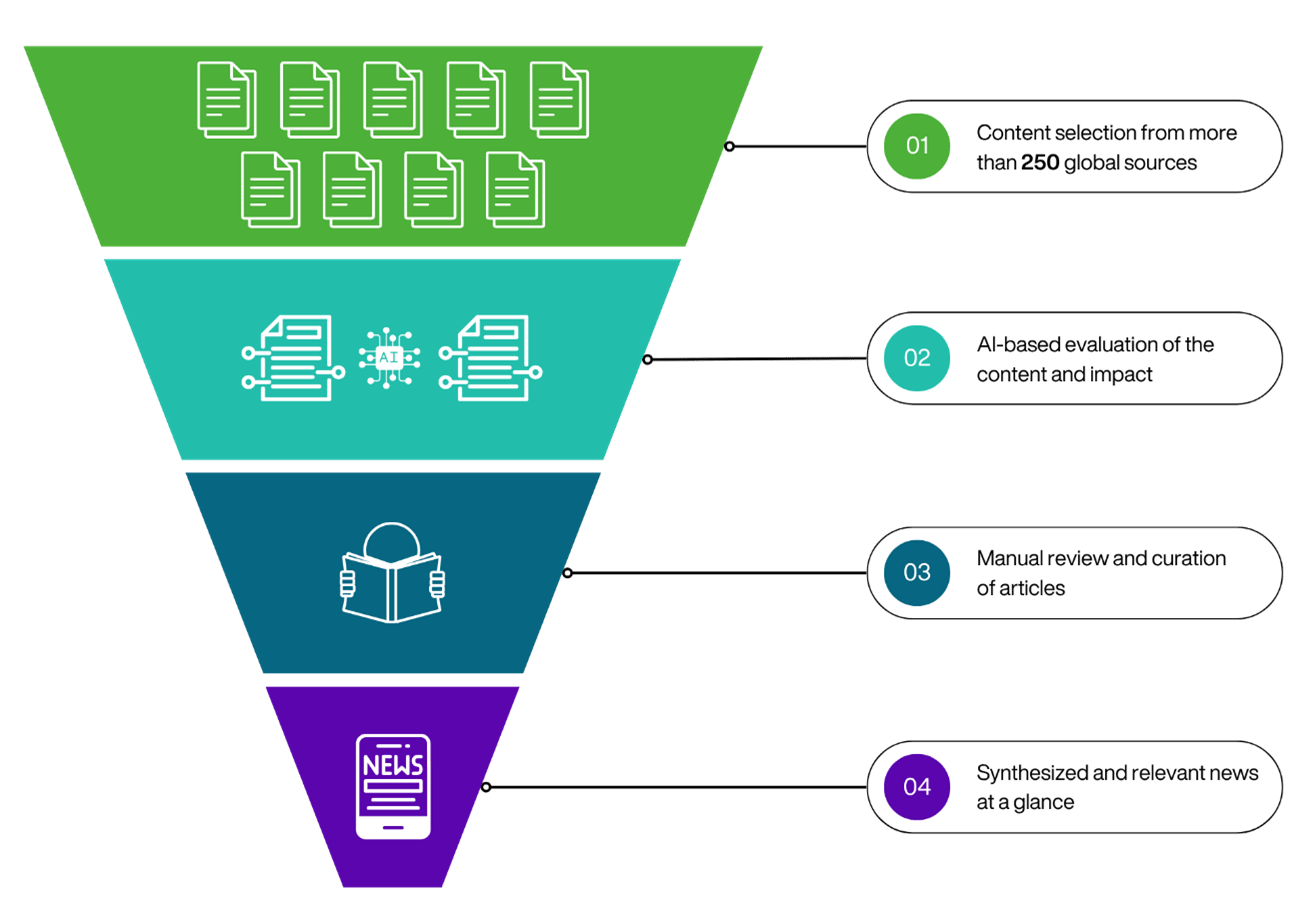
Our process is designed to be both scalable and selective. A broad network of over 250 global sources is continuously screened using six different AI tools. These tools help surface relevant content, which is then passed through a multi-step filtering and evaluation process that emphasizes innovation and impact.
In the final stage, selected articles are reviewed and curated by our team before being published. The result is a dynamic, well-structured view of what truly matters in the digital health ecosystem. This way you always stay ahead of the curve.