DIGI-HEALTH MONITOR Calendar Week 18
DIGI-HEALTH MONITOR: Calendar Week 18, 2026
The FDA’s Real-Time Clinical Trial Pilot: A Paradigm Shift for Regulatory Data Monitoring
The Food and Drug Administration (FDA) has launched its first two real-time clinical trials (RTCT) in collaboration with the University of Texas MD Anderson Cancer Center and the University of Pennsylvania. This initiative leverages a technical framework validated by Paradigm Health, enabling FDA scientists to monitor safety signals and clinical endpoints in real-time, eliminating the “dead time” in drug development where administrative tasks consume 45% of the timeline. The pilot includes a phase 2 multi-site trial for mantle cell lymphoma (AstraZeneca) and a phase 1b trial for small cell lung carcinoma (Amgen). Participating health systems identify and enroll patients while streaming high-fidelity data to the FDA, which uses a “human-in-the-loop” framework to protect patient privacy by handling only aggregated signals. The FDA aims to expand the program this summer, with a request for information to establish selection criteria for additional sites. This implementation is scalable, innovative, and systemically relevant, with the potential to cut years off drug approval cycles and maintain U.S. competitiveness in pharmaceutical innovation.
Heart Rhythm Society Reports Success of COMPASS Initiative: Increasing Early Rhythm Control Through Structured Pathways
The Heart Rhythm Society’s COMPASS initiative, a quality-improvement program involving 14,000+ patients across Duke University Medical Center, Cedars-Sinai Medical Center, and Texas Cardiac Arrhythmia Institute, utilizes structured care pathways and EHR tools to guide protocol-based recommendations for atrial fibrillation. Results show a 4% absolute increase in early rhythm control (ERC) therapies, with significantly greater odds of catheter ablation (OR 1.68) and increased referrals to specialists. Workflow optimizations included passive best practice alerts and an early-access AF clinic. While the increase fell short of the 10% goal, the initiative provides a scalable framework for turning clinical evidence into actionable care. Future steps will determine which pathway components drive the greatest impact on long-term outcomes like stroke and mortality. This implementation is clinically relevant and scalable, though the absolute improvement was modest.
Dong-A University Hospital Launches Region’s Largest AI Smart Ward with Daewoong
Dong-A University Hospital, in collaboration with Daewoong Pharmaceutical, activated the largest AI-powered smart ward in the Busan–Ulsan–South Gyeongsang region, expanding continuous monitoring to 272 general ward beds. The SEERS thynC platform uses wearable sensors to capture real-time ECG, oxygen saturation, and respiratory rate data, with AI algorithms alerting staff to subtle abnormalities before symptoms appear. Clinicians monitor patients through a centralized dashboard, reducing manual vital-sign rounds and enabling faster escalation of care. The hospital reports that the early-warning capability is already preventing emergencies and improving patient safety, though explicit outcome metrics were not disclosed. The implementation is positioned as a reference model for regional hospitals and plans to expand to 24-hour blood pressure and glucose monitoring.
Johns Hopkins’ Virtual Nursing Delivers Sustainable Value
Johns Hopkins Health System deployed a virtual nursing model across multiple medical-surgical units to address workforce pressures and documentation burdens. Experienced registered nurses work remotely, handling cognitive tasks such as admission assessments, discharge education, and care coordination, while bedside nurses focus on hands-on care. Over 16,000 virtual nursing sessions have saved 3,000+ hours of bedside nurse time, improving patient flow, admission readiness, and discharge workflows. The model also strengthens fall prevention and pressure-injury reduction, with leadership treating it as a permanent, scalable element of care delivery. Challenges such as technology acceptance were addressed through unit-level co-design with front-line nurses, though data privacy safeguards were not detailed. The next phase will standardize workflows across additional inpatient units.
The Global Digi-Health Monitor is our weekly published newsletter featuring curated updates on the latest developments in digital health. With a focus on innovation and relevance, it brings together key news across topics such as AI in healthcare, wearables, telemedicine, cybersecurity, and more.
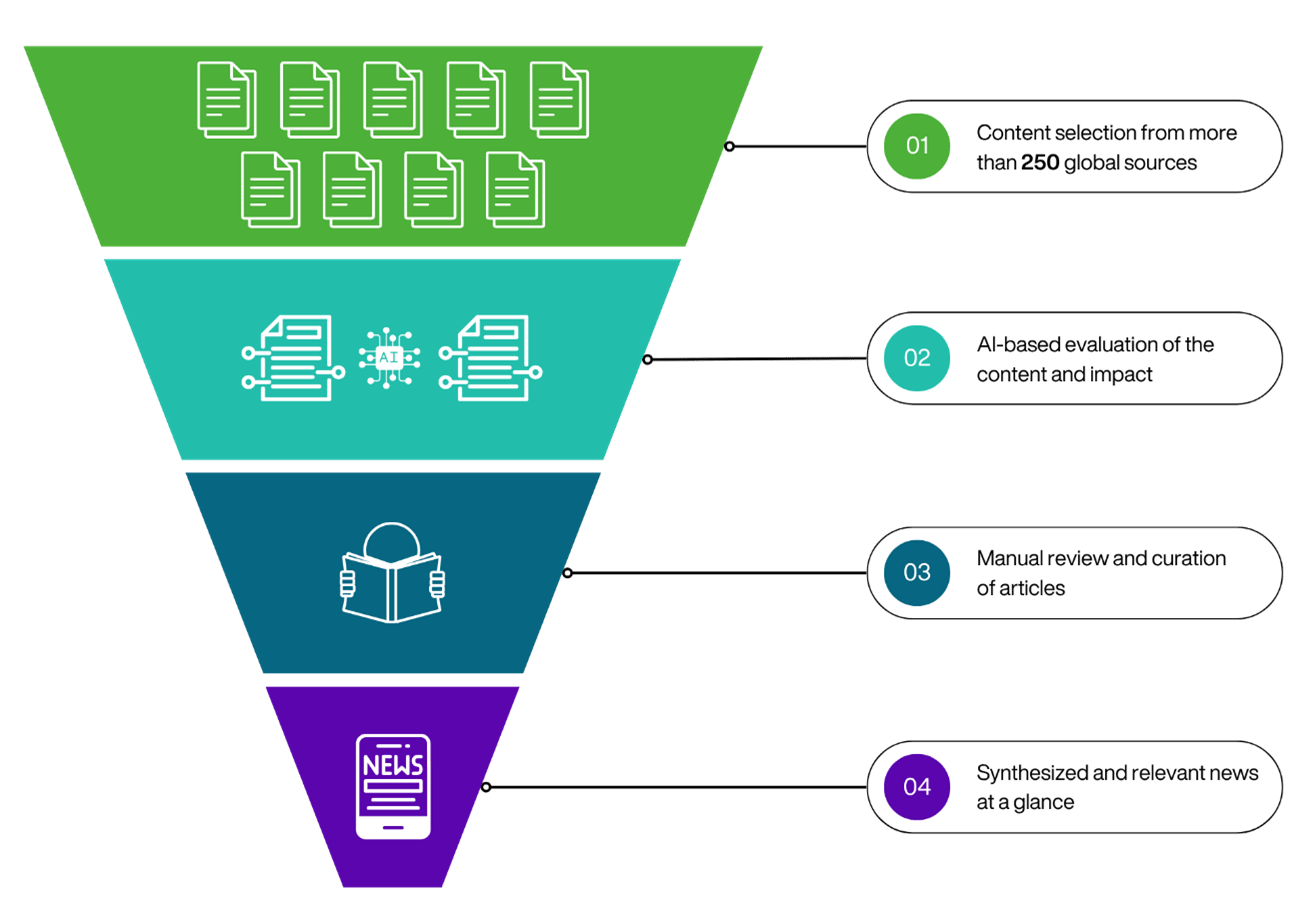
Our process is designed to be both scalable and selective. A broad network of over 250 global sources is continuously screened using six different AI tools. These tools help surface relevant content, which is then passed through a multi-step filtering and evaluation process that emphasizes innovation and impact.
In the final stage, selected articles are reviewed and curated by our team before being published. The result is a dynamic, well-structured view of what truly matters in the digital health ecosystem. This way you always stay ahead of the curve.