DIGI-HEALTH MONITOR Calendar Week 15
DIGI-HEALTH MONITOR: Calendar Week 15, 2026
Good Samaritan Hospital Adopts AI-Driven 3D Imaging for Stroke Care
HCA Healthcare’s Good Samaritan Hospital in San Jose has become the first facility in the San Francisco Bay Area to implement Lumina 3D by RapidAI, an AI-driven imaging solution designed to accelerate stroke diagnosis. The system generates detailed three-dimensional visualizations of blood vessels in the brain and neck from standard CT scans within minutes. The primary objective is to eliminate the time-consuming manual post-processing typically required by radiology teams, which can delay life-saving treatment. According to the hospital, the automated system has reduced imaging turnaround time by an average of 24 minutes per patient. These time savings are clinically significant, as every minute saved in stroke triage can preserve millions of neurons. Operationally, the automation reduces the cognitive and manual burden on technologists, freeing up an estimated 72 hours of staff time per month across similar systems. This allows the clinical team to focus on interpretation and immediate intervention rather than technical reconstruction. The implementation serves as a blueprint for high-volume neurovascular centers seeking to integrate deep clinical AI to improve both patient outcomes and imaging revenue cycle efficiency.
UnitedHealth Group’s $3 Billion AI Push Transforms Payer and Care Operations
Published 6 April 2026, this investigative special report by STAT traces how UnitedHealth Group (UHG) — the largest US health insurer and, through its Optum division, one of the country’s largest care delivery and analytics organisations — is executing one of the most extensive enterprise AI deployments in American healthcare history. A $3 billion AI investment commitment underpins the transformation. Sandeep Dadlani, CEO of Optum Insight, told STAT the company has systematically “doubled down on training, investments, and driving meaningful use cases” since generative AI became operationally viable. The stated operational objectives are to accelerate coverage decision-making, automate administrative processing, and remove bureaucratic friction from prior authorization and claims adjudication workflows.
UHG’s AI deployment spans multiple operational layers. On the insurance administration side, AI agents are processing prior authorization requests, triaging clinical appeals, and generating real-time benefit determinations for tens of millions of members. On the clinical services side, Optum’s data platforms use predictive models to identify high-risk members likely to benefit from proactive care management outreach. The company’s clinical staff access AI-generated patient summaries that synthesize records across care encounters, intended to improve care coordination. Consumer-facing AI handles member enquiries, appointment navigation, and plan information.
STAT’s investigation focuses equally on the risks that accompany this scale of deployment. Patients frequently do not know that AI is involved in coverage determinations, care pathway recommendations, or triage decisions — a structural transparency deficit with direct equity and patient safety implications. The article documents the governance challenge: at enterprise scale, detecting AI errors, correcting model drift, and maintaining human oversight across millions of daily decisions requires infrastructure and accountability frameworks that have not yet been formally established in US regulatory frameworks. No federal rule specifically governs payer-side AI at the time of publication. The article raises the accountability question explicitly — when an AI-influenced prior authorization denial results in delayed or missed care, determining responsibility across the vendor-payer-clinician chain remains legally and operationally unresolved. STAT presents UHG’s rollout as a case study in what AI governance at scale looks like in practice: significant efficiency gains coexisting with significant unresolved risks
Closing the Hypertension Gap: Remote Monitoring Boosts Blood Pressure Control in Brooklyn
NYU Langone’s Family Health Centers in Sunset Park, Brooklyn, have achieved major clinical outcomes through a digitally inclusive remote patient monitoring (RPM) program for hypertension. Supported by the National Institutes of Health, the program aims to close equity gaps by providing Bluetooth-enabled blood pressure cuffs that sync automatically with patient medical records. The implementation included nearly 1,000 patients, many from non-English-speaking or lower-income backgrounds. Results published in NEJM Catalyst in early April 2026 demonstrate a statistically significant average blood pressure reduction of 13.5/8.0 mmHg among participants. Overall hypertension control across the participating practices rose from a baseline of 68.44% to 82.99% by the end of the initial implementation period.
The workflow involves community health workers who assist with device setup and provide language-concordant coaching, while clinical decision support (CDS) tools flag uncontrolled readings for immediate medication adjustment by nurse practitioners and cardiologists. This success underscores the importance of combining wearable technology with human-centric support to improve chronic disease management. Next steps include scaling the model to manage diabetes and cardiovascular health system-wide.
South Infirmary Victoria University Hospital Pilot Demonstrates Major Reduction in Referral Wait Times with AI-Enabled Triage Platform
South Infirmary Victoria University Hospital (SIVUH) in Cork, Ireland, partnered with Health Innovation Hub Ireland (HIHI) and Irish SME Yellow Schedule to deploy Triage Link, an AI-enabled digital triage platform. The pilot targeted Ireland’s chronic public health system inefficiencies, where paper-based referrals contributed to over 631,600 patients waiting for hospital treatment as of March 2026. The technology digitizes the entire referral pathway, enabling electronic receipt, review, assignment, and remote triage via web and mobile interfaces. It replaces fragmented manual processes with structured digital workflows that provide real-time visibility and data capture for operational planning.
Clinicians and staff (38 participants, including consultants and appointments teams) co-designed the solution with HIHI facilitation and actively used it in daily workflows. Consultants performed remote triage, while administrative teams managed assignment and tracking. Over 8,000 referrals were processed during the pilot. Results showed dramatic operational gains: referral processing time dropped 99.6% (8.4 days to 0.03 days), consultant triage time fell 80% (16.4 days to 3.2 days), and end-to-end triage time decreased 87% (24.8 days to 3.23 days). These improvements accelerate patient access to specialist care without reported negative impacts on clinical judgment.
No major challenges or privacy risks were detailed beyond standard digital transition issues; governance relied on HIHI’s structured co-design, clinical liaison, and independent evaluation. Clinician involvement ensured workflow fit and buy-in. Lessons highlight the value of localized, co-designed solutions for legacy system problems. Next steps include leveraging results to support broader adoption across Ireland’s Health Service Executive (HSE), with HIHI continuing validation for national scaling. This represents a concrete, real-world deployment with measurable benefits for a public hospital system.
Telangana Launches AI-Powered Lung Cancer Screening Across Public Hospitals
A large-scale public health deployment in Telangana, India, involves AstraZeneca partnering with the state government to implement an AI-enabled lung cancer screening program across 20 public hospitals. The system uses Qure.ai’s chest X-ray AI to automatically analyze scans and flag high-risk pulmonary nodules alongside 29 other lung conditions. The workflow integrates into routine radiology: patients undergo chest X-rays, the AI triages cases, and those identified as high-risk are routed for confirmatory diagnostics and specialist follow-up. Clinicians remain in the loop for validation and treatment decisions, but the AI acts as a front-line screening and prioritization layer.
The primary objective is earlier detection, as lung cancer is often diagnosed at late stages in India, contributing to high mortality. Expected clinical outcomes include improved early-stage detection rates and faster referral pathways. Operationally, the system helps compensate for radiologist shortages and standardizes interpretation quality across urban and rural facilities. The program also includes workforce training and infrastructure support, indicating governance planning beyond simple tool deployment. Risks include over-reliance on AI triage and potential false positives or negatives, requiring strong clinical oversight. If successful, the initiative is likely to scale across additional regions, positioning AI screening as a population-level intervention rather than a pilot.
The Global Digi-Health Monitor is our weekly published newsletter featuring curated updates on the latest developments in digital health. With a focus on innovation and relevance, it brings together key news across topics such as AI in healthcare, wearables, telemedicine, cybersecurity, and more.
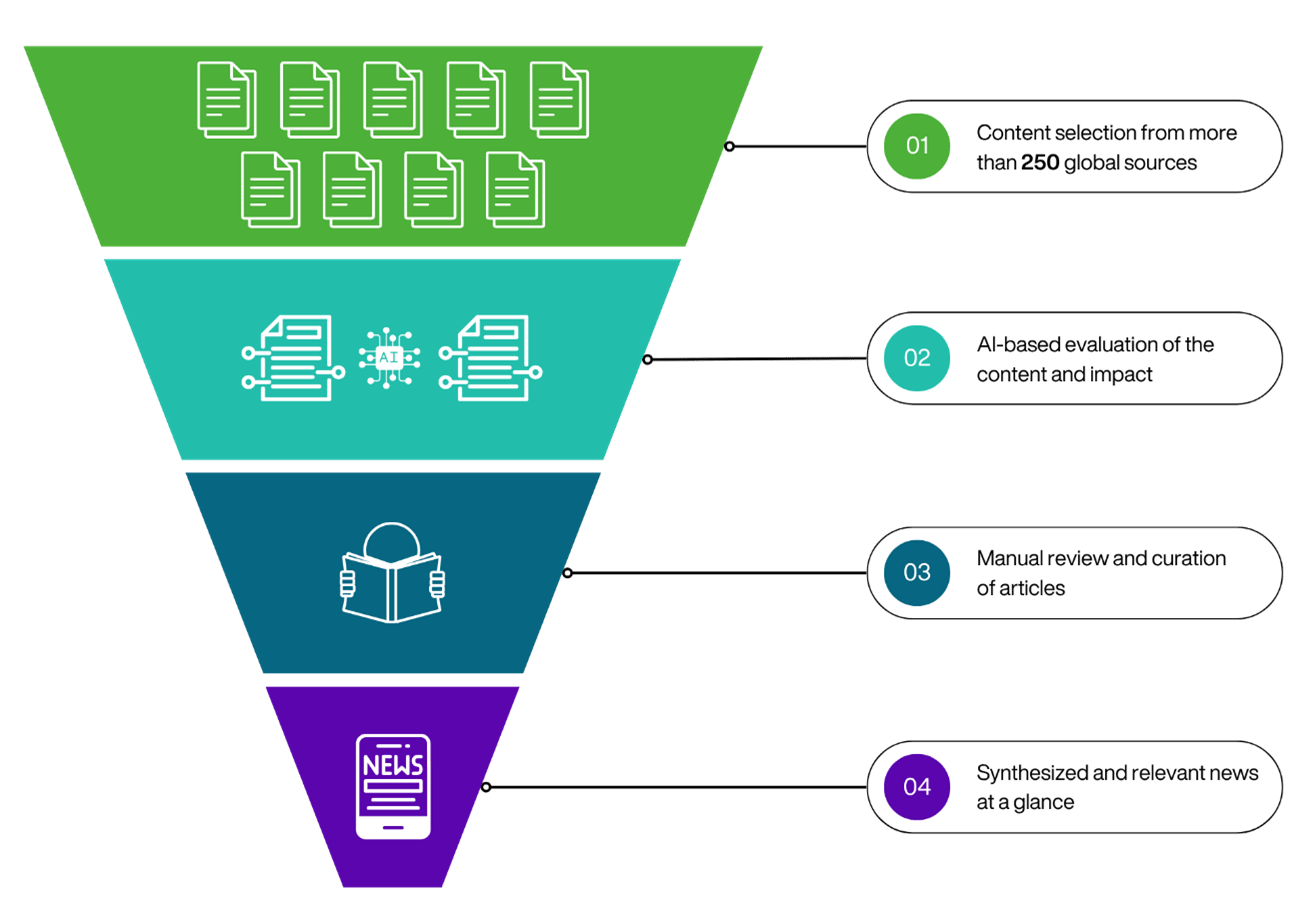
Our process is designed to be both scalable and selective. A broad network of over 250 global sources is continuously screened using six different AI tools. These tools help surface relevant content, which is then passed through a multi-step filtering and evaluation process that emphasizes innovation and impact.
In the final stage, selected articles are reviewed and curated by our team before being published. The result is a dynamic, well-structured view of what truly matters in the digital health ecosystem. This way you always stay ahead of the curve.