DIGI-HEALTH MONITOR Calendar Week 12, 2026
DIGI-HEALTH MONITOR: Calendar Week 12, 2026
Becamex International Hospital Deploys Machine Learning for Predictive Energy Optimization and Operational Efficiency
Becamex International Hospital (BIH), a 310-bed facility in Vietnam within a larger group, deployed an AI/ML platform using historical data (weather, patient volume, sub-meter readings) and models (Random Forest, XGBoost, Gradient Boosting—84.6% accuracy, RMSE <5%) to predict and optimize energy demand, tackling 10-15% operational costs (~1 billion VND monthly). Integrated via real-time dashboards with visualizations, anomaly alerts, daily reports, and staff recommendations, the system piloted in wards A3 and A6 through two PDSA cycles: first building models/dashboard, second guiding behavioral/procedural changes (e.g., consolidating activities in low-demand periods, closing doors for cooling retention, turning off idle equipment/lights, departmental targets). Non-clinical and frontline staff executed changes, with indirect clinician benefits from quieter, comfortable environments. Pilot results after one month showed 8.1% energy reduction; full rollout projects 976 million VND (~38,000 USD) annual savings, plus environmental gains and reduced noise for patients. Challenges included predictions not automatically cutting usage without complementary interventions. Governance relied on iterative PDSA testing/refinement for data-driven operations embedding. Lessons stress pairing AI insights with staff-led adaptations for impact. Next steps target hospital-wide scaling to other operational areas for sustained efficiency.
World’s Best Smart Hospitals 2026 showcase scaled digital and AI-enabled care delivery models
Leading global hospitals, including Mayo Clinic, Cleveland Clinic, and Charité Berlin, demonstrate how digital technologies can be embedded across entire care delivery systems rather than deployed as isolated tools. These institutions have implemented integrated ecosystems combining AI-assisted diagnostics, interoperable health data platforms, remote monitoring, and virtual care pathways. Clinical workflows are increasingly data-driven. AI supports imaging interpretation and triage, while unified data platforms enable real-time information sharing across departments. Remote monitoring allows clinicians to follow patients beyond hospital discharge, reducing readmissions and improving continuity of care. Operational benefits include faster decision-making, reduced duplication of tests, and improved coordination between specialties. Patient experience improves through digital front-door strategies, personalized care pathways, and hybrid care models combining in-person and virtual services. A key insight is that success depends on system-wide integration and governance rather than isolated innovation. These hospitals align IT strategy with clinical leadership, invest heavily in infrastructure, and continuously measure performance outcomes. However, disparities remain across regions, with adoption levels influenced by funding models, regulatory environments, and digital maturity. The implementations illustrate scalable blueprints for digital transformation, showing that meaningful impact requires organizational redesign, clinician engagement, and long-term investment in interoperable systems.
UC San Diego Health Scales System-Wide AI Agents for Patient Outreach and Workflow Orchestration with Notable
UC San Diego Health, a leading academic health system, has achieved enterprise-wide scaling of AI agents in partnership with Notable, moving from pilots to system-wide orchestration deeply integrated with Epic EHR. Presented at HIMSS26 by Chief Health AI Officer Karandeep Singh, MD, MMSc, Director Jeffrey Pan, and Notable CMO Aaron Neinstein, MD, the deployment includes ambient clinical voice tools and multi-channel patient communication agents (email, text, phone) that personalize outreach based on age and tech literacy. Key live workflows automate surgery preparation reminders and comprehensive claims auditing, enabling 100% patient reach previously limited by staff capacity, shifting to “technological abundance.” Real clinicians drive governance, co-design tools, benchmark AI against human performance, retain oversight with escalation paths, and lead cultural adoption to build trust. Quantified results show significantly reduced no-show and cancellation rates for surgical procedures, yielding massive ROI through increased surgical capacity, shorter wait lists, and better patient experience via consistent personalized contact; audits previously too costly are now routine. Challenges include overcoming error fears, mindset shifts from scarcity thinking, and adapting to rapid AI advances. Governance features system-wide project controls to curb shadow AI, structured risk-testing, and partial automation with human fallback. Lessons emphasize reimagining workflows around AI rather than layering on legacy processes, starting with targeted agents before full orchestration. Next steps focus on interconnecting more agents, deeper Epic embedding, and broader system expansion to maintain efficiency and innovation gains.
Physicians Embrace AI’s Promise, But Accuracy Concerns Still Hold Them Back
Physicians are increasingly turning to AI tools to ease administrative burdens and improve efficiency, with many reporting meaningful gains in productivity and time saved. Yet despite the growing enthusiasm, trust in the technology remains uneven. Concerns around accuracy, reliability, and the risk of errors in clinical settings continue to shape how doctors use these tools, often limiting them to lower-risk tasks or requiring careful human oversight. As adoption accelerates, the tension between AI’s promise and the need for dependable performance is emerging as a defining challenge for its role in healthcare.
Value-based healthcare programs leverage digital outcomes tracking and remote monitoring in live health systems
Health systems in the United States and Europe are operationalizing value-based healthcare models using digital infrastructure that captures and analyzes patient outcomes in real time. Organizations such as Dartmouth-Hitchcock Spine Center and UPMC have implemented systems combining patient-reported outcome measures, remote monitoring technologies, and analytics platforms directly into clinical workflows. Clinicians routinely collect structured outcome data, such as mobility, pain, and mental health indicators, during and after treatment. These data streams are integrated into decision-making processes, enabling earlier identification of complications and more personalized interventions. Remote monitoring extends visibility beyond hospital settings, shifting care from episodic encounters to continuous management. Operational and clinical outcomes include improved care coordination, reduction of unnecessary procedures, and earlier detection of deterioration. Financially, these programs align reimbursement with outcomes, supporting cost control and incentivizing quality improvement across large patient populations. Implementation challenges include ensuring data standardization, integrating tools into clinician workflows without increasing burden, and aligning incentives between providers and payers. Governance frameworks are required to ensure data privacy, fairness in outcome measurement, and transparency in performance benchmarking. This model represents a scalable transformation of care delivery, where digital tools are foundational to both clinical decision-making and reimbursement structures. Expansion efforts focus on broader condition coverage, improved interoperability, and international adoption.
The Global Digi-Health Monitor is our weekly published newsletter featuring curated updates on the latest developments in digital health. With a focus on innovation and relevance, it brings together key news across topics such as AI in healthcare, wearables, telemedicine, cybersecurity, and more.
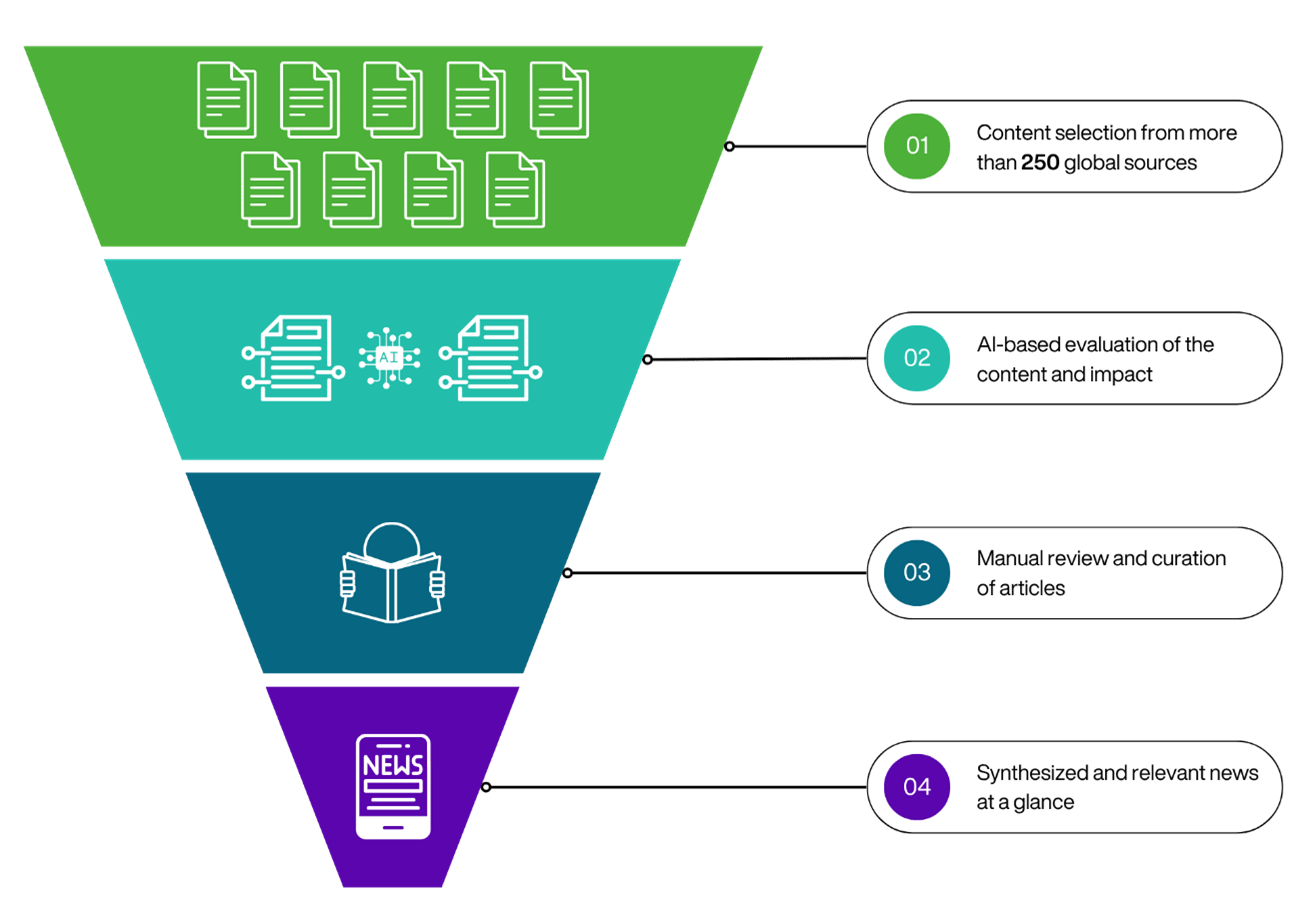
Our process is designed to be both scalable and selective. A broad network of over 250 global sources is continuously screened using six different AI tools. These tools help surface relevant content, which is then passed through a multi-step filtering and evaluation process that emphasizes innovation and impact.
In the final stage, selected articles are reviewed and curated by our team before being published. The result is a dynamic, well-structured view of what truly matters in the digital health ecosystem. This way you always stay ahead of the curve.