DIGI-HEALTH MONITOR Calendar Week 10, 2026
DIGI-HEALTH MONITOR: Calendar Week 10, 2026
Tampa General Hospital Scales 61 AI Applications Including Conversational Agent for Faster Patient Access and Reduced Administrative Load
Tampa General Hospital (TGH) has deployed 61 AI applications across clinical and operational areas, rejecting prolonged pilots in favor of rapid testing and scaling. Standout tools include the Hyro-powered conversational AI agent “Aimee” in the contact center for inquiry handling, appointment management, and intelligent routing; Microsoft ambient listening for nurses; and native Epic AI capabilities. Aimee automates scheduling by locating nearby imaging slots. Clinicians and staff benefit indirectly through reduced administrative burden, allowing focus on complex care. A centralized AI registry provides governance, tracking every application, purpose, and performance. Reported outcomes within two weeks of Aimee’s launch include a 21% increase in appointments booked within two weeks, a 56% drop in daily call abandonment rates, and average wait times reduced from 6.2 to 2.4 minutes—directly improving patient access and experience. Challenges are addressed via a “fail-fast” philosophy rather than extended pilots. Leadership, including Executive Vice President and Chief Digital and Innovation Officer Scott Arnold, emphasizes a “bullish” stance on agentic AI for broader care coordination. Next steps involve expanding autonomous AI capabilities while maintaining the registry for monitoring and rapid iteration. The model demonstrates how structured governance and quick decision-making enable enterprise-scale adoption without workflow disruption.
Sutter Health Implements Enterprise AI Platform and Clinical Detection Tools for Improved Clinician Experience and Earlier Cancer Diagnoses
Sutter Health, a not-for-profit integrated system serving Northern California, has embedded ambient documentation tools, an AI-powered lung-cancer detection workflow, and the internal Sutter IQ enterprise platform (an in-house Microsoft Copilot variant for chart summarization and In Basket triage) directly into Epic EHR workflows. These technologies operate systemwide across hospitals and clinics. Ambient tools listen during encounters and auto-generate notes; the lung-cancer AI analyzes imaging to flag cases for review; Sutter IQ handles real-time summarization and messaging. Clinicians remain the final decision-makers, reviewing and editing every output while contributing bottom-up ideas through informatics teams. A dedicated governance structure spans ethics, compliance, legal, risk, and informatics, with focused testing for higher-stakes uses such as AI cognitive behavioral therapy pilots. Reported outcomes include a 78% improvement in clinician job satisfaction from reduced documentation burden and nearly 70% of lung-cancer cases now diagnosed at early, treatable stages systemwide. More than 10,000 staff engage monthly with Sutter IQ. Challenges include instances where tools performed well in testing but lacked sufficient workflow consistency for scale, prompting earlier evaluation and pivots. Lessons emphasize embedding AI into existing habits rather than adding new platforms and balancing speed with privacy safeguards. Next steps focus on expanding successful pathways to additional specialties while maintaining human oversight and measuring broader outcome improvements. The approach deliberately prioritizes people-first transformation over technology-centric deployment.
Wayne General Hospital Deploys FDA-Cleared AI Cardiac Detection Platform Across Emergency and Primary Care to Address Rural Cardiovascular Disparity
Wayne General Hospital in Waynesboro, Mississippi — the sole hospital serving Wayne County, operating without on-site specialist cardiology — has deployed SENSORA®, Eko Health’s FDA-cleared AI cardiac detection platform, across its Emergency Department and Primary Care settings. The platform pairs a digital stethoscope with AI algorithms to analyse heart sounds in under 60 seconds, flagging risk for structural heart disease, low ejection fraction, and atrial fibrillation. Without cardiology on site, a positive signal activates a defined escalation pathway ranging from routine referral to emergency echocardiography or inter-facility transfer. Implementation included training for providers, nurses, and medical assistants across both departments, integrating the tool into standard physical examination workflows without adding a separate clinical step. A key enabler was the December 2025 CMS finalisation of national reimbursement for SENSORA under Category III CPT code 0962T, making the deployment financially viable for a small community hospital with limited margins. Rural populations carry disproportionately high cardiovascular mortality and typically present with more advanced disease at first contact. Wayne General’s model — specialist-level cardiac screening embedded at the primary care interface without cardiologist staffing — is directly replicable across the estimated 60 million Americans in rural health professional shortage areas, and illustrates how reimbursement policy changes can unlock clinical technology adoption at the community level.
AI supported digital physiotherapy pilot cuts MSK waiting times and back pain lists, trusts plan multi year rollout and procurement
Cambridgeshire Community Services NHS Trust and Norfolk Community Health and Care NHS Trust reported operational and access outcomes from a real-world pilot using an AI-based physiotherapy app, delivered in partnership with the GIRFT Further Faster programme and vendor Flok Health, for patients in Cambridgeshire and Peterborough. The pilot ran for 12 weeks and enrolled real users, with the trusts stating that more than 2,500 patients signed up. The reported outcomes were a 44 percent reduction in waiting times for musculoskeletal services and a 55 percent reduction in back pain waiting lists, alongside “hundreds of hours” of clinician time freed up to focus on more complex patients. The implementation is positioned as a pathway redesign rather than a passive waiting list tool, with plans to scale across MSK services and align with the trusts’ planned merger in April 2026. Governance and risk controls show up in the intended procurement requirements, including CQC registration, classification as a Class II medical device, 24/7 availability for triage and diagnosis, and an end-to-end service scope covering referral, triage, assessment, treatment, and discharge. Next steps include a three-year programme procurement valued around £2 million, with an option to extend, signalling system-level scaling intent.
Kaiser Permanente Deploys Ambient Scribes and Symptom-Based Navigation Portal to Enhance Physician-Patient Connections
Kaiser Permanente has rolled out ambient AI scribes in Northern California and the Intelligent Navigator patient portal in Southern California. Ambient scribes transcribe office-visit conversations in real time, auto-populate EHR notes, and surface diagnostic insights, allowing physicians to maintain eye contact. The Navigator lets patients describe symptoms in natural language; AI recommends appointment types and care settings while flagging urgent cases for immediate physician review. Integration occurs seamlessly within existing visit and portal workflows; clinicians retain full oversight, editing outputs and making final decisions. Governance embeds physician expertise at every validation step. Outcomes include the equivalent of 1,794 full working days saved annually across Northern California from reduced documentation, 97.7% accuracy in urgent-case detection via the Navigator, and an 8.6% increase in patient satisfaction scores. The Smart Messaging Tool component addresses high-acuity messages 77% faster. No major risks are highlighted beyond ongoing accuracy validation. Lessons stress aligning AI with value-based care to keep populations healthier and reduce utilization. Next steps include broader regional expansion and additional use cases that further strengthen the patient-physician relationship rather than replace it. The implementations demonstrate AI’s capacity to restore connection time without compromising safety.
The Global Digi-Health Monitor is our weekly published newsletter featuring curated updates on the latest developments in digital health. With a focus on innovation and relevance, it brings together key news across topics such as AI in healthcare, wearables, telemedicine, cybersecurity, and more.
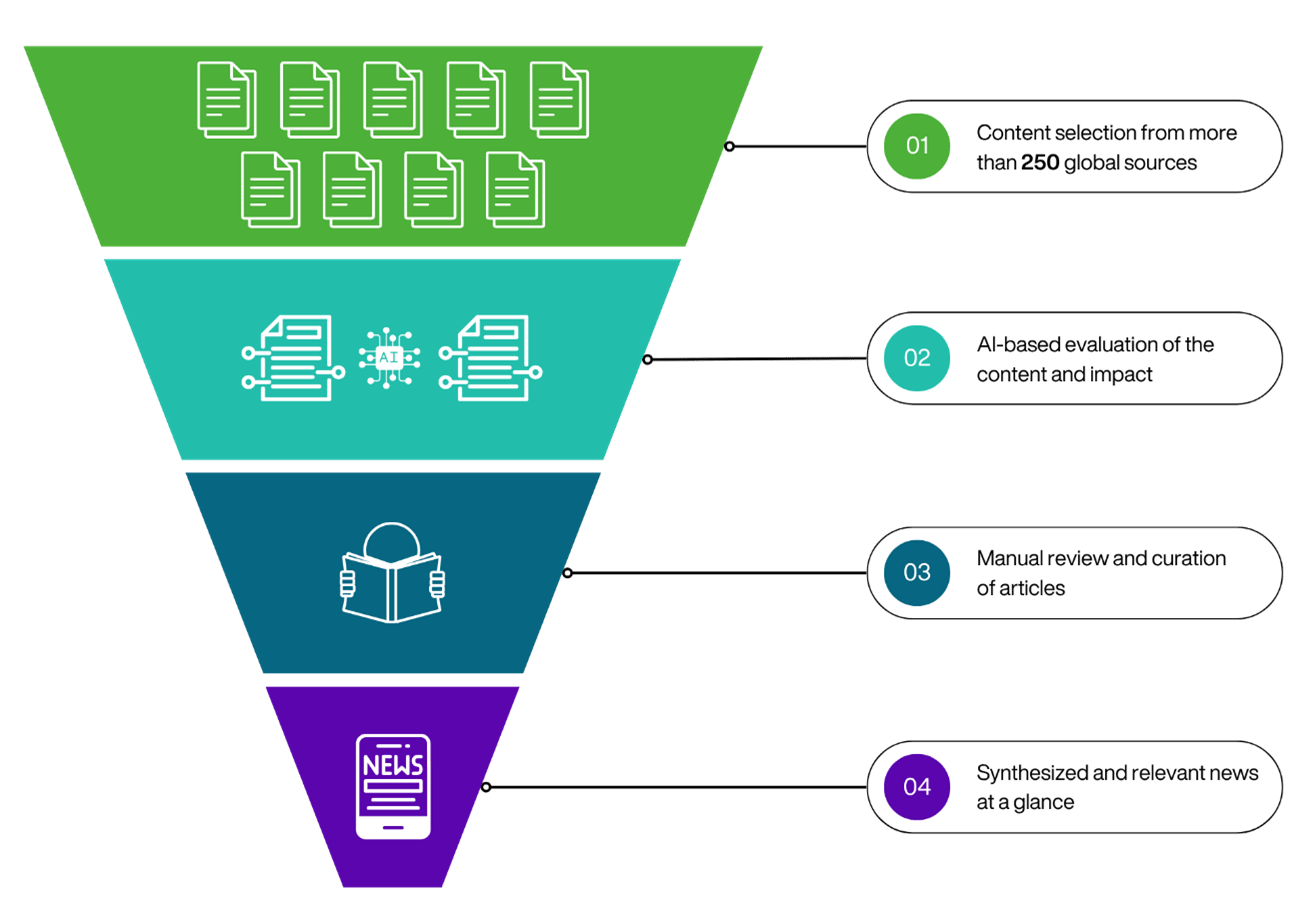
Our process is designed to be both scalable and selective. A broad network of over 250 global sources is continuously screened using six different AI tools. These tools help surface relevant content, which is then passed through a multi-step filtering and evaluation process that emphasizes innovation and impact.
In the final stage, selected articles are reviewed and curated by our team before being published. The result is a dynamic, well-structured view of what truly matters in the digital health ecosystem. This way you always stay ahead of the curve.