DIGI-HEALTH MONITOR Calendar Week 8, 2026
DIGI-HEALTH MONITOR: Calendar Week 8, 2026
Akron Children’s uses EHR analytics to cut anesthetic gas waste and emissions
Akron Children’s Hospital in Ohio leveraged data analytics in its Epic EHR to tackle an unusual operational challenge: reducing waste anesthetic gases that were contributing significantly to the hospital’s carbon footprint. Anesthetic gases like nitrous oxide (a potent greenhouse gas) were identified as 5–10% of the hospital’s overall emissions. Dr. Peggy Allen, a pediatric anesthesiologist, spearheaded an initiative to minimize gas flow rates during surgeries without affecting patient care. By analyzing electronic anesthesia records and real-time data, the team pinpointed opportunities to use “low-flow anesthesia” – delivering the same anesthetic percentages at much lower flow volumes. The hospital implemented simple tech-driven nudges: an alert in the EHR would pop up during each case reminding providers to consider low-flow settings, and anesthesia machines were configured with visual feedback (color-coded gauges) to indicate efficient gas flow levels. These measures yielded immediate results: nitrous oxide usage dropped by about 5% just from the initial EHR reminder intervention, and further reductions followed as clinicians adjusted practice. In 2025 the hospital estimates it eliminated nearly 500 metric tons of CO₂ emissions as a result of these changes. Clinically, patients remained fully anesthetized and safe – the change was in wasted excess gas, not in the quality of care. The project required educating anesthesiology staff (since traditional training hadn’t emphasized environmental impact) and modifying default settings in Epic to support the new protocol. Governance was relatively straightforward given strong department leadership and alignment with the health system’s sustainability goals (the hospital is a HIMSS EMRAM Stage 7 facility, highlighting advanced EHR integration). This data-driven workflow tweak not only benefited the environment but also lowered costs by wasting less anesthetic agent. Buoyed by the success, Akron Children’s plans to sustain these practices and share lessons with other departments and hospitals. The effort showcases how big data and real-time analytics, combined with clinician engagement, can drive measurable improvements in operational, financial, and even environmental outcomes in healthcare.
America’s National Interoperability Network Reaches 500 Million Records Exchanged via TEFCA
The U.S. Department of Health and Human Services (HHS), through the Assistant Secretary for Technology Policy (ASTP), announced on February 11, 2026, that America’s National Interoperability Network (TEFCA) has reached a milestone of 500 million health records exchanged. This infrastructure serves as a foundation for lowering healthcare costs and reducing administrative burden by standardizing the exchange of electronic health data nationwide. The implementation leverages USCDI version 7, which introduces 29 new data elements to support more efficient adverse event reporting and nutrition information exchange. Operationally, the standardization is expected to save certified health IT developers an estimated $1.53 billion in compliance costs, freeing capital for patient-centered innovation. To further improve data usability, ASTP is launching the EHIgnite Challenge, a prize competition designed to apply AI to single-patient health information exports. This initiative aims to transform raw data into clear, actionable information to better support care transitions, provider onboarding, and patient engagement. Challenges remain in eliminating redundant criteria and enforcing information-blocking regulations, with nearly 1,600 complaints submitted as of February 2026. The network’s success demonstrates a decisive move toward “intelligent orchestration” where technology anticipates needs and coordinates care behind the scenes to prioritize prevention.
How Smart Hospitals Push Forward From Pilot to Practice
UMass Memorial Health (Massachusetts) and WellSpan Health (Pennsylvania) have been advancing “smart hospital” rooms to enhance care coordination and safety. At WellSpan, a pilot introduced smart room technology with sensors, cameras and virtual nursing carts to monitor patients at risk. Remote “virtual nurses” could check in via video and bed sensors, helping to prevent falls. The 9-hospital pilot led to a 52% reduction in patient falls and a 92% decrease in the need for in-room sitters, indicating nurses could be redeployed to other tasks. Patient satisfaction scores rose, and nurse communication metrics improved. Following these results, WellSpan is hardwiring more rooms with the Artisight platform and integrating it with Epic EHR alerts. This allows AI-powered detection of patient movement (e.g. getting out of bed) to immediately alert staff and prevent harm. Clinicians were involved in co-designing the workflow from the start to ensure the tech blends into care routines. Leaders note that governance – including training and user buy-in – was crucial for success. With strong outcomes and staff support, both health systems are mapping out expansion of smart room capabilities to additional sites, focusing on the areas of greatest need for patient safety and experience improvements.
University Hospitals of Northamptonshire Deploys Isla Health Digital Pathway Platform Across 15 Specialties, Cutting Referral Times and Releasing Clinical Capacity
University Hospitals of Northamptonshire (UHN) has published a detailed case study documenting the outcomes of its partnership with Isla Health and deployment of Isla’s purpose-built Digital Pathway Platform (DPP) across 15 clinical specialties. The goal was to dismantle the fragmented, snapshot-appointment model that had long plagued NHS outpatient care. Results have been striking: in the Paediatric Epilepsy pathway, video processing time dropped from 3 days to just 10 minutes for 730 patients. In Pain Management, form return time fell from 8 days to 1.5 days for 4,183 patients. Across the whole platform, 10,620 patients are now managing administrative elements of their care from home, and 23,000 of the 30,227 total submissions in the study period were patient-initiated. Clinician feedback is positive, with measurable improvements in task completion times. UHN frames the strategy as a direct response to the NHS “Productivity Puzzle,” explicitly aligned with the NHS Fit for the Future agenda and the NHS Long Term Plan for digital outpatient care. Immediate expansion into Urology, ENT, Cardiology, and Respiratory Physiology is underway, with an ambitious 2030 vision of 200 optimised clinical pathways. Isla’s wider footprint — active in 40+ NHS Trusts across 40+ specialties, processing over 3 million patient submissions — signals significant scalability.
Nottingham University Hospitals NHS Trust Declares Nervecentre EPR Fully Operational Following Post-Go-Live Critical Incident, Plans Patient-Facing Module in 2026
Nottingham University Hospitals NHS Trust (NUH), one of the largest NHS trusts in England by activity, formally announced on 11 February 2026 that its Nervecentre electronic patient record system is fully operational across all sites, resolving a critical incident declared shortly after the EPR’s go-live on 3 November 2025. The go-live represented a significant expansion of the existing Nervecentre footprint at NUH — which had been in use within inpatient services since 2010 — to encompass Administration, Theatres, and Outpatients modules, giving the trust for the first time a single integrated system spanning those domains. The critical incident was triggered by slower-than-expected EPR performance during a period of acute operational pressure in the emergency department, with 24 ambulances waiting outside the ED when the incident was declared on 4 November 2025. Nervecentre CEO Paul Volkaerts confirmed that a planned migration window prior to go-live was followed by performance degradation under live load, with stability restored by 5pm on 5 November 2025. NUH and Nervecentre worked closely during this period to resolve the performance issues. Clinical staff responded by adapting workflows, and more than 300 volunteer “EPR Connectors” from within the trust — including ward nurses — had supported the deployment through peer-to-peer engagement and pre-go-live system testing. Mark Simmonds, deputy medical director and EPR clinical lead, acknowledged the inherent balance of risk in introducing technology at this scale in a live clinical environment, but expressed confidence in the digital foundations now established. Dermot Ryan, NHS England’s Director of Digital Transformation, cited the go-live as “important digital foundations” for further innovation. Anticipated operational benefits — including seamless cross-department data access, reduced paperwork, and improved care coordination — are projected to materialise over the 10-year partnership with Nervecentre. For 2026, NUH plans to introduce the Patient Centre module, enabling patients to use digital tools to engage more actively in their own care. The case represents a widely observed pattern in NHS EPR implementation: genuine risk at the point of go-live, significant human effort to recover, and long-horizon benefit realisation.
The Global Digi-Health Monitor is our weekly published newsletter featuring curated updates on the latest developments in digital health. With a focus on innovation and relevance, it brings together key news across topics such as AI in healthcare, wearables, telemedicine, cybersecurity, and more.
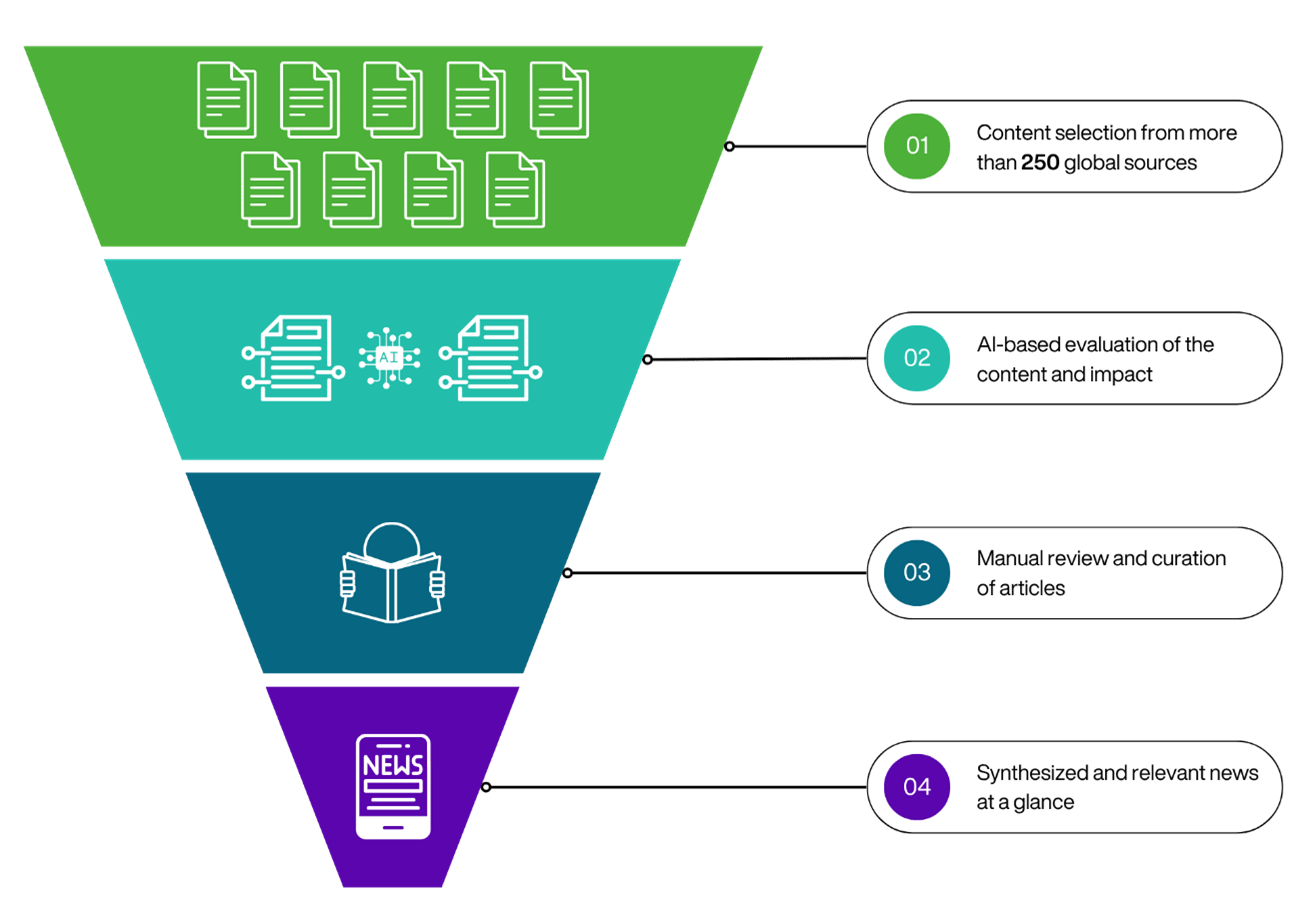
Our process is designed to be both scalable and selective. A broad network of over 250 global sources is continuously screened using six different AI tools. These tools help surface relevant content, which is then passed through a multi-step filtering and evaluation process that emphasizes innovation and impact.
In the final stage, selected articles are reviewed and curated by our team before being published. The result is a dynamic, well-structured view of what truly matters in the digital health ecosystem. This way you always stay ahead of the curve.