DIGI-HEALTH MONITOR Calendar Week 50, 2025
DIGI-HEALTH MONITOR: Calendar Week 50, 2025
SoCal network closes 40,000 care gaps via unified analytics platform
Integrated Health Partners (IHP), a Southern California network of over 30 health centers, implemented Arcadia’s population health analytics platform to improve value-based care performance. The platform consolidated data from nine EHR systems, payer claims, hospital alerts, and social determinants into a unified dashboard accessible to care teams. Clinicians used predictive tools to identify patients with care gaps, resulting in the closure of over 40,000 gaps across one Medicare contract year. The platform also enabled IHP to become the top-rated performer for multiple health plans on HEDIS and utilization metrics. Reductions included a 3% drop in emergency department visits and a 7% decline in 30-day readmissions. IHP facilitated adoption through benchmarking meetings with physicians and tailored reporting. The system uses HL7 integration and patient matching to maintain data integrity. Next steps include adding immunization and social risk feeds and extending analytics to more risk contracts and care teams.
RFID track-and-trace pilot achieves 100% drug supply chain visibility
Michigan State University’s Axia Institute conducted a real-world pilot using RFID technology to meet U.S. federal requirements for end-to-end drug traceability. The pilot, involving pharmaceutical supply chain participants, implemented RFID tags based on GS1 standards to track drugs from manufacturers to dispensing points. In field conditions at a pharma distribution center, the optimized tags achieved 100% scan accuracy across multiple packaging formats and environments. The solution supports serialization at the unit level, flagging expired or recalled items instantly and enabling real-time inventory management without line-of-sight scanning. This far outperformed traditional barcoding and complies with the U.S. Drug Supply Chain Security Act. The system architecture supports vendor-neutral data sharing, and governance is reinforced by open standards and decentralized ownership. The pilot is now informing best practices for healthcare organizations preparing for national DSCSA compliance in 2026, with broader applications being evaluated for hospital pharmacy automation.
Hospitals Continue to Improve Performance on Key Patient Safety Measures, Outcomes in 2025
This American Hospital Association (AHA) report, utilizing comprehensive data analyzed by Vizient from 705 hospitals across the nation (Q4 2019 through Q2 2025), provides aggregated evidence of successful, system-wide digital and safety strategy implementation. The primary objective of the analysis was to validate the impact of hospitals’ ongoing focus on safety and quality initiatives. The quantifiable clinical and operational outcomes are significant: hospitalized patients in Q2 2025 were nearly 30% more likely to survive than expected, relative to the severity of their illness, when compared to the 2019 baseline. This improvement is projected to have resulted in more than 300,000 Americans surviving episodes of care they would not have otherwise survived. Furthermore, hospitals successfully reduced key hospital-acquired infections (HAIs) and achieved a dramatic 95% increase in key preventive screenings for breast and colorectal cancer, confirming the success of population health management tools and digital outreach. These clinical gains were achieved while hospitals simultaneously managed a sicker, more complex patient population, evidenced by a 4% increase in patient volume and a 5% increase in Case Mix Index. The report validates that sustained investments in data-driven tools and safety programs provide a robust return on investment (ROI) by enhancing organizational resilience and maximizing clinical performance.
Western Australia public health system launches AI-enabled patient flow pilot at Royal Perth Hospital
The Government of Western Australia has funded a 700,000 AUD artificial intelligence pilot to optimize hospital patient flow, with the first deployment planned at Royal Perth Hospital ahead of the 2026 winter season as part of the state’s public health system. The Office of Digital Government will partner with WA Health and the State Health Operations Centre to build an AI-enabled platform that predicts length of stay and automatically sequences key tasks such as imaging, laboratory testing, pharmacy dispensing, and discharge documentation to improve bed availability and reduce delays in the care pathway. Frontline clinicians and operational staff are expected to use real-time dashboards that aggregate data from a new system-wide data platform, which will track demand, capacity, and patient movements across facilities, while clinical decision-making responsibility remains with healthcare professionals. Although quantitative performance results are not yet available because the pilot is just entering implementation, the program is positioned as a live, soon-to-be-operational deployment with explicit expectations of shorter waits, more efficient use of existing capacity, and less pressure on staff during seasonal surges. The initiative is supported by a “robust governance framework” for safe and responsible AI deployment, indicating structured oversight of algorithm use, data handling, and integration with other digital health initiatives in the state’s hospitals. Policy relevance is high because the pilot is government-funded, explicitly designed for scalability across multiple public hospitals if successful, and intended to inform broader system-level digital transformation to meet the needs of a growing and ageing population.
Royal Flying Doctor Service testing AI enhancements on award-winning EMR
Royal Flying Doctor Service in Australia enhanced its Oracle-based EMR, operational since 2023, with AI prototypes for data entry via image, voice, and video. Serving remote regions in South Australia and Northern Territory, the system supports offline mobile recording, safety alerts, and API interoperability with national platforms like My Health Record. Clinicians, including doctors and nurses on aeromedical missions, input data once for automated sharing across care teams, reducing redundancy. Outcomes include a 50% reduction in administrative time over two years, improved documentation quality, and “Exemplar Practice” status under national health standards. Risks from prior paper systems, such as errors in disconnected environments, are addressed through robust connectivity handling. Privacy is ensured via secure APIs and compliant data exchange. Insights emphasize shifting focus from paperwork to care in challenging settings, with plans to advance into an intelligent platform and extend nationally or internationally.
The Global Digi-Health Monitor is our weekly published newsletter featuring curated updates on the latest developments in digital health. With a focus on innovation and relevance, it brings together key news across topics such as AI in healthcare, wearables, telemedicine, cybersecurity, and more.
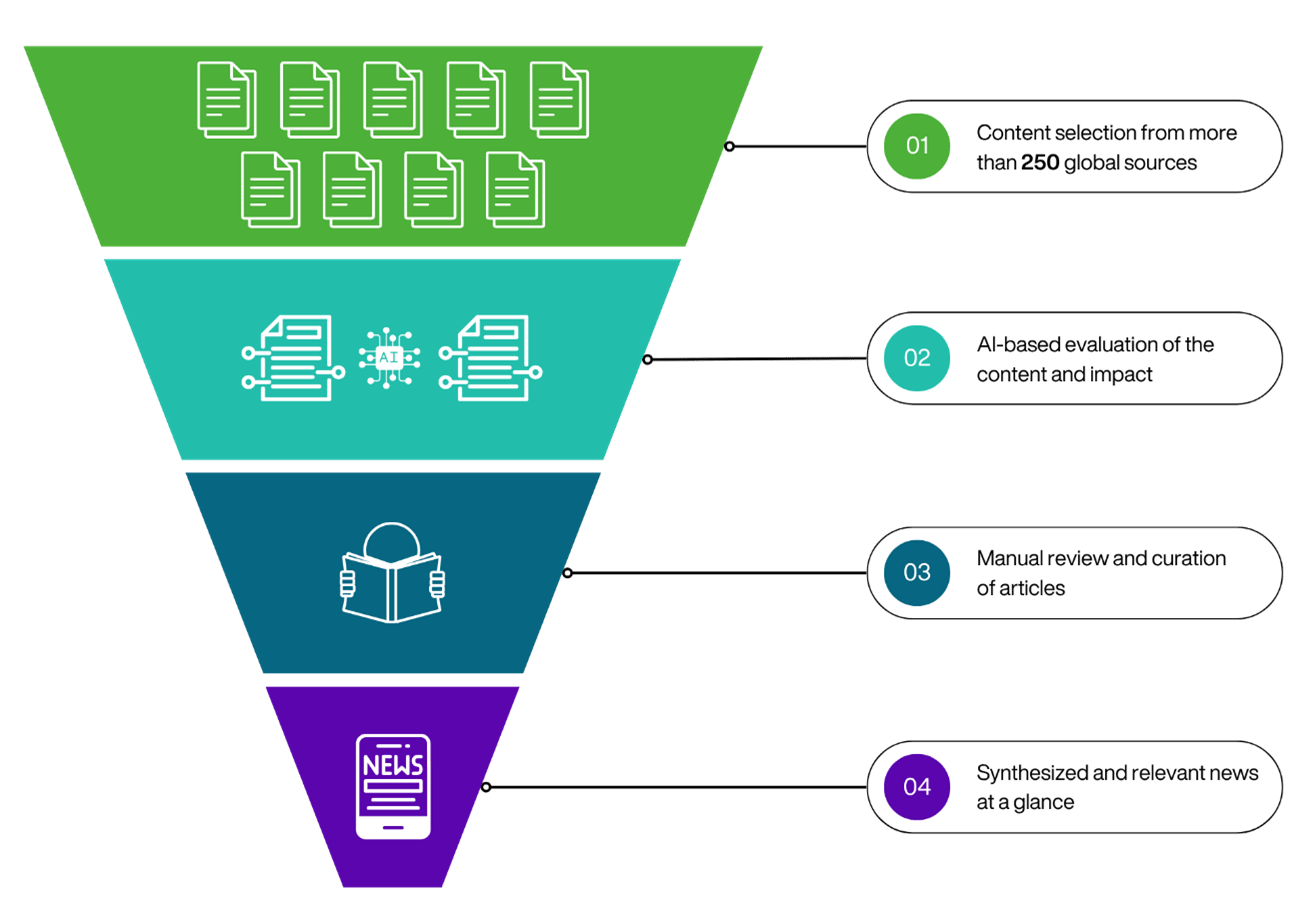
Our process is designed to be both scalable and selective. A broad network of over 250 global sources is continuously screened using six different AI tools. These tools help surface relevant content, which is then passed through a multi-step filtering and evaluation process that emphasizes innovation and impact.
In the final stage, selected articles are reviewed and curated by our team before being published. The result is a dynamic, well-structured view of what truly matters in the digital health ecosystem. This way you always stay ahead of the curve.