DIGI-HEALTH MONITOR Calendar Week 48, 2025
DIGI-HEALTH MONITOR: Calendar Week 48, 2025
AI system helps NHS hospitals cut no-shows and unlock outpatient capacity
Deep Medical, a UK health-tech company originating from a University College London project, has deployed an AI platform with several National Health Service (NHS) hospital partners in Essex, Surrey, and Hertfordshire to predict and reduce missed outpatient appointments, a problem estimated to cost the NHS billions of pounds and worsen patient outcomes each year. The system uses 15 years of hospital data and around 200 predictive factors, including demographics, transport access, and weather, to estimate which patients are most likely to miss visits and why, without directly using identifiable clinical records, which the team explicitly avoided on ethical grounds. Hospital teams then use model outputs to trigger tailored interventions such as additional reminders, reworded messages, rapid rebooking, or arranging free transport via an integrated Uber Health partnership, while clinicians and administrative staff retain responsibility for scheduling and patient communication workflows. Early partners report measurable operational gains: in hospital systems with an 8 percent baseline no-show rate, the AI-supported workflow reduced missed appointments to below 6 percent, and a 2024 trial cited in the article showed about a 30 percent reduction in no-shows over six months, supported by an AI-informed “backup booking” feature that fills a substantial share of otherwise empty slots. Mid and South Essex NHS Foundation Trust described its pilot as “hugely encouraging,” emphasizing better use of existing resources and more effective movement of patients off waiting lists through multi-channel communication at scale.
Memorial Sloan Kettering innovates clinical trials with AI
Memorial Sloan Kettering Cancer Center in New York conducts around 1,800 oncology studies in parallel and struggles with enormous amounts of data, most of which is contained in unstructured texts. To speed up screening and matching, the team led by Joe Lengfellner, Head of Clinical Research IT, conducted a structured tender and tested several providers. In the end, Triomics prevailed with an oncology-specialized AI platform that converts unstructured documents from the Epic system into structured features for inclusion and exclusion criteria. In a retrospective test, the AI was given historical data from completed studies and had to find all trial candidates identified by humans and track down additional suitable patients. According to Lengfellner, both tasks were successful: the AI achieved complete agreement with manual screening and identified additional suitable cases, which significantly increased the hit rate and reduced false negatives. The platform runs through hundreds of files at night, while study coordinators validate suggestions in a dashboard during the day, place nearly suitable patients on watch lists, and invest the hours they save in direct patient care. The rollout is taking place in stages, with controlled pilots across different tumor entities and clear performance gates for scaling, always with human-in-the-loop control to ensure quality, safety, and regulatory requirements are met.
Hybrid Ambient Documentation Decreases After-Hours Work, Note Delays for Physicians
Mass General Brigham conducted a large-scale study to examine how a hybrid ambient documentation solution affects physicians’ workload and productivity. In 14 primary care practices at Massachusetts General Hospital, 181 physicians and advanced practice providers used a combination of generative AI, which records conversation content and creates draft notes, and a virtual human scribe, who enters the final version into the EHR. Over a period of 80 days, including a familiarization phase, the team analyzed after-hours time spent in the EHR, delays in note completion, and financial productivity metrics. The result: time spent on electronic records outside of regular office hours decreased by about 41 to 42 percent, the number of notes that were still incomplete two days after the appointment decreased by about 66 percent, and productivity, measured in RVUs, increased by about 12 percent. The researchers emphasize that the hybrid approach leaves clinical responsibility with humans while AI takes over routine tasks. The program now serves as the basis for the broader rollout of ambient documentation throughout the system and provides concrete evidence that well-implemented AI tools can reduce burnout risks while improving throughput and documentation quality.
Mount Sinai Medical Center attains Stage 7 on HIMSS EMRAM
Mount Sinai Medical Center (Miami) achieved the highest EHR maturity level (Stage 7), reflecting full digital integration. The hospital reports “safer, faster and more coordinated care” through its optimized EHR and ancillary tech, which provide a real-time, complete patient picture across settings. Notable results of its digital transformation include reduced duplicate tests, quicker clinical decision-making, and expanded patient engagement via the MyChart portal. Mount Sinai also implemented AI-enabled workflows and advanced clinical decision support that have cut alert fatigue and improved evidence-based ordering. Leaders credit strong clinician–IT collaboration for these improvements, emphasizing that the digital systems have reduced administrative burden and given clinicians better insight at the point of care.
Tampa General Hospital taps Hyro voice AI to boost call-center efficiency
Tampa General Hospital (Florida) deployed Hyro’s voice AI agents in its patient contact center, automating appointment scheduling, routing, and FAQs via Epic-integrated “conversational AI.” Within weeks of go-live, daily call abandonment fell from 34% to 14.9% (a 56% drop) and average hold times dropped 58% (from 6.2 to 2.4 minutes). The AI handles routine calls end-to-end (“from ‘hello’ to scheduling”) and frees staff for complex needs. Outcomes: TGH saw a 21% increase in appointments booked through the center and achieved its lowest ever call abandonment rate. Clinician teams also report faster response times and a more “coherent” patient access experience. Interoperability was key: Hyro’s agents plug into TGH’s Epic EHR and phone systems, ensuring seamless workflow and real-time data logging. TGH’s CDIO noted that in just weeks the AI yielded “measurable impact…more appointments scheduled, fewer dropped calls,” allowing staff to focus on higher-value interactions.
The Global Digi-Health Monitor is our weekly published newsletter featuring curated updates on the latest developments in digital health. With a focus on innovation and relevance, it brings together key news across topics such as AI in healthcare, wearables, telemedicine, cybersecurity, and more.
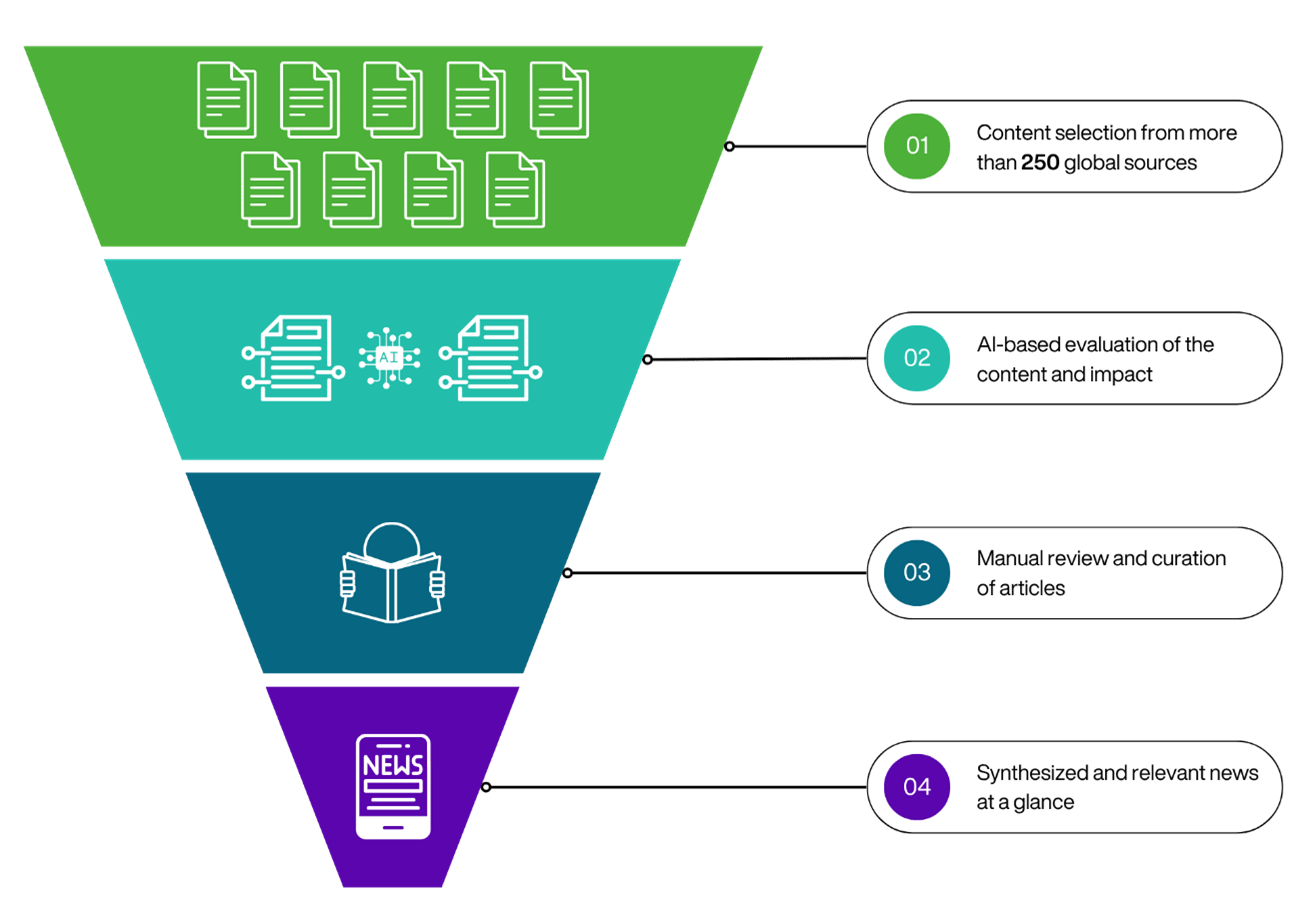
Our process is designed to be both scalable and selective. A broad network of over 250 global sources is continuously screened using six different AI tools. These tools help surface relevant content, which is then passed through a multi-step filtering and evaluation process that emphasizes innovation and impact.
In the final stage, selected articles are reviewed and curated by our team before being published. The result is a dynamic, well-structured view of what truly matters in the digital health ecosystem. This way you always stay ahead of the curve.