DIGI-HEALTH MONITOR Calendar Week 47, 2025
DIGI-HEALTH MONITOR: Calendar Week 47, 2025
Towards Personalized Care for All: Abu Dhabi’s Digital Health Quest
Abu Dhabi’s Department of Health describes a live, integrated digital health ecosystem that combines AI, multimodal data, and genomics to deliver preventive and personalized care across the emirate, positioning the system as a full-scale real-world implementation rather than a pilot. At its core is the Intelligent Health System, a sovereign infrastructure that integrates medical records, insurance claims, environmental exposures, lifestyle data, and genomic information into a unified platform governed by privacy-by-design and interoperability standards. The Malaffi health information exchange connects 100% of public and private providers and insurers, enabling real-time access to longitudinal patient histories, which is reported to improve coordination, reduce duplicated diagnostics, and support more efficient system-level resource use. Sahatna, a mobile app used by over 800,000 residents, provides secure access to personal records, telehealth consultations, and proactive booking while embedding behavioural nudges to support prevention, thus giving citizens a single digital front door into the ecosystem.
Atrium Health Extends Reach with Virtual Care to Improve Health and Elevate Hope
Atrium Health has expanded its virtual-care footprint across hospitals, schools, community clinics and patients’ homes throughout the Carolinas, Georgia and Alabama — developing more than 30 distinct programs that have driven major gains in access and efficiency. The system reports 15 facilities offering eICU care, 47 emergency-departments providing telestroke services, over 20,000 school- and community-based virtual visits annually, and 125,000+ behavioral-health visits each year. Home-based hospital-level care, a virtual care presence in 150 schools (which cut preventable ED visits by 32 %) and remote oncology, cardiology and behavioral-health service lines highlight the strategic ambition. With leadership emphasizing full-person, connected outreach (“between patients and providers, between patients and clinicians”), Atrium’s approach underlines how virtual-care tools can reshape both operational workflows and equitable access. As the model scales, the organization emphasizes design, governance and integration — not just technology — to ensure clinician adoption, patient engagement and measurable system-level impact.
How ambient AI is reshaping revenue integrity and compliance at the point of care
At Mayo Clinic in Minnesota and Ardent Health Services in Tennessee, clinicians are using ambient AI tools during patient visits to automatically capture and audit clinical documentation. Instead of treating compliance as a back-end task, these health systems have embedded “audit-grade” AI assistance into point-of-care workflows, allowing physicians’ spoken notes to be transcribed and checked in real time. This upstream approach has improved documentation accuracy and boosted revenue integrity, with Ardent reporting a 20% increase in captured diagnosis codes (HCCs) and higher coding complexity after piloting the AI system. Physician adoption has been exceptional – Ardent saw over 90% utilization upon rollout, and 100% of participating providers reported satisfaction with the tool. Leaders from both organizations note that winning clinicians’ trust was crucial. They introduced the technology gradually, ensured it fit into existing workflows, and required each provider to achieve 90% accuracy with the AI assistant before fully launching. Governance and training were emphasized: Mayo uses continuous feedback and oversight until clinicians “graduate” from intensive review. The AI does not replace human judgment – it augments it, catching documentation gaps early so that costly retroactive fixes are minimized. Going forward, leaders are exploring broader uses of these ambient AI tools (like aiding clinical outcomes and risk management) beyond billing compliance. The success at Mayo and Ardent illustrates how integrating AI at the bedside can streamline workflows, reduce provider burden, and secure financial accuracy in care delivery.
AI-Powered Diabetes Prevention Program Achieves Clinical Parity and Higher Engagement Rates at Johns Hopkins
Johns Hopkins Medicine researchers examined the efficacy of an AI-powered diabetes prevention program designed to overcome logistical barriers (like scheduling and travel) by guiding participants through standard Centers for Disease Control and Prevention (CDC) risk reduction benchmarks. The study compared the automated care delivery with traditional human coaching. The key clinical efficacy KPI showed that after a 12-month period, approximately one-third of participants in the AI-guided group met the CDC benchmarks for reducing diabetes risk (e.g., losing 5% of body weight or reducing A1C levels), demonstrating that the AI-powered program achieved nearly the same health benefits as traditional, human-led programs. The major patient engagement KPI was significantly superior: enrollment was 93% in the AI-based program compared with 83% in the human-led version, and nearly two-thirds completed the program. This outcome highlights AI’s powerful potential as a tool for health equity and access, achieving clinical parity while significantly improving population reach and adherence by removing logistical impediments.
AI Adoption In Healthcare Is Surging
A new industry report — spotlighted by Forbes — shows a sharp uptick in how hospitals and health systems are deploying artificial intelligence (AI) across care settings. The findings highlight that nearly three-quarters of organizations now have at least one AI initiative live, and roughly half plan to scale these tools enterprise-wide within the next 12 months. Key adoption areas include clinical decision-support, revenue cycle optimization and imaging*. Health leaders are optimistic: more than 60 % say AI has already improved operational efficiency, while nearly half report patient experience gains. At the same time, the report warns of growing pains—issues around data quality, governance models and clinician trust persist. The article underscores that while AI is no longer “future tech” in healthcare, realizing its full potential requires solid frameworks around responsible use, change management and interoperability—not just clever algorithms.
The Global Digi-Health Monitor is our weekly published newsletter featuring curated updates on the latest developments in digital health. With a focus on innovation and relevance, it brings together key news across topics such as AI in healthcare, wearables, telemedicine, cybersecurity, and more.
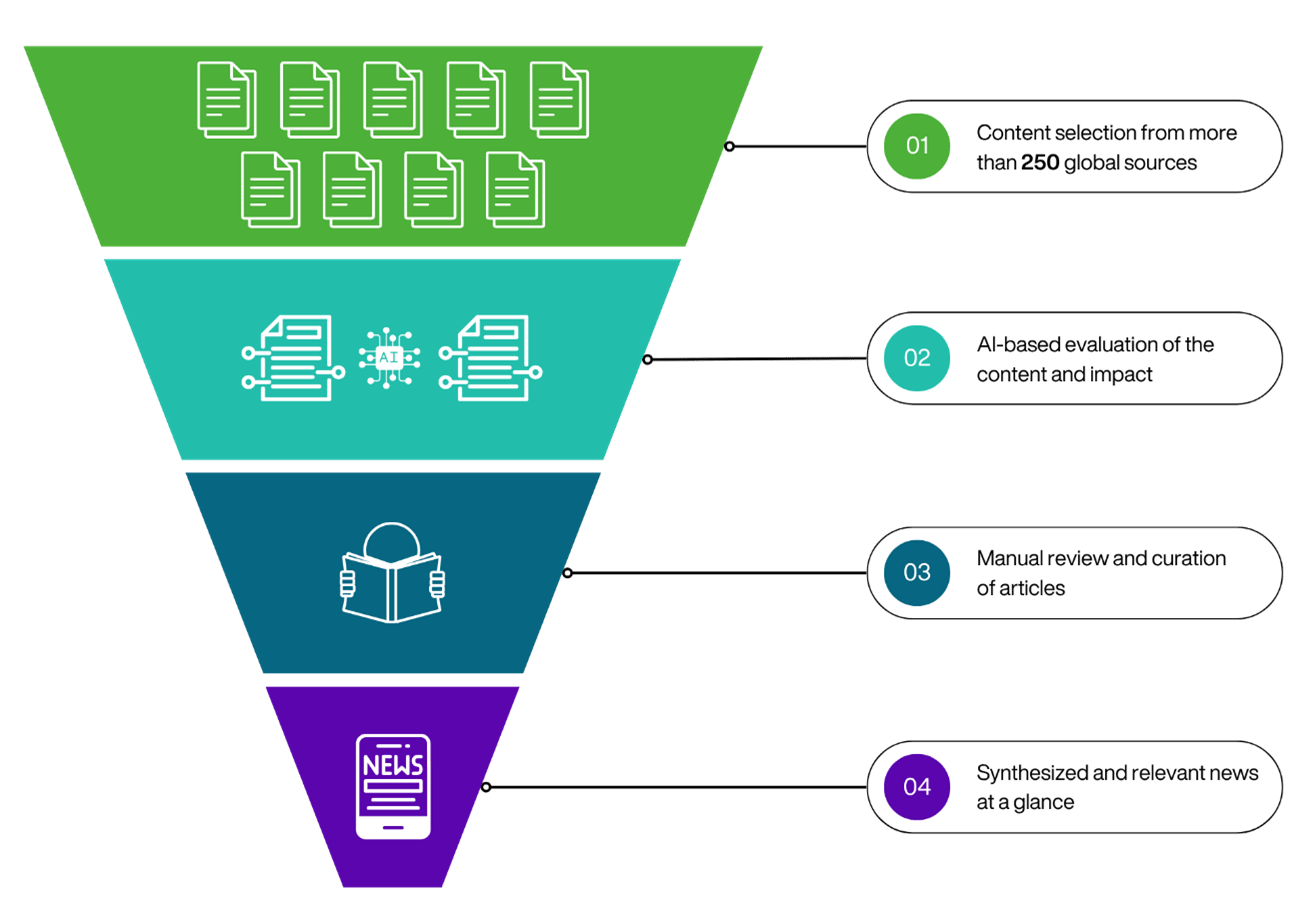
Our process is designed to be both scalable and selective. A broad network of over 250 global sources is continuously screened using six different AI tools. These tools help surface relevant content, which is then passed through a multi-step filtering and evaluation process that emphasizes innovation and impact.
In the final stage, selected articles are reviewed and curated by our team before being published. The result is a dynamic, well-structured view of what truly matters in the digital health ecosystem. This way you always stay ahead of the curve.