DIGI-HEALTH MONITOR Calendar Week 45, 2025
DIGI-HEALTH MONITOR: Calendar Week 45, 2025
Wearable AI Predicts Hospital Patient Deterioration Continuously
Researchers from institutions including those affiliated with Nature Communications deployed lightweight sensors in diverse hospital wards, validating the system with real patient data across demographics. The deep learning technology analyzed time-series vitals like ECG and oxygen saturation via secure wireless transmission, providing continual personalized predictions. Workflows integrated dashboards with customizable alerts into clinical routines, enabling proactive interventions without added burden. Results demonstrated superior early warning scores, shortened response times, and improved survival correlations for sepsis or cardiac events, with retrospective analyses revealing new decline precursors. Challenges centered on preprocessing heterogeneous data to counter noise and artifacts. Governance featured encrypted transmission, de-identification, and consent protocols aligned with regulations. Clinicians interacted via interpretable rationales, contributing to development and validation for protocol alignment. Lessons stressed multidisciplinary collaboration for practical balance and explainable AI for trust. Next steps involve electronic health record integration, remote expansions, and feedback-driven refinements for home care scalability.
Telehealth Initiative Launches in Four Rural School Districts
Seven schools across four rural North Carolina districts have started a pilot telehealth program connecting students and staff with remote medical providers. Spearheaded by the North Carolina Community Schools Coalition, the initiative addresses critical doctor shortages in areas designated as Health Professional Shortage Areas. The program, managed by a nonprofit medical volunteer corps, equips school nurses and coordinators to facilitate virtual appointments during the school day. By offering on-site telehealth screenings four days a week, the pilot aims to reduce barriers such as long travel distances and parents missing work to take children to clinics. Expected benefits include fewer student absences and more timely care for common illnesses. Success metrics will focus on how many students and educators use the service and improvements in attendance rates. If effective, this school-based telehealth model could significantly improve access to care in underserved rural communities by making schools a hub for healthcare delivery.
Leicester’s AF Virtual Ward Expansion: From Pilot Project to National Blueprint?
A pioneering virtual ward in Leicester, UK is transforming atrial fibrillation (AF) care and is being scaled as a potential national model. Launched during the COVID-19 pandemic, the program enables certain AF patients to receive hospital-level monitoring and treatment at home via digital ECG devices, Bluetooth vital sign monitors, and daily telehealth rounds. In its initial 12-month pilot (2022–2023), this remote AF service prevented 127 unplanned hospital admissions and saved an estimated 444 bed-days by treating patients outside the hospital. Over 700 patients have since been managed through the virtual ward, with data showing nearly 60% avoided a hospital stay entirely thanks to early discharge or outpatient enrollment. Outcomes have been positive: an independent evaluation found the virtual care at least as safe as inpatient treatment at 30 days, with patients actually faring better by 90 days post-discharge. Buoyed by £312,000 in innovation funding, the Leicester team is expanding the model to three other NHS sites, with the goal of creating a scalable blueprint for virtual cardiology wards nationwide. This real-world example highlights how digital health innovation can improve patient experience (allowing recovery at home), reduce hospital burden, and maintain high safety standards.
AI in Healthcare: How Generative Tools Are Transforming Clinical Practice
Dr. Rahul Goyal, a UK-based family physician and Elsevier executive, implemented ClinicalKey AI in urgent care consultations and a Middle East pilot trial involving multidisciplinary teams in ICU settings. The conversational generative AI tool processed patient scenarios, integrating evidence from global guidelines for diagnostics, medication plans, and documentation via speech recognition. Workflows entailed inputting details like history and comorbidities for instant referenced outputs, shown to patients for transparency during 10-minute visits, and compared against human consensus in team discussions. Results included 45-minute time savings per complex case, 4 minutes per consultation, full recovery in a tuberculosis diagnosis overlooked by bias, and reduced decision friction with faster justifications. Challenges involved initial colleague skepticism on opacity and replacement fears, addressed through “glass box” designs revealing sources and logic. Governance emphasized validated data compliance, ethical sharing, and human oversight per NHS recommendations. Clinicians co-designed prompts, reviewed outputs, and maintained control, fostering trust by framing AI as assistive. Lessons highlighted targeting workflow pain points like evidence lookup, co-creation to mitigate resistance, and sharing success stories for uptake. Next steps focus on NHS standardization, staff training via programs like Gen AI Academy, and ecosystem building for governance to scale high-impact uses.
Remote Patient Monitoring Boosts Primary Care Revenue and Capacity
A major study from Columbia University Mailman School of Public Health quantified the impact of remote physiologic monitoring (RPM) in primary care practices across the U.S., analyzing national Medicare data from 754 clinics adopting RPM between 2019–2021. Practices saw a 20% two-year increase in Medicare revenue following RPM adoption, with growth attributed to RPM billing and broader care management, while also serving more patients overall—including higher-risk and more diverse groups. RPM integration did not reduce access for non-RPM patients, refuting previous concerns about resource tradeoffs. The research highlights real workflow changes, enhanced chronic disease management, and new revenue streams. Clinician feedback and operational impact data are included, demonstrating RPM’s role in supporting capacity and equity.
The Global Digi-Health Monitor is our weekly published newsletter featuring curated updates on the latest developments in digital health. With a focus on innovation and relevance, it brings together key news across topics such as AI in healthcare, wearables, telemedicine, cybersecurity, and more.
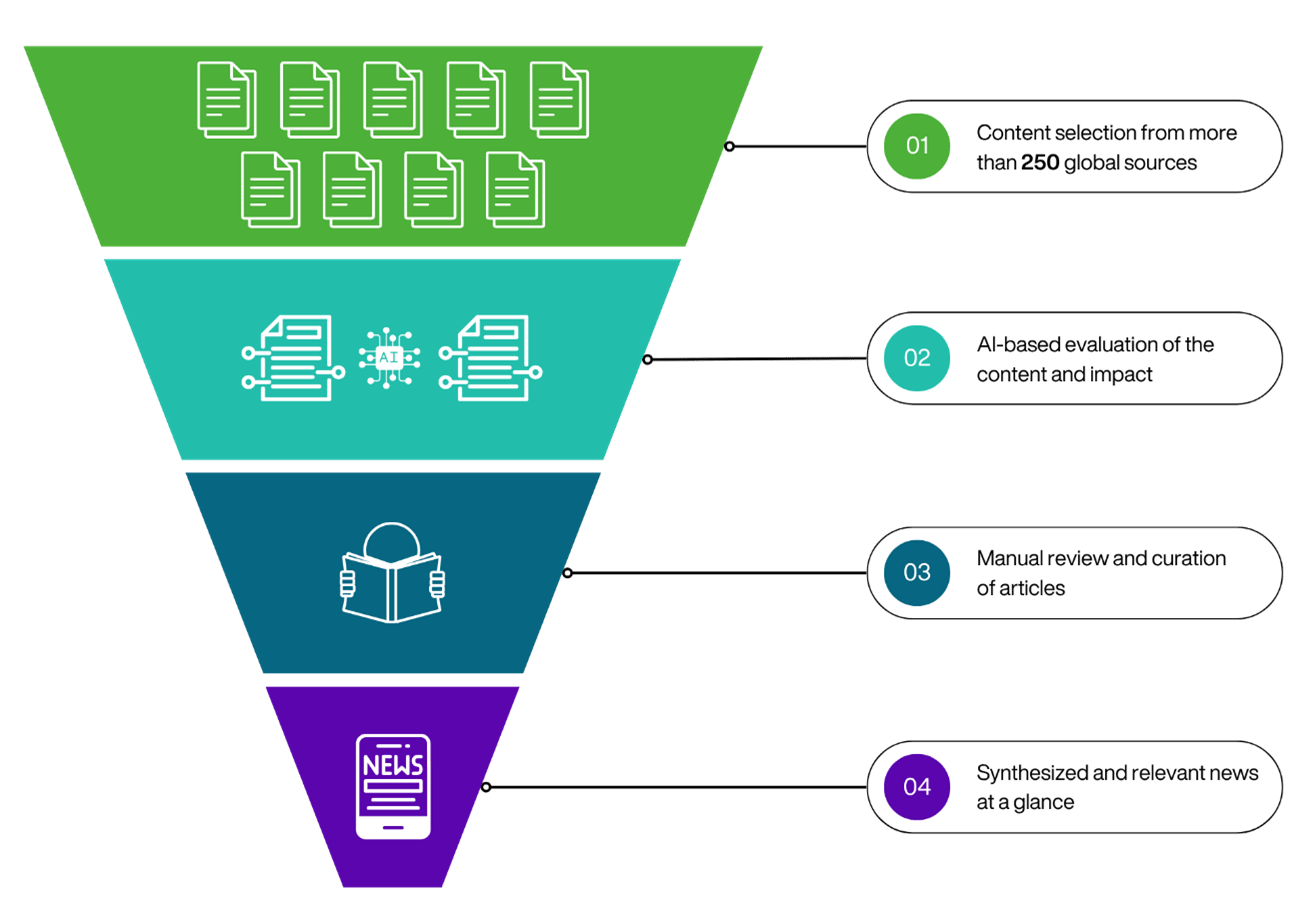
Our process is designed to be both scalable and selective. A broad network of over 250 global sources is continuously screened using six different AI tools. These tools help surface relevant content, which is then passed through a multi-step filtering and evaluation process that emphasizes innovation and impact.
In the final stage, selected articles are reviewed and curated by our team before being published. The result is a dynamic, well-structured view of what truly matters in the digital health ecosystem. This way you always stay ahead of the curve.