DIGI-HEALTH MONITOR Calendar Week 40, 2025
DIGI-HEALTH MONITOR: Calendar Week 40, 2025
As Federal Government Hurtles Towards a Shutdown, Telehealth Is Endangered
As the federal government moves closer to a shutdown, telehealth access is at risk of becoming one of its casualties. During the COVID-19 public health emergency, Congress expanded reimbursement flexibilities that allowed patients—especially seniors—to receive hospital-level and primary care from their homes. Those flexibilities are now set to expire without legislative action, raising concerns about the continuity of care for millions of Americans. Policymakers and health system leaders warn that a lapse could disrupt care coordination, increase costs, and reverse progress made in expanding digital health equity. For hospitals and providers that have invested heavily in virtual care infrastructure, the uncertainty surrounding telehealth’s future creates a volatile policy environment, where patient access and financial stability both hang in the balance.
Healthcare’s Device Crisis: Device Security Failures Are Direct Patient Safety Threats
A comprehensive analysis asserts that the vulnerability of mobile devices and medical endpoints constitutes healthcare’s most preventable security crisis, directly translating cybersecurity failures into patient safety risks. Referencing recent high-profile incidents, such as the Change Healthcare ransomware attack, the author notes that basic endpoint security failures—like the cracking of a single password without multi-factor authentication—can lead to data theft, massive financial losses, and critically, the cancellation of urgent surgeries and patient services. With healthcare attacks rising 150% year-over-year, the industry’s slow pace in addressing known vulnerabilities is unacceptable. Reports show that nearly half of mobile devices used in healthcare settings run outdated operating systems, creating a major target, as one-third of ransomware attacks exploit known yet unpatched vulnerabilities. The increase in networked endpoints post-pandemic, coupled with hackers leveraging AI for efficiency, has significantly tipped the numbers in favor of bad actors. The article calls upon healthcare leaders to recognize device security not merely as an IT function, but as a core component of clinical risk management, demanding immediate upgrades and robust patching policies to close this dangerous security gap.
Breakthrough in Alzheimer’s Diagnostics: AI-Powered Screening and Blood Biomarkers Reshape Preventive Care
The year 2025 is marked by a paradigm shift in Alzheimer’s disease management, moving its detection from symptomatic diagnosis to pre-symptomatic, preventative health monitoring. Newly approved blood biomarker tests—capable of analyzing proteins like β-amyloid and p-tau217—are rapidly becoming integrated into standard preventive health checkups. This scientific breakthrough is matched by the simultaneous adoption of sophisticated AI-powered screening platforms by both clinical practices and telemedicine providers. These platforms enable large-scale, cost-effective, and rapid risk assessments across large populations. The ability to detect Alzheimer’s years before cognitive symptoms manifest carries profound implications for healthcare systems, insurance risk modeling, and the global eldercare supply chain. Furthermore, this technological progress is paralleled by significant shifts in global policy and social attitudes. Alzheimer’s is no longer universally viewed as an inevitable consequence of aging but as a manageable, early-detectable condition. Governments are actively enacting policies focused on supporting early detection, safeguarding patient rights, and promoting inclusive community care models. The climate is shifting toward proactive care, collaboration, and empowerment, setting new international benchmarks for care accessibility and quality, significantly boosting the market for diagnostics, pharmaceuticals, and digital health tools focused on early risk mitigation. This evolution not only enhances individual outcomes but also reduces long-term societal costs associated with advanced disease stages, encouraging further investment in integrated AI and biomarker technologies.
Smart Wearable Device Developed to Monitor Muscle Health
Researchers in the UK unveil Axoband, a sophisticated smart textile wearable targeting the detection and management of sarcopenia, a condition causing muscle loss and frailty for millions of older adults. This band, developed in partnership between Nottingham Trent University, Newcastle University, and Axomics Medical Ltd, represents a major advance in objective, quantitative biomonitoring. It captures electrical muscle signals and movement to allow clinicians remote, continuous insight into a patient’s muscle health. With the economic burden of sarcopenia costing billions annually and the prevalence expected to rise over the coming decade, the wearable is projected to reshape early intervention, personalized treatment, and frailty prevention programs—reducing falls and hospitalizations for aging populations. Its low cost, adaptability, and integration into digital diagnostics make it a transformative solution with system-wide application. Supported by international health funding, Axoband also promises broader use for chronic disease management and multi-condition monitoring, marking a disruptive innovation in geriatric and preventive care. By enabling real-time data sharing with healthcare providers, it facilitates timely adjustments to therapy plans, potentially integrating with AI algorithms for predictive analytics on muscle deterioration trends, thus empowering proactive healthcare strategies and alleviating pressure on overburdened systems.
A foundational architecture for AI agents in healthcare
Medical AI agents stand out from traditional AI due to their autonomy, adaptability, and capacity to handle complex tasks in healthcare settings. A conceptual framework outlines four core components: planning, action, reflection, and memory, which enable these agents to operate effectively. Applications span clinical domains, including boosting diagnostic accuracy through data integration, personalizing treatments based on patient profiles, guiding precise robotic surgeries, and facilitating continuous patient monitoring in real-time. Implementation challenges encompass technical hurdles in system integration, resistance from clinicians accustomed to conventional methods, the need for regulatory frameworks to evolve with technology, and ethical concerns like ensuring data privacy and mitigating algorithmic biases that could affect equitable care. Future prospects involve creating proactive, collaborative multi-agent systems and visionary concepts such as an AI Agent Hospital, where agents manage entire care processes. This approach promises to revolutionize healthcare by improving efficiency, reducing errors, and enhancing patient outcomes, but success depends on addressing barriers through interdisciplinary collaboration, robust validation, and inclusive design. The framework provides a blueprint for developers and policymakers to guide ethical and effective deployment, ultimately fostering a more responsive and intelligent healthcare ecosystem. By emphasizing modularity and scalability, it paves the way for AI to become an integral part of clinical workflows, potentially transforming how healthcare professionals interact with technology and patients receive care across global systems.
The Global Digi-Health Monitor is our weekly published newsletter featuring curated updates on the latest developments in digital health. With a focus on innovation and relevance, it brings together key news across topics such as AI in healthcare, wearables, telemedicine, cybersecurity, and more.
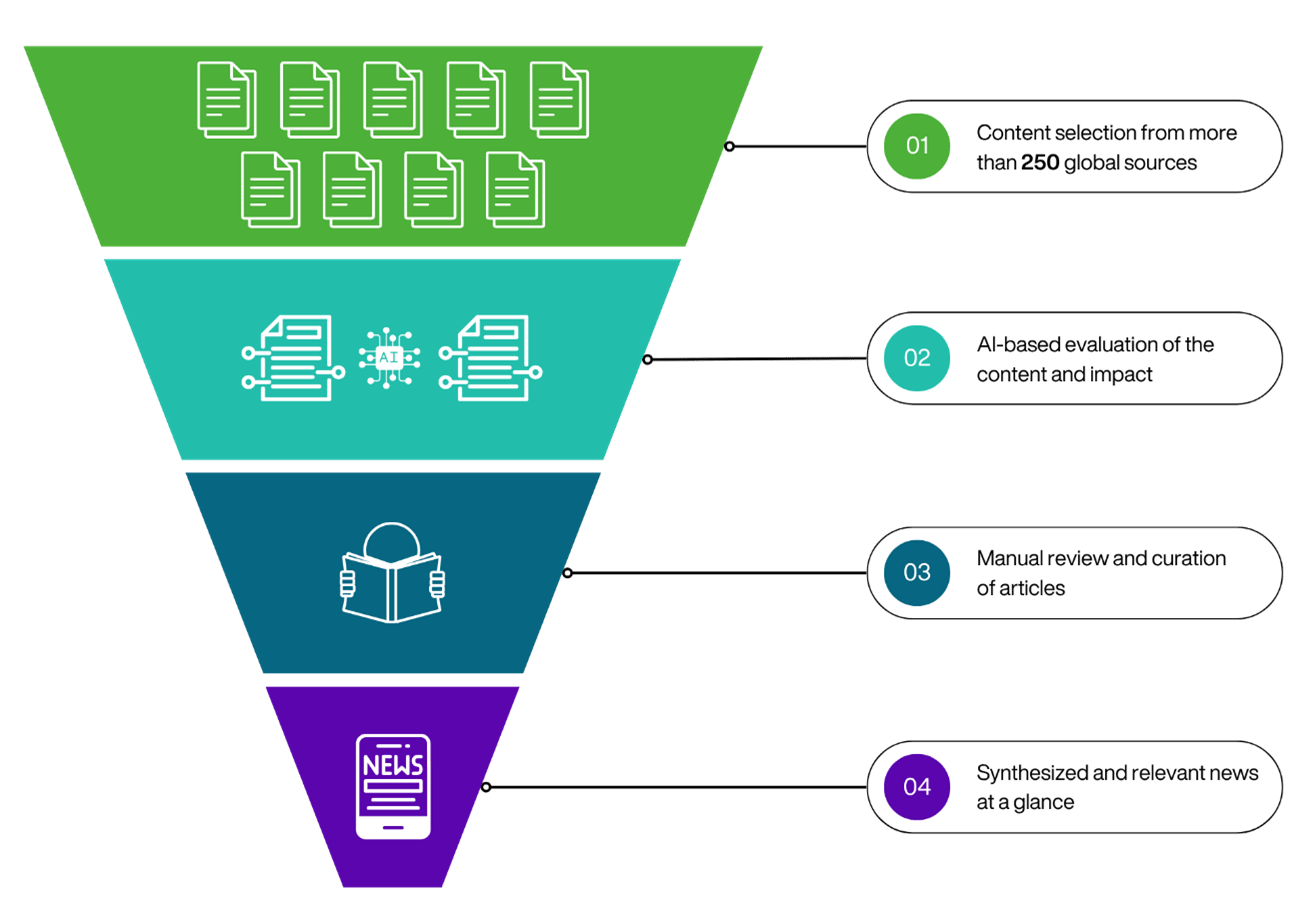
Our process is designed to be both scalable and selective. A broad network of over 250 global sources is continuously screened using six different AI tools. These tools help surface relevant content, which is then passed through a multi-step filtering and evaluation process that emphasizes innovation and impact.
In the final stage, selected articles are reviewed and curated by our team before being published. The result is a dynamic, well-structured view of what truly matters in the digital health ecosystem. This way you always stay ahead of the curve.