DIGI-HEALTH MONITOR Calendar Week 38, 2025
DIGI-HEALTH MONITOR: Calendar Week 38, 2025
Training doctors for the digital age: Study charts new course for health education
Canadian researchers from the British Columbia Institute of Technology and University of Calgary are calling for a revamp of health professional education to prepare the workforce for a digital health era. Using the Quintuple Aim framework (expanding on the Triple Aim to include provider well-being and health equity), their study highlights that current training is fragmented and leaves new doctors underprepared for tools like telehealth, electronic records, data analytics, and AI-driven decision support. They propose core digital competencies become standard in medical and nursing curricula, including digital literacy, data privacy and security awareness, patient-centered technology design, data-driven decision-making, and ensuring digital tools address health disparities. To make these skills tangible, the authors suggest practical assessments using simulations, hackathons, or project-based learning focused on real-world digital health challenges. They also stress that programs should be adaptable to rapidly evolving tech trends and regional needs (recognizing that resources and priorities differ by location). Collaboration among educators, healthcare organizations, and technology developers is urged to keep curricula up-to-date. By aligning training with the Quintuple Aim goals (better patient experience, improved population health, cost reduction, provider well-being, and equity), the study envisions a future workforce that can seamlessly integrate digital innovations into patient care. Implementing these educational reforms could not only reduce technology-related errors and inefficiencies but also improve healthcare outcomes for diverse populations, ensuring that digital transformation in healthcare is both effective and inclusive.
The Federal Ministry of Health, UNICEF, launch digital innovations to strengthen health services in Sudan
In Port Sudan, the Federal Ministry of Health and UNICEF have unveiled three new digital applications designed to shore up collapsing health services amid the country’s crisis. Deployed across over 400 health facilities, these innovations will assist 3,000 health workers and reach an estimated 500,000 children and mothers in need. The suite includes “Care Connect” for secure communication among healthcare teams, “IConnect” for telehealth consultations integrated with electronic health records, and “ZAMW” for AI-enhanced medical education and training of staff. Amid conflict that has damaged a third of Sudan’s clinics and fueled outbreaks of disease (like cholera), these tools enable real-time coordination, remote patient care, and ongoing skills development even in hard-hit regions. Part of the World Bank-funded SHARE project, the initiative is a lifeline for maternal and child health services in areas with little infrastructure. Officials emphasize that security and scalability are top priorities to ensure trust in the digital systems. Dr. Heitham M. Awadalla of Sudan’s health ministry hailed the apps’ role in system resilience, while UNICEF’s representative called them “lifelines” for communities with shattered access. This launch not only demonstrates the power of digital solutions in humanitarian crises but could also serve as a model for how technology can sustain healthcare delivery in other conflict or disaster zones by improving frontline efficiency and equitable access to care despite extreme challenges.
Remote Monitoring Improves Recovery from Cancer Surgery
A new study, published in npj Digital Medicine, has demonstrated that a remote perioperative monitoring (RPM) program can significantly enhance the recovery of cancer surgery patients. The randomized trial compared the outcomes of patients who used wristband accelerometers and a mobile app to report symptoms with those who received standard post-operative care. Patients in the RPM group had a 6% greater functional recovery rate by day 14 after surgery and experienced fewer major complications. The technology’s primary value was in providing actionable data: when patient metrics deviated from preset thresholds, triage nurses were alerted to intervene early. According to Dr. Tracy Crane, a co-author of the study, it’s this human response to the data — a “human-in-the-loop” model — that truly makes the difference, highlighting the importance of combining digital tools with attentive clinical follow-up. The study’s design, which included both English and Spanish-speaking participants using their own devices, aimed to reflect real-world conditions and ensure broad applicability. The findings validate how integrating patient-generated health data and remote monitoring into standard care can bridge the gap between hospital and home, catching issues sooner and supporting patients through recovery to improve outcomes.
Samsung Medical Center Develops AI Model to Predict Lung Cancer Recurrence
Samsung Medical Center in South Korea has unveiled an AI-powered predictive model called RADAR CARE, capable of forecasting the recurrence risk of early-stage non-small cell lung cancer (NSCLC) up to a year in advance. Trained on a massive dataset of over 14,000 surgical cases, the transformer-based model integrates multimodal data sources such as imaging, pathology, and clinical demographics to produce individualized risk profiles. Unlike conventional cancer staging, which groups patients by broad categories, RADAR CARE stratifies them into dynamic low, intermediate, and high-risk tiers, uncovering recurrence likelihoods that vary even within the same stage. In validation studies, some stage I patients identified as high-risk by the model showed greater recurrence probabilities than certain stage III patients categorized as low-risk. This tool is now being piloted in clinical practice to guide follow-up intensity and personalize post-surgery treatment plans. It has the potential to transform oncology care by enabling earlier interventions, more tailored surveillance, and informed, patient-specific therapy adjustments to improve long-term outcomes.
Telemedicine without borders? ECJ creates new scope
A major legal decision by the European Court of Justice in September 2025 is recasting the telemedicine landscape across the EU. By clarifying that virtual medical services are governed by the provider’s jurisdiction, the decision removes cross-border regulatory barriers for digital consultations and virtual treatments. This shift paves the way for international telehealth platforms, allowing patients from different EU states improved access to specialized care previously obstructed by local licensure or reimbursement rules. The article emphasizes the broader strategic implications for health systems, such as streamlined EU-wide telehealth integration, regulatory harmonization, and the enabling of innovation in both public and private sectors. The move is poised to boost competition, foster technology-led partnerships, and provide a model for health system transformation in other regions seeking to modernize their digital health strategies.
The Global Digi-Health Monitor is our weekly published newsletter featuring curated updates on the latest developments in digital health. With a focus on innovation and relevance, it brings together key news across topics such as AI in healthcare, wearables, telemedicine, cybersecurity, and more.
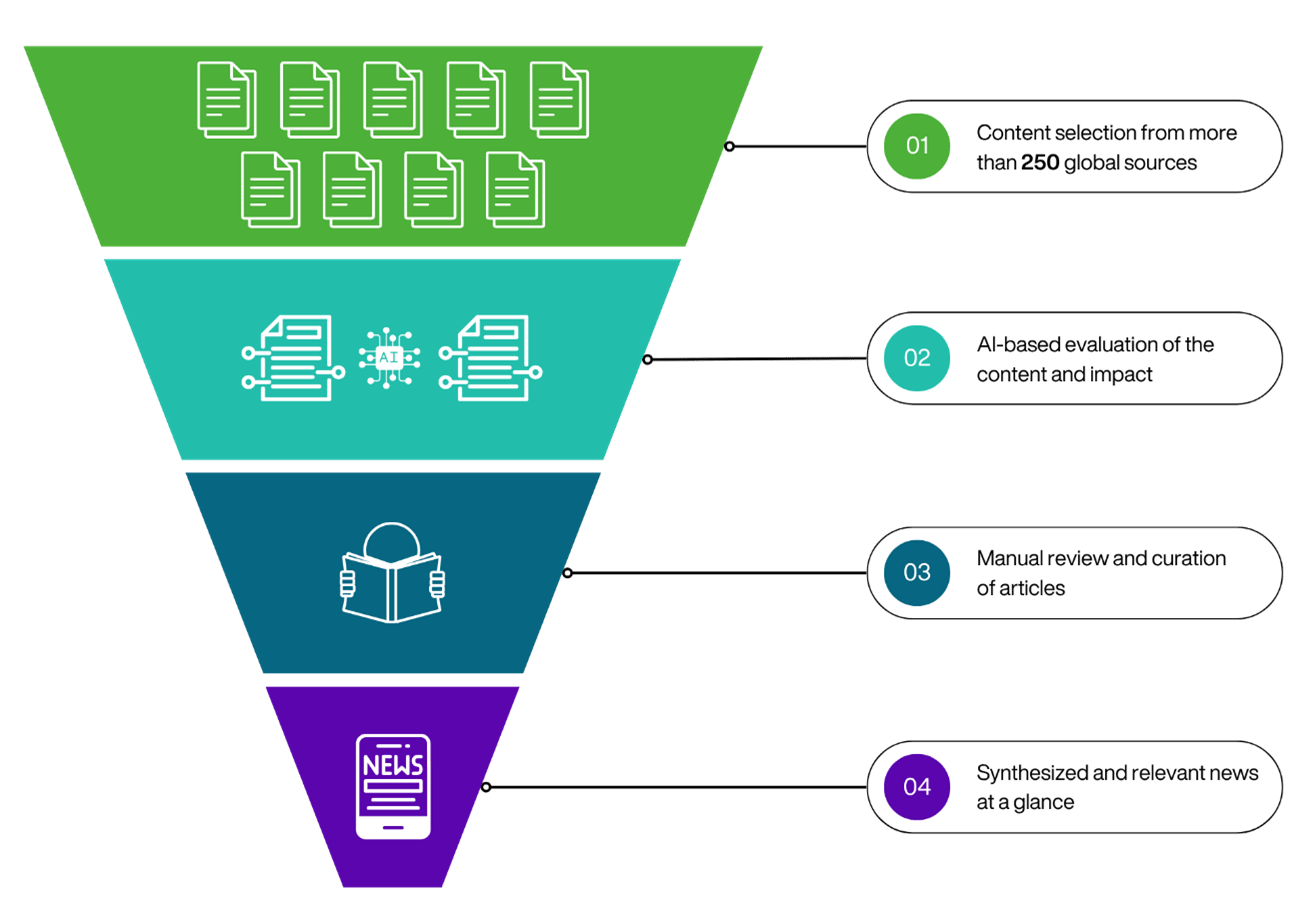
Our process is designed to be both scalable and selective. A broad network of over 250 global sources is continuously screened using six different AI tools. These tools help surface relevant content, which is then passed through a multi-step filtering and evaluation process that emphasizes innovation and impact.
In the final stage, selected articles are reviewed and curated by our team before being published. The result is a dynamic, well-structured view of what truly matters in the digital health ecosystem. This way you always stay ahead of the curve.