DIGI-HEALTH MONITOR Calendar Week 37, 2025
DIGI-HEALTH MONITOR: Calendar Week 37, 2025
The Telehealth Policy Cliff: Preparing for October 1, 2025
A critical deadline looms for the U.S. healthcare industry, with key telehealth flexibilities set to expire on September 30, 2025, unless Congress takes action. This impending “telehealth policy cliff” could reverse significant gains in patient access and care innovation that were established during the COVID-19 public health emergency. The article, created by the National Consortium of Telehealth Resource Centers, advises healthcare providers and organizations to prepare for a likely return to pre-pandemic regulations. Without an extension, previous geographic restrictions will resume, preventing Medicare reimbursement for most telehealth services provided in patients’ homes. It would also disrupt programs like the Hospital at Home initiative and remove telehealth eligibility for various healthcare professionals, including physical therapists and audiologists. While the DEA has separately extended flexibilities for prescribing controlled substances via telehealth, the article warns that lack of Medicare reimbursement could still make many virtual services unsustainable. A detailed checklist is provided for contingency planning, urging providers to assess financial risk, determine the impact on their patients, and prepare clear communication plans for staff and patients. It differentiates specific affected segments (FQHCs, RHCs, audio-only services, etc.) and emphasizes that retroactive billing may not be possible if services continue without coverage. The overall tone is one of urgency, highlighting the need for legislative action or robust backup plans to avoid sudden loss of telehealth access for patients nationwide.
Eli Lilly launches “TuneLab,” an AI/ML drug-discovery platform
Eli Lilly is opening up part of its multi-billion-dollar, decades-long R&D dataset to biotech partners through “TuneLab,” a new AI/ML platform designed for drug discovery and optimization. The initiative makes predictive models—trained on Lilly’s proprietary, high-quality experimental data—accessible to smaller companies. In return, new findings flow back into the platform, creating a continuously learning ecosystem. Early partners such as Circle Pharma and insitro signal that this is more than a PR exercise, with concrete oncology and small-molecule discovery programs underway. Systemically, the move breaks down data silos between Big Pharma and startups, shifting development cycles toward in-silico design, faster toxicity screenings, and reduced reliance on animal testing—aligning with regulatory efforts to streamline preclinical phases. From a market perspective, TuneLab could significantly lower barriers to high-end AI discovery models and expand therapeutic pipelines, while raising questions about IP allocation, bias control, and prospective validation. Overall, it represents a highly novel and innovative step with major potential system-wide impact.
University Hospitals and Hippocratic AI collaborate to advance patient outcomes through safe, patient‑facing AI
University Hospitals (UH), a nationally recognized U.S. academic health system, has entered a strategic collaboration with Hippocratic AI, a startup known for its safe generative AI healthcare agents. This partnership aims to enhance patient outcomes by deploying voice-based AI agents for a range of non-diagnostic, patient-facing tasks. In an initial pilot focused on pharmacy-related queries and needs, the AI agents demonstrated promising results, which has encouraged broader planned applications. Future use cases include conducting preventative screening calls, providing patient education on chronic disease management, and handling routine appointment scheduling or follow-up reminders. By offering round-the-clock, compassionate conversational support, these AI agents are designed to close communication gaps between visits – keeping patients more informed, adherent to their care plans, and more likely to seek help at early signs of trouble. The initiative aligns with UH’s strategy of responsibly integrating AI: all interactions are carefully monitored and the AI’s advice is constrained to non-diagnostic realms, preserving the clinician-patient relationship and ensuring patient safety. Hippocratic AI’s platform underwent a rigorous safety certification process, including evaluations by physicians and nurses and extensive scenario testing with partner health systems, to ensure its responses meet high standards for accuracy and empathy. The collaboration exemplifies how health systems can innovate with AI to support clinical staff by automating routine communications and triage, thereby allowing clinicians to practice at the top of their license and dedicate more time to complex patient care.
Medical Device Security Market to Hit USD 15.02 Billion by 2032, Driven by Increasing Healthcare Cyber-attacks
Cybersecurity is no longer a secondary concern but a foundational pillar of modern healthcare infrastructure. This market analysis report details the aggressive growth trajectory of the medical device security sector, propelled by an alarming rise in sophisticated cyber-attacks targeting connected health ecosystems. The report delves into core market drivers, identifying the exponential expansion of the Internet of Medical Things (IoMT) as a primary factor that both enables advanced patient care and creates critical vulnerabilities. It moves beyond mere statistics to explain strategic shifts in how security is implemented, highlighting the pivotal role of AI and machine learning in proactive threat hunting and real-time anomaly detection within network traffic. The competitive landscape is explored, with segmentation by deployment mode indicating a strong industry pivot toward cloud-based security solutions for their agility and scalability. This underscores a broader transformation where cybersecurity becomes directly integrated into the design and lifecycle management of medical devices, a necessity reinforced by evolving regulatory frameworks worldwide (such as stricter EU MDR and FDA guidelines for device cybersecurity). The potential large-scale impact is clear: securing this sector is essential to protect patient safety, ensure the operational continuity of healthcare providers, and safeguard sensitive health data on an unprecedented scale as digital health adoption accelerates.
Oracle launches an AI Center of Excellence for Healthcare
Oracle has announced the creation of a new AI Center of Excellence for Healthcare, a centralized resource designed to help health systems and hospitals effectively deploy and optimize artificial intelligence across their organizations. Launched at Oracle Health’s annual summit, the center provides a blend of deep technical knowledge and strategic insight, supported by a dedicated team of Oracle experts. Its mission is to assist healthcare clients in building secure cloud environments for AI experimentation, accelerating change management, and scaling successful AI pilots into enterprise-wide solutions. Through this hub, Oracle will guide customers in operationalizing AI agents (such as chatbots or clinical decision support tools) and ensure that implementations align with best practices in data governance and compliance with critical regulations like HIPAA for privacy and protections around personally identifiable information (PII). According to Oracle’s Executive VP of Health, Seema Verma, the center is intended to help healthcare organizations enhance patient care, streamline complex workflows, and enable deeper research insights by tapping into advanced AI capabilities. It will also promote cross-collaboration by giving clients access to Oracle partners and sharing lessons learned from peer institutions. By establishing this center of excellence, Oracle signals a strategic investment in its healthcare clientele’s AI success — aiming to demystify AI adoption and drive innovation in clinical, operational, and financial workflows through a supportive, knowledge-rich network.
The Global Digi-Health Monitor is our weekly published newsletter featuring curated updates on the latest developments in digital health. With a focus on innovation and relevance, it brings together key news across topics such as AI in healthcare, wearables, telemedicine, cybersecurity, and more.
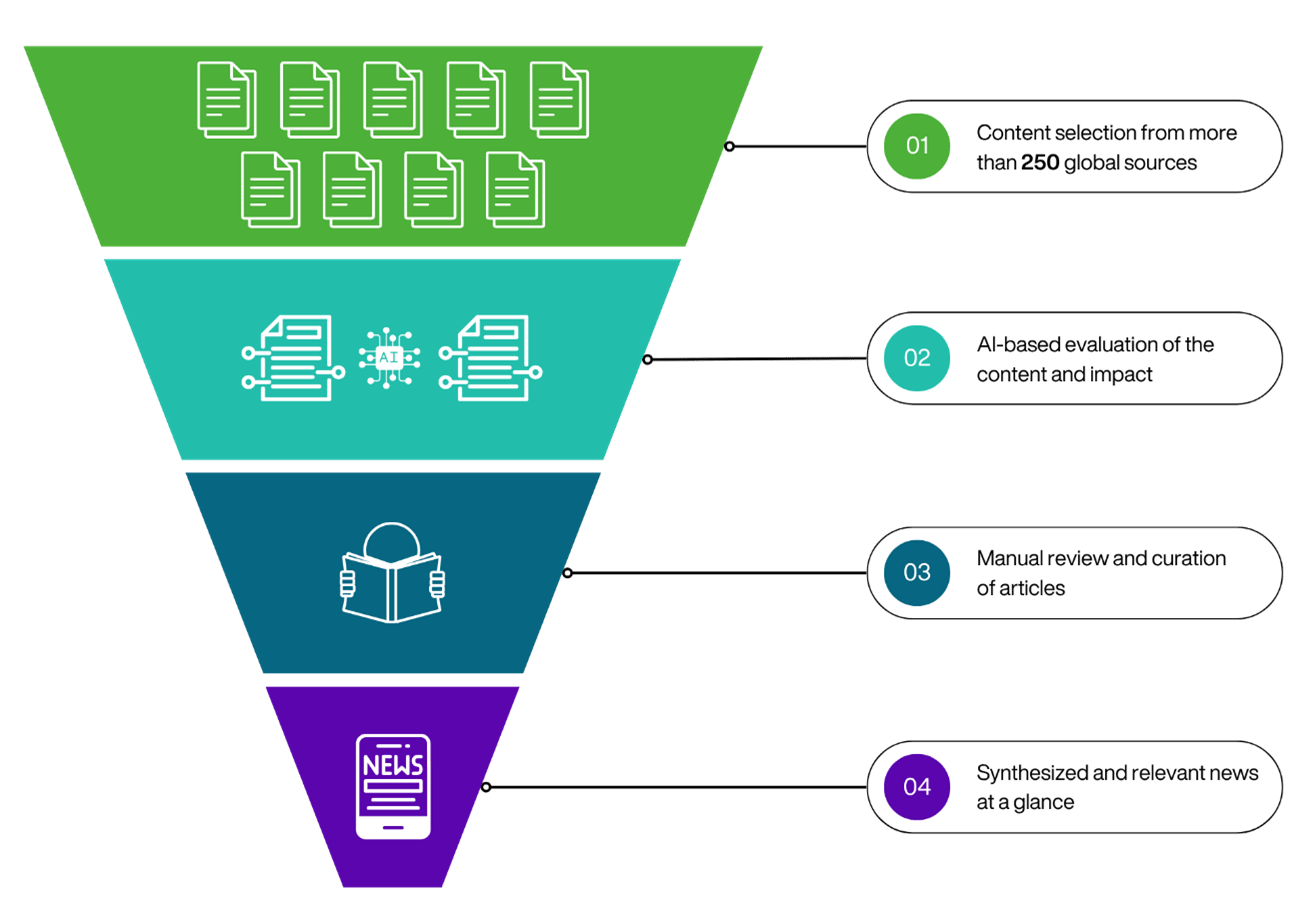
Our process is designed to be both scalable and selective. A broad network of over 250 global sources is continuously screened using six different AI tools. These tools help surface relevant content, which is then passed through a multi-step filtering and evaluation process that emphasizes innovation and impact.
In the final stage, selected articles are reviewed and curated by our team before being published. The result is a dynamic, well-structured view of what truly matters in the digital health ecosystem. This way you always stay ahead of the curve.