DIGI-HEALTH MONITOR Calendar Week 35, 2025
DIGI-HEALTH MONITOR: Calendar Week 35, 2025
FDA Launches Regulatory Accelerator for Digital Health Devices
The FDA has introduced a Regulatory Accelerator initiative, managed by the Center for Devices and Radiological Health (CDRH), to streamline the development and approval of digital health devices. The program is designed to reduce barriers for innovators and improve clarity around regulatory expectations. A key feature is the Resource Index, a visual guide that consolidates tools, guidances, and engagement opportunities such as webinars to support developers throughout design and review. The initiative also offers Orientation Meetings, giving innovators direct access to FDA experts to clarify submission requirements and processes before moving forward. Complementing these resources is the Medical Device Software Guidance Navigator, which helps developers identify the most relevant guidances and align them with the FDA’s eSTAR electronic submission system. Together, these resources aim to reduce uncertainty, accelerate review timelines, and encourage safe innovation. By simplifying pathways to approval, the Accelerator could enable faster access to cutting-edge digital health technologies while safeguarding patient outcomes.
Shadow AI: A growing risk for hospitals
Healthcare’s increasing use of AI comes with hidden dangers, as highlighted by a recent industry report on “shadow AI” posing cybersecurity risks to hospitals. The IBM-sponsored report found that the healthcare sector suffers the costliest data breaches of any industry (average breach cost $7.42 million) and pointed to a rise in breaches caused by employees’ unapproved use of AI tools. So-called shadow AI occurs when staff utilize AI chatbots or cloud services without their employer’s authorization – for example, inputting patient data into an online AI system – inadvertently exposing sensitive information. In fact, 1 in 5 organizations surveyed had experienced a breach linked to shadow AI, and such incidents were significantly more damaging financially – adding an estimated $670,000 in costs per breach on average. These “innocent” uses of AI can lead to sprawling data leaks, since information pasted into external AI models may be retained and later revealed. Security experts urge healthcare systems to establish strict policies and training to prevent unauthorized AI use. Limor Kessem, IBM’s cyber crisis lead, advises hospitals to provide approved AI tools for employees and to clearly communicate which AI applications are allowed or forbidden, in order to curb this growing risk. Without proactive governance, the convenience of generative AI could continue to invite costly breaches and privacy violations in healthcare settings.
Global Big Data in Healthcare Market is Predicted to Cross the USD 330 Billion Mark by 2032
This market analysis report provides a macro-level view of the immense financial and strategic forces shaping the future of healthcare. Projecting a market value exceeding USD 330 billion by 2032 underscores that big data analytics is no longer a niche field but a fundamental component of modern healthcare infrastructure. The growth is driven by critical industry needs: managing the deluge of data from electronic health records (EHRs) and digital health solutions, improving risk assessment for populations, and enabling earlier, more personalized treatment strategies. The report’s depth comes from identifying key players like IBM, Microsoft, and Oracle, and highlighting real-world strategic movements, such as the Databricks-Synapxe partnership to bolster Singapore’s national health data platform. This signifies a trend where robust data platforms are becoming a matter of public health and national competitiveness. The article effectively explains the system-level impact, illustrating how investment in data capabilities is directly linked to improving patient outcomes and operational efficiency on a global scale.
XRP Healthcare M&A Holding Inc. Launches Africa’s First HIPAA-Grade Digital Health App
A Dubai-based company has launched a groundbreaking digital health application for Africa that prioritizes patient data privacy alongside AI-driven care. XRP Healthcare’s “XRPH” app meets U.S. HIPAA standards, ensuring that all personal health information stays encrypted on the user’s own device and never uploads to any cloud or company server. This approach addresses data security concerns while bringing advanced e-health tools to underserved markets. Africa – home to 1.4 billion people – still sees over half of healthcare systems relying on paper records, but mobile connectivity is rising. By combining stringent privacy with artificial intelligence, XRPH aims to bridge gaps in healthcare access, literacy, and affordability across the continent. The app, launching first in Uganda, offers features like an on-device prescription scanner to log medications and an AI symptom checker that uses encrypted photos (e.g. of skin conditions or throat issues) to provide preliminary health guidance offline. It also supports multiple languages and voice interaction (speech-to-text and text-to-speech), overcoming literacy and language barriers. The founders tout this “Africa-first” innovation as a new gold standard for digital health, giving individuals control of their data while delivering modern telemedicine services. With plans to integrate into local hospital systems and expand via pharmacy clinics, XRPH could form the backbone of a scalable, privacy-centric health platform across Africa.
The Global Digi-Health Monitor is our weekly published newsletter featuring curated updates on the latest developments in digital health. With a focus on innovation and relevance, it brings together key news across topics such as AI in healthcare, wearables, telemedicine, cybersecurity, and more.
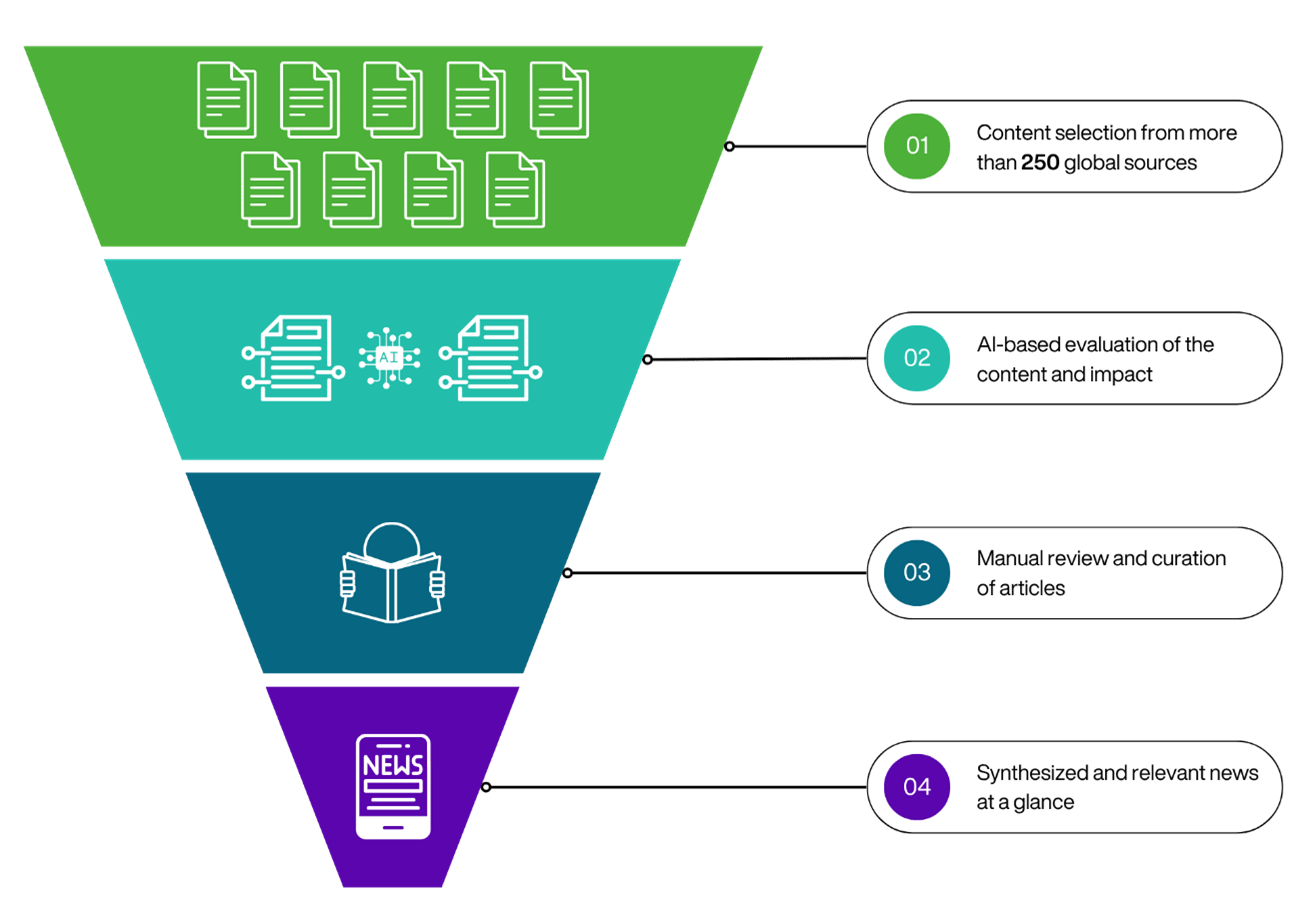
Our process is designed to be both scalable and selective. A broad network of over 250 global sources is continuously screened using six different AI tools. These tools help surface relevant content, which is then passed through a multi-step filtering and evaluation process that emphasizes innovation and impact.
In the final stage, selected articles are reviewed and curated by our team before being published. The result is a dynamic, well-structured view of what truly matters in the digital health ecosystem. This way you always stay ahead of the curve.