DIGI-HEALTH MONITOR Calendar Week 34, 2025
DIGI-HEALTH MONITOR: Calendar Week 34, 2025
New Study Warns: Routine AI Use May Affect Doctors’ Tumor Diagnostic Skills by 20%
A new study published in The Lancet Gastroenterology and Hepatology warns that routine reliance on AI may erode doctors’ diagnostic skills. Physicians who regularly used AI assistance during colonoscopy were 20 percent less accurate when the AI was removed. The findings suggest that over-reliance on algorithms can cause “deskilling,” as doctors unconsciously transfer responsibility for detection to the system. The article places this within a broader context, noting that similar patterns have been observed in education and other industries. It emphasizes the importance of designing AI as a supportive tool that augments rather than replaces human expertise. Suggested mitigation strategies include alternating between AI-assisted and manual practice and building training programs to maintain diagnostic sharpness. This cautionary perspective is crucial for healthcare leaders, reminding them that while AI can enhance efficiency, it must be implemented in ways that preserve the essential skills of clinicians.
7 Innovations Driving Big Data in Healthcare
This analysis explores seven ways big data is transforming healthcare, with applications spanning predictive analytics, precision medicine, workflow optimization, and population health management. Examples from leading institutions include Mayo Clinic’s use of genomic data to guide oncology care and Cleveland Clinic’s reliance on advanced analytics to reduce wait times and improve efficiency. The article also points to trends such as IoT integration, global health data spaces, and AI-enabled automation as shaping forces for the next decade. While somewhat promotional in tone, it links these innovations to broader systemic changes, presenting big data as the backbone of digital health ecosystems. By connecting case studies with high-level forecasts, it shows how healthcare is moving toward a model where vast datasets fuel personalized therapies, more equitable access, and improved resource management. The piece ultimately positions big data not just as a tool but as an essential infrastructure for future healthcare delivery worldwide.
AI Use Is Common Among Health Systems. Fleshed-Out Governance Is Not
A new survey of 233 U.S. health systems reveals a significant imbalance between AI adoption and governance. While nearly 90 percent of organizations report using AI tools in some capacity, only 18 percent have a comprehensive strategy in place. Most respondents acknowledged limited or ad-hoc governance structures, leaving gaps in oversight around vendor evaluation, risk mitigation, and ethical safeguards. The article frames this as a systemic vulnerability: the industry is moving quickly to deploy AI but without the frameworks needed to ensure safety and accountability. Experts emphasize that governance is not bureaucratic red tape but essential infrastructure for sustainable adoption. The lack of maturity in governance models highlights the need for standard-setting and education across the sector. By exposing this readiness gap, the article raises awareness of a pressing issue that will shape whether AI delivers its promised benefits or creates unintended risks.
7 Ways AI is Transforming Healthcare
The World Economic Forum provides a sweeping overview of how artificial intelligence is reshaping healthcare globally. Highlighted applications include AI systems that detect brain lesions too subtle for human radiologists, models that improve stroke and fracture diagnoses, and predictive tools that help ambulance crews anticipate hospital admissions. Beyond diagnostics, AI is being applied in early disease detection, administrative automation, integration with traditional practices such as Ayurveda, and clinical chatbots that provide decision support. The article underscores not only the efficiency and cost savings these technologies bring, but also their potential to improve access to care in underserved regions. It takes a balanced approach by stressing the importance of human oversight, robust regulatory frameworks, and ethically diverse data sources. This combination of real-world examples and strategic reflections paints AI as a critical driver for achieving universal health coverage and a sustainable, equitable healthcare future.
Wireless Sweat Patch for Cystic Fibrosis Care: Biomarker Monitoring at the Wrist
Northwestern Medicine researchers have developed a wireless sweat patch that could transform cystic fibrosis care. The flexible, wrist-worn device measures sweat chloride levels and transmits results to a smartphone in real time. Unlike traditional lab-based sweat tests, this wearable enables continuous, at-home monitoring. Clinical trials have shown that its readings match the accuracy of gold-standard tests, raising hopes for earlier detection of exacerbations and better management of CF therapies. The patch uses microfluidic channels and embedded electronics to capture biomarkers, while a smartphone camera interprets the results. Beyond clinical accuracy, the innovation represents a shift toward patient-centered care, allowing individuals to track their condition outside hospital settings. Although broader validation studies are pending, this technology could reduce clinic visits, enhance adherence, and support more proactive treatment. By merging wearable sensors with cloud connectivity, the sweat patch showcases how digital health can move diagnostics from episodic snapshots to continuous, personalized monitoring.
The Global Digi-Health Monitor is our weekly published newsletter featuring curated updates on the latest developments in digital health. With a focus on innovation and relevance, it brings together key news across topics such as AI in healthcare, wearables, telemedicine, cybersecurity, and more.
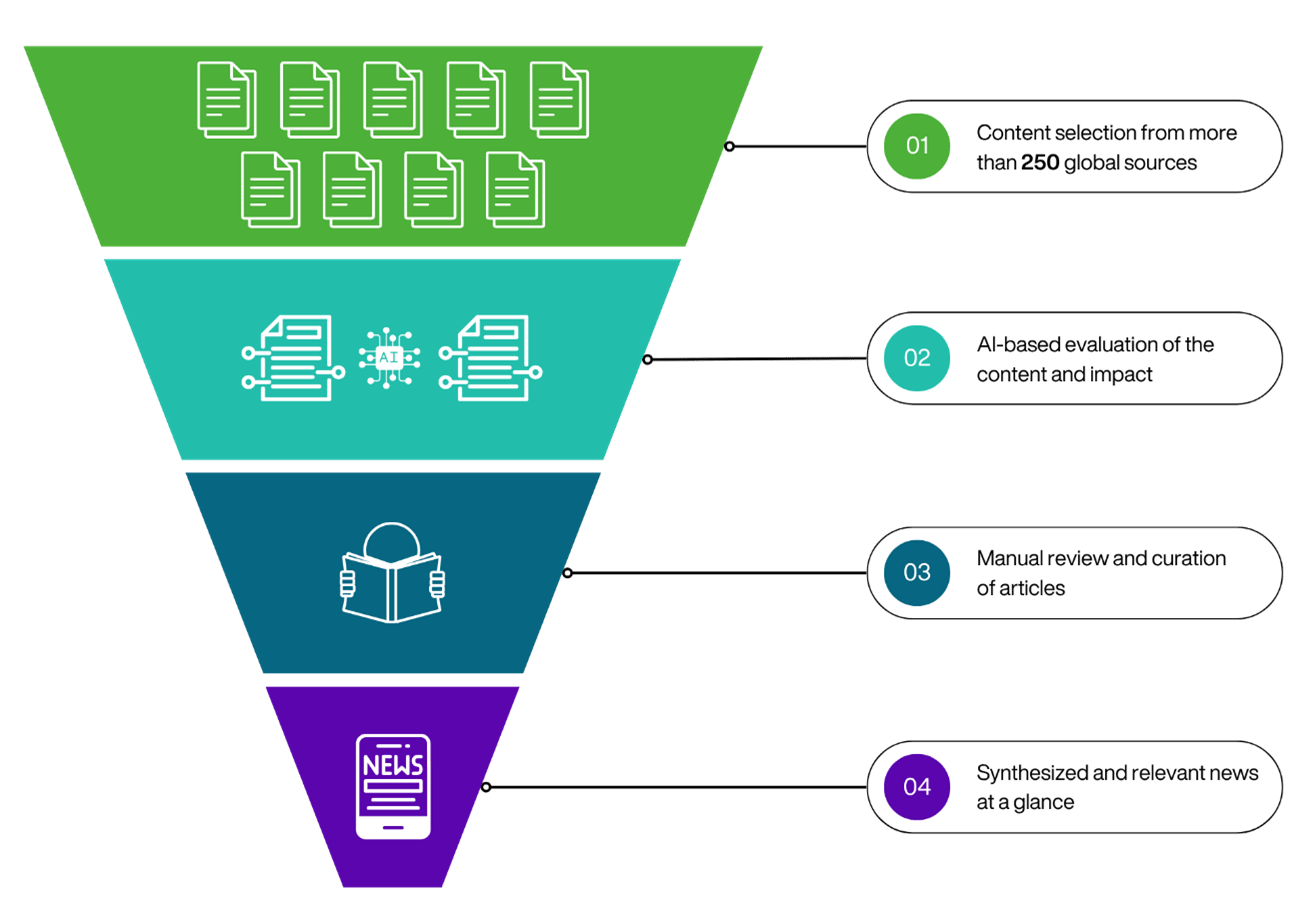
Our process is designed to be both scalable and selective. A broad network of over 250 global sources is continuously screened using six different AI tools. These tools help surface relevant content, which is then passed through a multi-step filtering and evaluation process that emphasizes innovation and impact.
In the final stage, selected articles are reviewed and curated by our team before being published. The result is a dynamic, well-structured view of what truly matters in the digital health ecosystem. This way you always stay ahead of the curve.