DIGI-HEALTH MONITOR Calendar Week 29, 2025
DIGI-HEALTH MONITOR: Calendar Week 29, 2025
First Study to Use Consumer Wearables to Predict Pediatric Surgery Complications
A pioneering study by Northwestern University and Shirley Ryan AbilityLab, published in July 2025, leverages Fitbits to predict complications in pediatric post-surgical patients. By analyzing circadian rhythm metrics, novel algorithms detect infection and recovery delays earlier than traditional methods, improving outcomes and reducing hospital readmissions. This first-of-its-kind use of consumer wearables in pediatric care empowers clinicians and parents to intervene proactively, addressing a critical gap in post-acute monitoring. Its affordability and accessibility suggest scalability, potentially transforming pediatric healthcare delivery. The study’s implications extend to broader remote monitoring applications, offering a cost-effective solution to enhance patient safety and care quality across health systems, particularly for vulnerable populations, with significant potential to influence clinical practices and reduce healthcare costs.
AI in Healthcare: What’s Working, What’s Not—And What Comes Next
Insights from a July 10, 2025, healthcare technology conference panel reveal AI’s current successes and challenges in clinical settings. Improved diagnostics and workflow efficiencies mark progress, but integration hurdles and ethical concerns persist. Industry leaders offer a forward-looking perspective on AI’s trajectory, blending real-world applications with strategic forecasts. This balanced view captures AI’s evolving role in enhancing patient care and system efficiency, making it a valuable resource for healthcare professionals. While not introducing groundbreaking tools, its focus on practical advancements and future directions highlights AI’s potential to address systemic issues, with moderate market impact as adoption grows and challenges are resolved.
Tomorrow’s Precision Therapeutics Depend on Precision Diagnostics
Precision therapeutics for cancer rely on computational pathology, as argued in this July 14, 2025, opinion piece by Leica Biosystems executives. Digital imaging and AI quantify biomarker expression with pixel-level precision, surpassing traditional pathology for therapies like antibody-drug conjugates. Fewer than 20% of clinical labs have adopted digital pathology due to infrastructure and validation barriers, yet its necessity for targeted treatments is clear. By enabling faster, more accurate diagnoses, computational pathology could reduce treatment times, minimize toxicities, and lower costs, transforming oncology care. The piece emphasizes systemic shifts needed to support precision medicine, offering strategic insights for healthcare systems aiming to integrate advanced diagnostics for improved patient outcomes and market competitiveness.
Samsung Acquires Xealth to Integrate Wearable Data with Hospital EHRs
Samsung’s acquisition of Xealth, announced on July 9, 2025, aims to integrate Galaxy Watch biometric data with hospital EHRs by late 2025, enabling hyper-personalized preventive care. This move bridges home-to-clinical data gaps, allowing clinicians to contextualize metrics like heart rate within medical histories. Navigating FDA certification and HIPAA compliance, Xealth’s platform centralizes fragmented data into systems like Epic, expanding Samsung’s provider network. This initiative signals a shift toward real-time remote monitoring, raising debates on privacy and data ownership. Its potential to influence reimbursement models for preventive care underscores its market impact, though integration challenges and regulatory hurdles must be addressed to fully realize its transformative potential in healthcare delivery systems.
Your Skin Is Breathing. This New Wearable Device Can Measure It.
Northwestern University’s breakthrough wearable sensor, unveiled in 2025, hovers above the skin to measure gaseous molecules like CO2 and volatile organic compounds, offering a novel approach to health monitoring. Unlike traditional wearables, its no-contact design safely assesses skin health in vulnerable patients, such as newborns or diabetics, by tracking wound healing, infections, and hydration levels. Early trials, published in Nature, confirm its efficacy, paving the way for noninvasive diagnostics in clinical settings. This technology builds on sweat sensors but captures continuously emitted skin vapors, enabling early detection of health issues before visible symptoms. Its potential to transform chronic disease management and hospital care highlights its innovation, with broad implications for personalized medicine and healthcare delivery, particularly for high-risk populations, if integrated into clinical workflows.
The Global Digi-Health Monitor is our weekly published newsletter featuring curated updates on the latest developments in digital health. With a focus on innovation and relevance, it brings together key news across topics such as AI in healthcare, wearables, telemedicine, cybersecurity, and more.
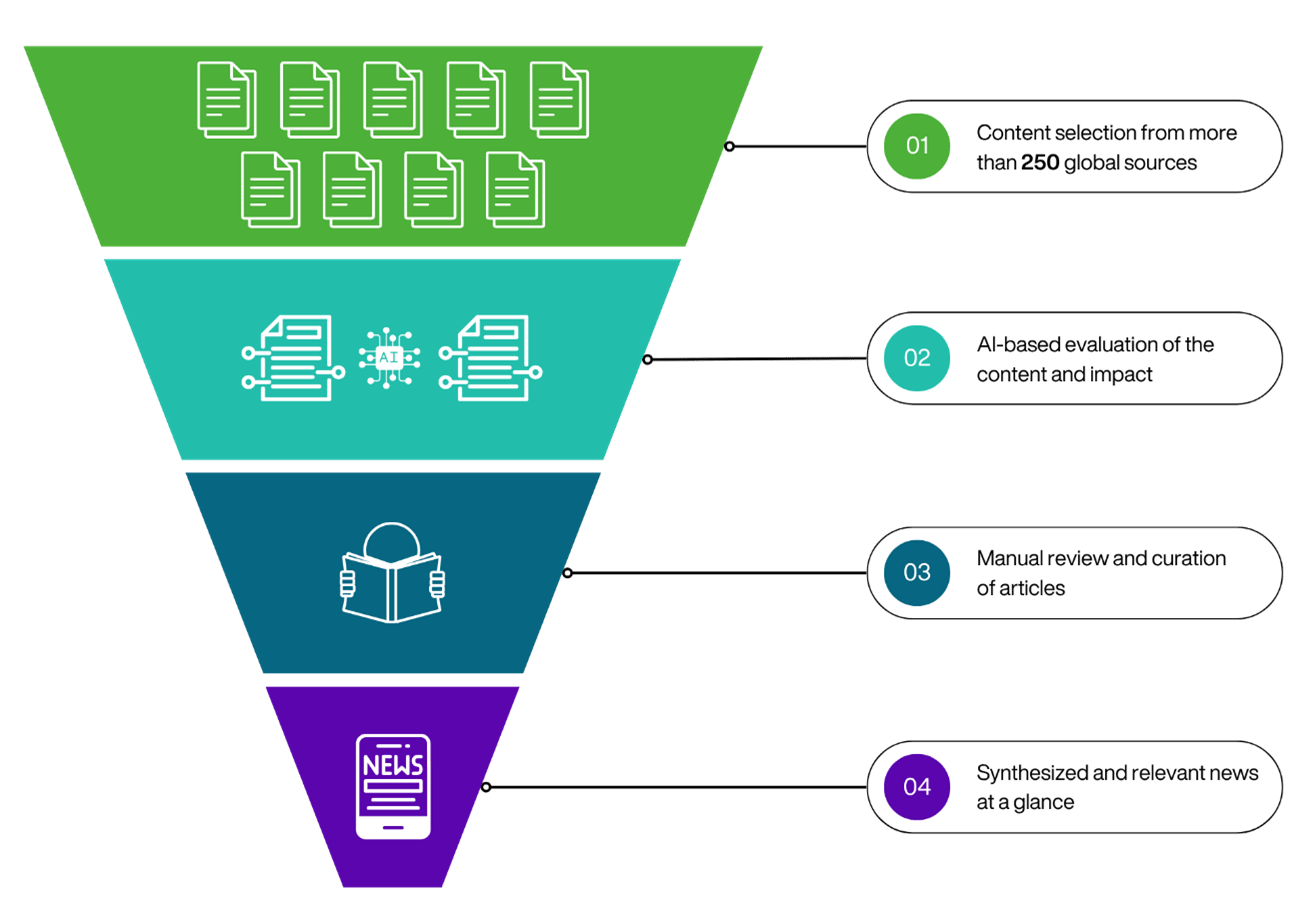
Our process is designed to be both scalable and selective. A broad network of over 250 global sources is continuously screened using six different AI tools. These tools help surface relevant content, which is then passed through a multi-step filtering and evaluation process that emphasizes innovation and impact.
In the final stage, selected articles are reviewed and curated by our team before being published. The result is a dynamic, well-structured view of what truly matters in the digital health ecosystem. This way you always stay ahead of the curve.