

DIGI-HEALTH MONITOR
DIGI-HEALTH MONITOR:
Calendar Week 38, 2026
This week’s spotlight article
Why good AI can still fail in the clinic
What happens when a clinic is built around AI from the ground up, rather than bolting the technology onto existing workflows? In Beijing, there is now a first honest answer.
At the Beijing Visual Science and Translational Eye Research Institute, researchers created the AI-TEC, an eye clinic in which artificial intelligence accompanies the entire journey, from preparation through the analysis of retinal scans to follow-up. Doctors retain the final decision and the contact with patients. The results were published in Nature Medicine (Yan et al., 2026).
The research team also lays open the setbacks. At first, the AI recognised conditions such as glaucoma and age-related macular degeneration only moderately reliably. Accuracy rose sharply only after experienced ophthalmologists contributed 1,426 carefully labelled images. This comparatively small but high-quality set of data achieved more than the original nearly 27,000 images of lower quality.
A problem also emerged in everyday use. After five months, the use of the AI tools had fallen to 3.8 percent of examinations. Staff avoided the technology because it required too many clicks and too much manual input. Only after the interface was simplified did usage climb back to 23 percent the following month.
What decides success is above all the quality of the data, the integration into everyday work, the involvement of the clinicians and a rapid response when something does not work. The raw performance score of the algorithm takes a back seat to these factors. A model that shines in testing but is avoided in practice does not change care.
And it is precisely this openness that makes the case so instructive. Other institutions can learn from it before making the same mistakes. It is also a reminder of what a clinical AI must be measured against. What matters is whether it is genuinely used day to day and whether it helps patients.
Other articles from this week
More hospitals are adopting AI, yet the access gap is proving hard to close
Drexel University researchers analysed 6,166 US hospitals across 3,143 counties, combining American Hospital Association technology data, CMS clinical care metrics, CDC mortality data and county socioeconomic indicators, to test whether specific AI and robotic capabilities track with time-sensitive care outcomes and whether access is geographically equitable. Particular workflow AI capabilities were associated with statistically significant differences, including a 5.4% relative decline in 30-day pneumonia mortality and a 2.24-percentage-point rise in sepsis bundle compliance linked to staff-scheduling AI. Access, however, is sharply uneven: roughly 114.6 million people lived more than a 30-minute drive from an AI-enabled hospital. Large, digitally mature systems adopt first while rural communities remain distant from AI- and robotics-enabled care. The analysis is observational and based on 2023 data, and the reporting keeps association and causation distinct throughout. Implications are policy-level: technology diffusion, infrastructure investment in underserved areas, and monitoring of access disparities as adoption accelerates. The work is independent academic research with no vendor involvement.
Web pathway expands cardiac rehab options for rural women
Cardiac Rehabilitation Especially for Women, developed by Flinders University’s Country Heart Attack Prevention project and co-designed with 19 rural South Australian women who had completed rehabilitation, was tested with 40 patients referred through South Australia’s integrated Cardiovascular Clinical Network between November 2023 and November 2024. The four-module web programme covers orientation, self-reported health assessment, guideline-based education and women-specific cardiovascular content, with streams for acute coronary syndromes, heart failure, arrhythmia and cardiothoracic surgery. Patients self-enrol and progress at their own pace on any device, and the programme sits alongside rather than replaces in-person or telephone rehabilitation. Published in Heart, Lung and Circulation, findings showed 82.5% of participants initiated rehabilitation versus 56.1% of 114 controls, and 60% completed versus 45.6%. Clinicians identified a workflow niche in the discharge-to-first-appointment gap, which can extend six weeks. The report states plainly that cardiovascular risk factors, exercise capacity, quality of life and longer-term behaviour change were not assessed, and that an adequately powered controlled trial is needed. Barriers included digital literacy, rural connectivity, staffing pressure and technical faults.
11 health systems reporting measurable AI ROI
Eleven named US health systems disclosed dollar figures attributed to AI and automation, ranging from $550,000 to $105 million. Penn Medicine has budgeted $105 million in AI benefits by fiscal 2028, with returns visible in radiation oncology contouring — automating work otherwise requiring a nationally scarce dosimetrist — and in clinical documentation. CommonSpirit Health reported over $100 million in fiscal 2025 value from 242 live applications, including reduced sepsis mortality and imaging scan times cut by up to half. Mount Sinai projects $50 million led by pressure-injury prevention and in-house malnutrition detection. UNC Health broke returns into ambient scribing, infusion scheduling, prior authorization and nursing retention; Providence cut observation length of stay 32% across 28 additional hospitals; Boston Children’s recovered about 60,000 hours; Tampa General attributed $40 million and a 25% diversion reduction to its command centre. Several figures are explicitly vendor-reported or projected rather than audited. The piece frames these systems as outliers, citing an April finding that only 4% of health systems have reached scaled implementation with measurable outcomes.
How telemedicine and AI-powered hospitals are enhancing BRICS healthcare cooperation
Chinese institutions have put nationwide telemedicine networks and remote robotic procedures into operation and are transferring elements of the model to BRICS partners. At Zhongshan Ophthalmic Center in Guangzhou, an ophthalmologist used a 5G-linked surgical console to guide a robotic arm in Urumqi, Xinjiang — roughly 4,200 km away — to perform a subretinal injection at micron-level precision, described as a clinical first. China’s National Health Commission states the telemedicine network now covers all cities and counties, with 70% of township health centres partnered with higher-level hospitals. At Ruijin Hospital in Shanghai, an AI pathology platform scans digital slides and flags potential lesions in seconds rather than roughly 40 minutes manually. Brazil’s first public smart hospital, an 800-bed facility within the University of São Paulo complex, is under construction on a $320 million New Development Bank loan for 2029 opening, incorporating 5G ambulances, AI-assisted triage and automated operations. Time savings are organization-reported; long-term outcomes for the newest remote procedures are not detailed. State-media sourcing warrants caution on framing.
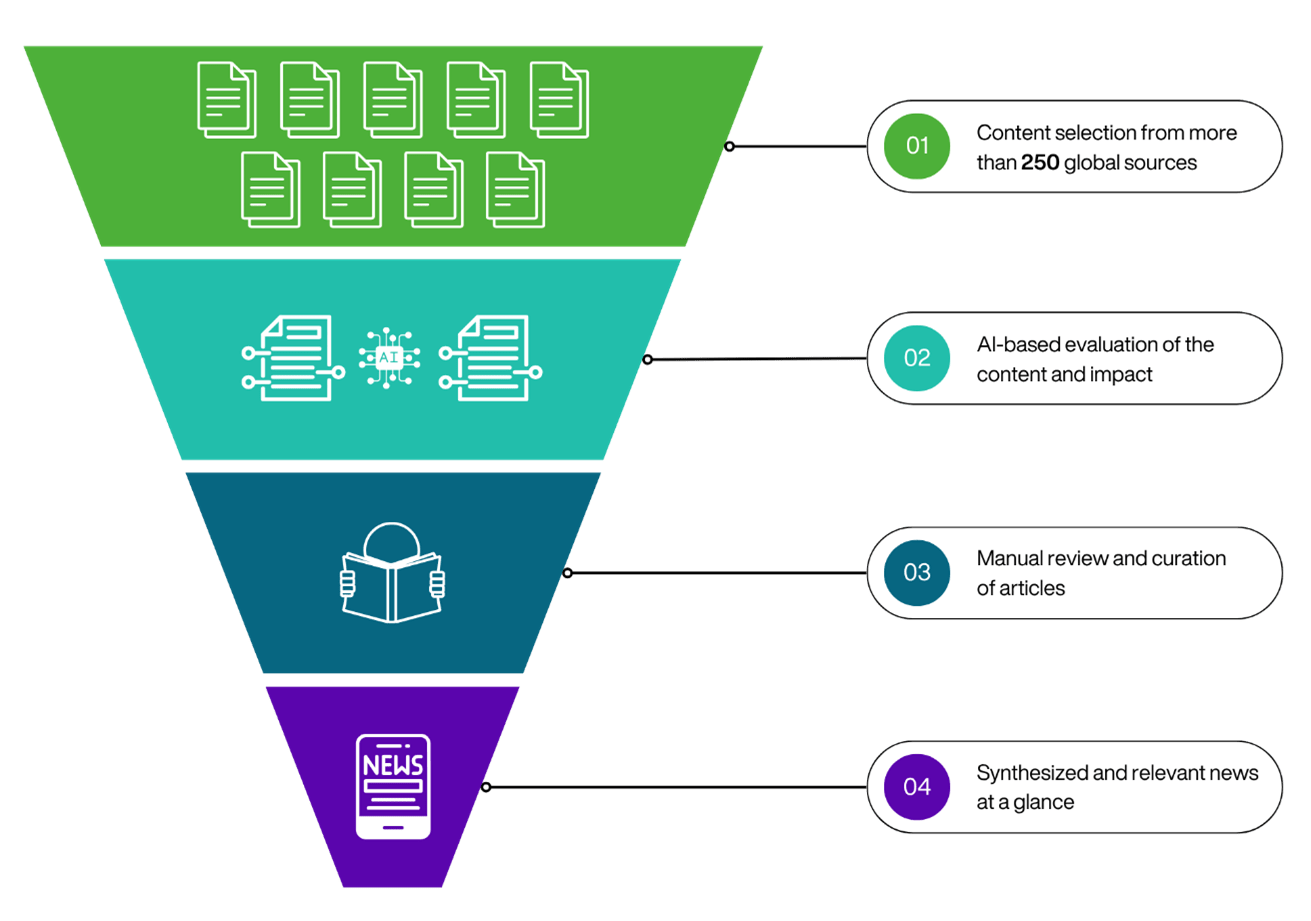
The Global Digi-Health Monitor is our weekly published newsletter featuring curated updates on the latest developments in digital health. With a focus on innovation and relevance, it brings together key news across topics such as AI in healthcare, wearables, telemedicine, cybersecurity, and more.
Our process is designed to be both scalable and selective. A broad network of over 250 global sources is continuously screened using six different AI tools. These tools help surface relevant content, which is then passed through a multi-step filtering and evaluation process that emphasizes innovation and impact.
In the final stage, selected articles are reviewed and curated by our team before being published. The result is a dynamic, well-structured view of what truly matters in the digital health ecosystem. This way you always stay ahead of the curve.
News from Previous Weeks
-

DIGI-HEALTH MONITOR Calendar Week 37
News-Summary
digital health news: AI detects sepsis earlier, dogs+AI screen for cancer, ransomware hits US hospital & ARPA-H builds autonomous cardio-AI.
-
DIGI-HEALTH MONITOR Calendar Week 36
News-Summary
Digital Health News: UPMC scales AI care, sepsis tech cuts mortality, ambient AI saves time, while hospitals race to secure AI.
-
DIGI-HEALTH MONITOR Calendar Week 35
News-Summary
Digital health news: AI moves deeper into care pathways, while cyberattacks, stroke robots and ambient scribes reshape healthcare’s risks and possibilities.
-
DIGI-HEALTH MONITOR Calendar Week 34
News-Summary
Digital health news: A hybrid surgical robot enters Europe, while AI governance, smarter hospital operations, image exchange and consumer diagnostics advance.
-
DIGI-HEALTH MONITOR Calendar Week 33
News-Summary
Digital health news: AI supports cancer prognosis, scales across Mayo Clinic, guides patient triage, and drones bring prescriptions directly to homes.
-
DIGI-HEALTH MONITOR Calendar Week 32
News-Summary
Digital health news: From physical AI to safer hospitals, smarter cancer care and AI documentation, this week shows how technology is reshaping care.
-
DIGI-HEALTH MONITOR Calendar Week 31
News-Summary
Digital health news: AI transforms cancer therapy, home care, hospital workflows, and telehealth, bringing smarter treatment and specialist access to more patients.
-
DIGI-HEALTH MONITOR Calendar Week 30
News-Summary
Digital health news: AI streamlines care with automation, triage and data integration, while human oversight and strong governance remain essential.
-
DIGI-HEALTH MONITOR Calendar Week 29
News-Summary
Digital health news: AI reads heart scans in seconds, smartwatches spot deterioration hours earlier, and hospitals scale ambient AI and virtual care.
Contact
E-Mail:
atlas-itg@uni-wh.deInnovation in Healthcare
Alfred-Herrhausen-Straße 50
58448 Witten, Germany