

DIGI-HEALTH MONITOR Calendar Week 37
DIGI-HEALTH MONITOR:
Calendar Week 37, 2026
This week’s spotlight article
Detecting sepsis in time, thanks to learning AIArtificial Intelligence (AI) implies the attempt to transfer human learning and thinking to computers. Computer systems are intended to solve problems—for which a human would require intelligence—using large datasets. In the field of radiology, for example, artificial intelligence can assist physicians in diagnosing findings and detecting abnormali… Explained in the video.
Many hospitals already warn of sepsis automatically. The problem is that these warnings are often too imprecise. Conventional, mostly rule-based systems frequently raise false alarms or trigger so late that the lead time gained is small. The result is a well-known fatigue among staff, who eventually stop reacting to the many signals.
This is the weak point a research project in Spain set out to address. At Hospital Universitario Son Llàtzer University Hospital in Palma de Mallorca, an AI-based early-warning system called BIAlert Sepsis replaces the rigid rule logic with a learning model. It was developed by the Balearic Islands Health Research Institute, the university hospital itself and the Instituto de Ingeniería del Conocimiento (IIC) (PLOS Global Public Health, 2026).
The system continuously analyses the data in the electronic health record, more than 70 clinical variables such as lab values, vital signs and demographic details, and updates its assessment every 30 minutes. From this it calculates the sepsis risk for the coming 24 hours. When it triggers, it also shows which values tipped the balance, so that the treating clinicians can put the warning in context and decide for themselves.
Whether this shift from rigid rules to a learning model actually makes a difference is shown by a peer-reviewed study of 8,039 patients. The period under the old rule-based system was compared with the period after the AIArtificial Intelligence (AI) implies the attempt to transfer human learning and thinking to computers. Computer systems are intended to solve problems—for which a human would require intelligence—using large datasets. In the field of radiology, for example, artificial intelligence can assist physicians in diagnosing findings and detecting abnormali… Explained in the video. was introduced. The share of sepsis patients who had to be admitted to intensive care fell from 34.4 to 30.4 percent. The average length of stay shortened by almost a day, and the cost per case dropped by around 1,900 euros.
Some context is needed. This is a before-and-after comparison over a long period, during which other things in care may also have changed. In sepsis, time is what matters most. A warning system that staff can trust again can help provide it.
Other articles from this week
Can dogs sniff cancer? AIArtificial Intelligence (AI) implies the attempt to transfer human learning and thinking to computers. Computer systems are intended to solve problems—for which a human would require intelligence—using large datasets. In the field of radiology, for example, artificial intelligence can assist physicians in diagnosing findings and detecting abnormali… Explained in the video. joins the hunt in India
A dog sniffs out cancer, and an AIArtificial Intelligence (AI) implies the attempt to transfer human learning and thinking to computers. Computer systems are intended to solve problems—for which a human would require intelligence—using large datasets. In the field of radiology, for example, artificial intelligence can assist physicians in diagnosing findings and detecting abnormali… Explained in the video. turns its reaction into data. In India, the startupA start-up is a recently founded company that has not yet established itself in the market, characterized by an innovative business idea, limited initial capital, and high growth potential. Due to the associated high risks, financing is often provided not through traditional banks but through development banks and innovative financing instruments,… Dognosis combines the extraordinary sense of smell of trained rescue dogs with sensors and machine learningMachine learning is an iterative process and is classified as a subcategory within the field of Artificial Intelligence. Algorithms are programmed to initially learn from datasets and can subsequently develop in a self-learning manner without further explicit intervention. Accordingly, predictions are generated by algorithms based on retrospectivel… Explained in the video. to build a non-invasive screening method. Patients breathe into a cotton mask for about ten minutes, which is then sealed and taken to a lab, where dogs fitted with 3D-printed helmets and sensor harnesses sniff the sample. As they react, AIArtificial Intelligence (AI) implies the attempt to transfer human learning and thinking to computers. Computer systems are intended to solve problems—for which a human would require intelligence—using large datasets. In the field of radiology, for example, artificial intelligence can assist physicians in diagnosing findings and detecting abnormali… Explained in the video. reads their brain activity, respiration and body language, translating a pause or a movement into structured data. A phase-2 study of more than 1,500 participants across six hospitals in Karnataka reports over 90 percent accuracy across seven major cancer types. Independent oncologists voice cautious optimism but stress that far larger studies are needed before any firm conclusions. A commercial launch is planned for 2027.
Cyberattack on Luminis Health Disrupts Maryland Hospital Operations, Reigniting Warnings About Rising Healthcare Ransomware Risk
A cyberattack paralyses parts of a hospital’s operations in Maryland. At Luminis Health, which runs Anne Arundel Medical Center, certain systems went down after an attack by an unauthorised criminal actor, disrupting some appointments and services, though the hospitals stayed open throughout. Days later, the health system was still working to restore affected systems. The case adds to a growing pattern of attacks on healthcare that experts trace back a decade, from MedStar in 2016 to Ascension in 2024. According to FBI data, healthcare was the single largest ransomware target among US critical-infrastructure sectors in 2025, with 460 of more than 2,100 reported attacks. Specialists stress that this is a patient-safety issue, not only a data-privacy one, because any downtime, from blocked records to delayed lab results, can put lives at risk. They urge better state-level readiness and coordination.
Proximie, AWS and Deloitte Launch NHS AIArtificial Intelligence (AI) implies the attempt to transfer human learning and thinking to computers. Computer systems are intended to solve problems—for which a human would require intelligence—using large datasets. In the field of radiology, for example, artificial intelligence can assist physicians in diagnosing findings and detecting abnormali… Explained in the video. Programme Across 104 Operating Theatres
Can AIArtificial Intelligence (AI) implies the attempt to transfer human learning and thinking to computers. Computer systems are intended to solve problems—for which a human would require intelligence—using large datasets. In the field of radiology, for example, artificial intelligence can assist physicians in diagnosing findings and detecting abnormali… Explained in the video. increase the number of operations without building a single new theatre? In England, the largest surgical AIArtificial Intelligence (AI) implies the attempt to transfer human learning and thinking to computers. Computer systems are intended to solve problems—for which a human would require intelligence—using large datasets. In the field of radiology, for example, artificial intelligence can assist physicians in diagnosing findings and detecting abnormali… Explained in the video. evaluation of its kind to date is now under way. Across eight NHS hospital sites, more than 104 operating theatres, endoscopy suites and catheterisation labs are being equipped with a system that captures surgical and operational data in the background, without disrupting clinical teams. The data is anonymised at source and then analysed to reveal bottlenecks and improve the flow between operations. The programme is expected to cover more than 20,000 procedures a year. Earlier deployments at other trusts suggested the potential for an additional case per day, with reports of an 8.2 percent increase in cases and a 30 percent reduction in turnover time. Results of the new, year-long programme are still pending and will be formally evaluated.
ARPA-H launches the world’s first bid to build FDA-authorized clinical AIArtificial Intelligence (AI) implies the attempt to transfer human learning and thinking to computers. Computer systems are intended to solve problems—for which a human would require intelligence—using large datasets. In the field of radiology, for example, artificial intelligence can assist physicians in diagnosing findings and detecting abnormali… Explained in the video. for cardiovascular care
Nearly half of all US counties have no cardiologist at all. A new programme by the US health research agency ARPA-H aims to change that by building the world’s first FDA-authorised, autonomous clinical AIArtificial Intelligence (AI) implies the attempt to transfer human learning and thinking to computers. Computer systems are intended to solve problems—for which a human would require intelligence—using large datasets. In the field of radiology, for example, artificial intelligence can assist physicians in diagnosing findings and detecting abnormali… Explained in the video. for cardiovascular care, intended to act around the clock as a digital member of the care team. Over four years and with up to 62.7 million dollars, patient-facing AIArtificial Intelligence (AI) implies the attempt to transfer human learning and thinking to computers. Computer systems are intended to solve problems—for which a human would require intelligence—using large datasets. In the field of radiology, for example, artificial intelligence can assist physicians in diagnosing findings and detecting abnormali… Explained in the video. agents are meant to support heart-failure patients between visits, assessing symptoms, adjusting medications, ordering labs and escalating to clinicians when needed, while a separate supervisory AIArtificial Intelligence (AI) implies the attempt to transfer human learning and thinking to computers. Computer systems are intended to solve problems—for which a human would require intelligence—using large datasets. In the field of radiology, for example, artificial intelligence can assist physicians in diagnosing findings and detecting abnormali… Explained in the video. monitors safety in real time. Duke University, Stanford University and the Johns Hopkins University Applied Physics Laboratory are among those involved, and the agency plans to work with the FDA on the regulatory framework throughout. The stated benefits remain intended goals, not yet demonstrated results.
The Global Digi-Health Monitor is our weekly published newsletter featuring curated updates on the latest developments in digital health. With a focus on innovation and relevance, it brings together key news across topics such as AIArtificial Intelligence (AI) implies the attempt to transfer human learning and thinking to computers. Computer systems are intended to solve problems—for which a human would require intelligence—using large datasets. In the field of radiology, for example, artificial intelligence can assist physicians in diagnosing findings and detecting abnormali… Explained in the video. in healthcare, wearables,Wearables refer to technologies in the form of sensors or mobile applications that collect health data asynchronously and beyond the boundaries of medical care. They include wristbands, smartwatches, and other mobile sensors. These measure and collect data such as blood glucose levels, pulse, or sleep data, and transmit this information either auto… telemedicine,Telemedicine encompasses various healthcare delivery concepts characterized by direct patient care across geographical distances or time delays. This includes diagnostic, therapeutic, rehabilitative, and consultative services delivered through information and communication technologies. Particularly with regard to rural areas, telemedicine offers s… Explained in the video. cybersecurity, and more.
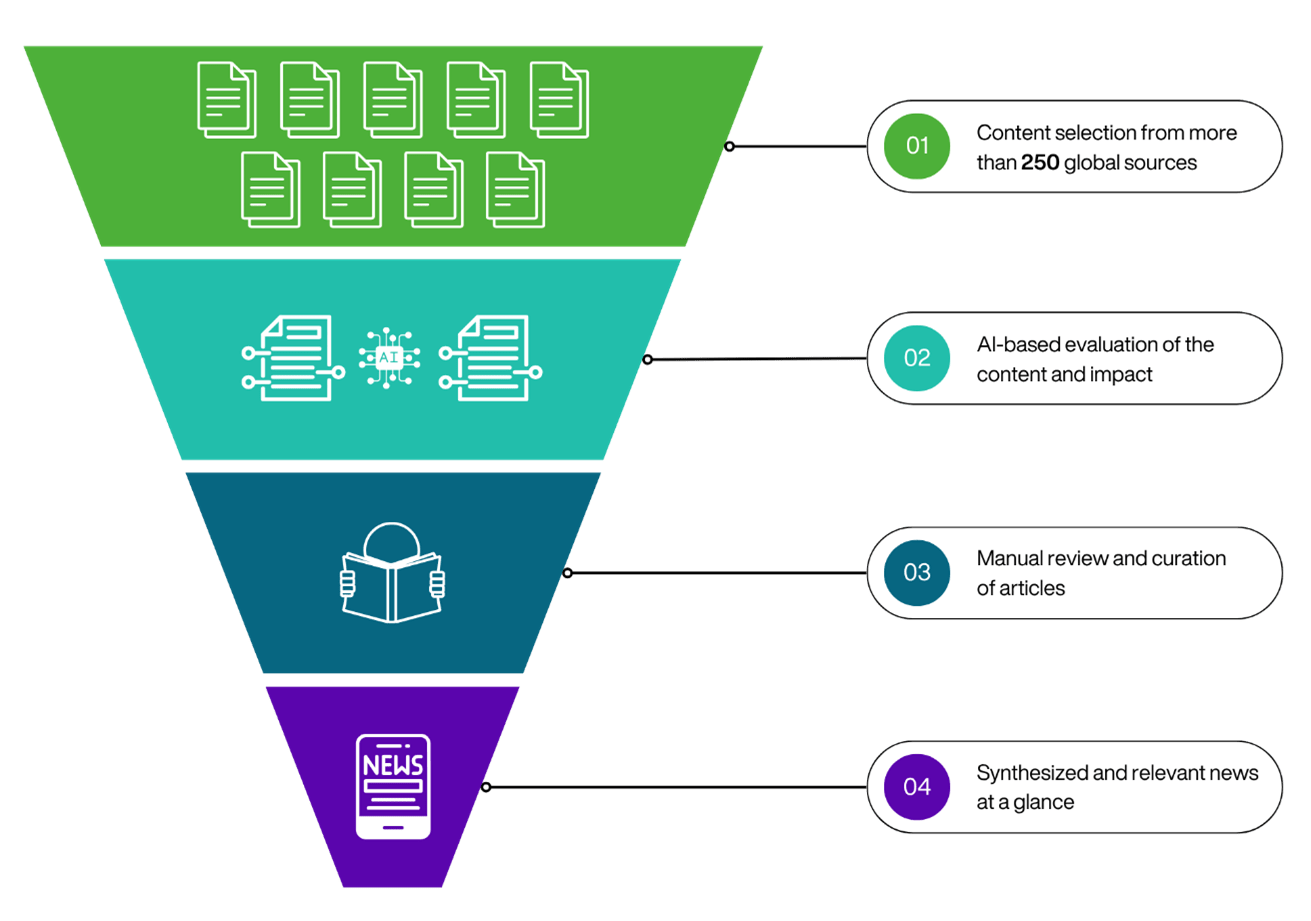
Our process is designed to be both scalable and selective. A broad network of over 250 global sources is continuously screened using six different AIArtificial Intelligence (AI) implies the attempt to transfer human learning and thinking to computers. Computer systems are intended to solve problems—for which a human would require intelligence—using large datasets. In the field of radiology, for example, artificial intelligence can assist physicians in diagnosing findings and detecting abnormali… Explained in the video. tools. These tools help surface relevant content, which is then passed through a multi-step filtering and evaluation process that emphasizes innovation and impact.
In the final stage, selected articles are reviewed and curated by our team before being published. The result is a dynamic, well-structured view of what truly matters in the digital health ecosystem. This way you always stay ahead of the curve.
Contact
E-Mail:
atlas-itg@uni-wh.deInnovation in Healthcare
Alfred-Herrhausen-Straße 50
58448 Witten, Germany