

DIGI-HEALTH MONITOR Calendar Week 36
DIGI-HEALTH MONITOR:
Calendar Week 36, 2026
This week’s spotlight article
UPMC Expands AI-Native Transitional Care Management Model to 18 Hospitals with Andor Health and Psynergy Health
UPMC is scaling an AI-native transitional care management program from a single-campus pilot at UPMC Jameson to 18 hospitals, with 10 already live, one launching on 1 September 2026, and seven more on 22 September 2026. The model leverages ThinkAndor’s agentic AIArtificial Intelligence (AI) implies the attempt to transfer human learning and thinking to computers. Computer systems are intended to solve problems—for which a human would require intelligence—using large datasets. In the field of radiology, for example, artificial intelligence can assist physicians in diagnosing findings and detecting abnormali… Explained in the video. infrastructure and Psynergy Health’s licensed clinical workforce to unify patient outreach, scheduling, clinical visits, EHR documentation, billing, and regulatory compliance.
Autonomous AIArtificial Intelligence (AI) implies the attempt to transfer human learning and thinking to computers. Computer systems are intended to solve problems—for which a human would require intelligence—using large datasets. In the field of radiology, for example, artificial intelligence can assist physicians in diagnosing findings and detecting abnormali… Explained in the video. agents contact 100% of enrolled discharged patients within 48 hours to conduct symptom screens, routing high-risk cases to live care coordinators. Pre-encounter chart synthesis aggregates EHRs, discharge notes, and remote telemetry, reducing non-clinical documentation time by 63% and filtering out 82% of non-actionable remote alerts. Automated day-15 check-ins catch emerging complications before escalation. Reported outcomes include a 180% increase in post-discharge follow-up completion rates and a 45% reduction in total cost of care, though these are organization- and partner-reported rather than independently validated.
The deployment addresses severe nursing shortages by eliminating manual dialing and voicemail logging, allowing care teams to focus on clinical interventions. Challenges include sustaining AIArtificial Intelligence (AI) implies the attempt to transfer human learning and thinking to computers. Computer systems are intended to solve problems—for which a human would require intelligence—using large datasets. In the field of radiology, for example, artificial intelligence can assist physicians in diagnosing findings and detecting abnormali… Explained in the video. governance, integrating with existing EHR workflows, and ensuring human oversight of AI-driven triage decisions. The clear expansion pathway from pilot to enterprise scale offers lessons for other health systems automating transitional care while maintaining clinical accountability.
Other articles from this week
Rapid sepsis technology associated with lower mortality and shorter hospital stays
FMOL Health reports three years of operational use of IntelliSep, a rapid test identifying sepsis risk in under ten minutes across emergency departments in Louisiana and Mississippi. Deployed at Our Lady of the Lake Regional Medical Center since April 2023, the technology triggered immediate treatment for nearly 1,000 high-risk patients waiting in ED queues. Reported outcomes across tens of thousands of at-risk patients include 24% lower mortality among sepsis patients, 19% lower mortality among those ultimately found not to have sepsis, 18% fewer blood cultures, 14% less antibiotic use, 12% more safe ED discharges, and nearly one day shorter hospital stays for high-risk patients, translating to 30,000 saved hospital days and nearly $25 million in cost savings. The implementation integrates into admission, testing, and monitoring workflows with nurses and physicians acting on the results. These outcomes were reported by the implementing health system, which co-developed the test with Cytovale and Louisiana State University, and lack comparison groups, adjustment methods, or independent validation, limiting causal inference. Key limitations include the absence of confidence intervals or controlled comparisons. Governance measures emphasize safety monitoring, particularly as FMOL begins studying inpatient deployment, where more detailed evaluation will be critical. The initiative directly addresses a major clinical problem—sepsis—with system-level financial and operational impact.
Ardent Health finds ambient AI’s value goes beyond ROIThe abbreviation ROI stands for Return on Investment, which literally translates to “return on the investment made” In business, the term refers to the rate of return on capital and is a metric used to determine the success of an investment. The standard formula is: ROI (%) = (net program benefit / program costs) × … Continued
Ardent Health deployed ambient AIArtificial Intelligence (AI) implies the attempt to transfer human learning and thinking to computers. Computer systems are intended to solve problems—for which a human would require intelligence—using large datasets. In the field of radiology, for example, artificial intelligence can assist physicians in diagnosing findings and detecting abnormali… Explained in the video. across a multi-state system, logging over one million patient encounters since September 2025, with more than 650 clinicians using the technology in approximately 87% of visits on a voluntary basis. Users report saving over three hours per week on documentation, with one Texas family physician achieving a 53% reduction. The health system calculated a roughly threefold return on investmentThe abbreviation ROI stands for Return on Investment, which literally translates to “return on the investment made” In business, the term refers to the rate of return on capital and is a metric used to determine the success of an investment. The standard formula is: ROI (%) = (net program benefit / program costs) × … Continued from time savings, improved documentation, and more complete coding, with hierarchical condition categories documented per visit increasing by 20%. Ardent emphasizes the software captures care actually delivered, not unsupported billable activity, and internal compliance reviews confirmed submitted codes were supported by documentation. A single Epic environment simplified scaling, while peer advocacy and framing the program as a burnout initiative drove adoption. Results are organization-reported with limited methodological detail, so financial and workforce effects should not be treated as independently established. Ardent recommends tracking voluntary use, after-hours EHR activity, note quality, coding accuracy, and provider satisfaction rather than relying on ROIThe abbreviation ROI stands for Return on Investment, which literally translates to “return on the investment made” In business, the term refers to the rate of return on capital and is a metric used to determine the success of an investment. The standard formula is: ROI (%) = (net program benefit / program costs) × … Continued alone. The deployment builds clinician trust for future AIArtificial Intelligence (AI) implies the attempt to transfer human learning and thinking to computers. Computer systems are intended to solve problems—for which a human would require intelligence—using large datasets. In the field of radiology, for example, artificial intelligence can assist physicians in diagnosing findings and detecting abnormali… Explained in the video. initiatives, addressing a critical workforce challenge in healthcare documentation.
Black Book Report Warns Hospital AIArtificial Intelligence (AI) implies the attempt to transfer human learning and thinking to computers. Computer systems are intended to solve problems—for which a human would require intelligence—using large datasets. In the field of radiology, for example, artificial intelligence can assist physicians in diagnosing findings and detecting abnormali… Explained in the video. Adoption Is Outpacing CybersecurityCybersecurity represents an extension of information security. It goes beyond the boundaries of traditional information security and encompasses, in addition to the protection of information resources, also the protection of other assets including the individual. In cybersecurity, the human factor gains an additional dimension: the person as a pote… Explained in the video. Controls
A September 2026 Black Book Research report warns that hospitals are deploying artificial intelligenceArtificial Intelligence (AI) implies the attempt to transfer human learning and thinking to computers. Computer systems are intended to solve problems—for which a human would require intelligence—using large datasets. In the field of radiology, for example, artificial intelligence can assist physicians in diagnosing findings and detecting abnormali… Explained in the video. faster than they are adapting identity controls, data-loss prevention, asset inventories, vendor oversight, and incident-response plans, creating new breach surfaces through 2027. The analysis identifies six layers where AIArtificial Intelligence (AI) implies the attempt to transfer human learning and thinking to computers. Computer systems are intended to solve problems—for which a human would require intelligence—using large datasets. In the field of radiology, for example, artificial intelligence can assist physicians in diagnosing findings and detecting abnormali… Explained in the video. introduces vulnerabilities: user prompts and uploaded content; models and AI-enabled applications; retrieval-augmented generation and knowledge stores; autonomous agents and connected tools; AIArtificial Intelligence (AI) implies the attempt to transfer human learning and thinking to computers. Computer systems are intended to solve problems—for which a human would require intelligence—using large datasets. In the field of radiology, for example, artificial intelligence can assist physicians in diagnosing findings and detecting abnormali… Explained in the video. vendors, models, plugins, and software dependencies; and cloud, API, notebook, and computing infrastructure. It recommends that no AIArtificial Intelligence (AI) implies the attempt to transfer human learning and thinking to computers. Computer systems are intended to solve problems—for which a human would require intelligence—using large datasets. In the field of radiology, for example, artificial intelligence can assist physicians in diagnosing findings and detecting abnormali… Explained in the video. agent receive broader privileges than the human role it supports, and that high-consequence actions such as medication administration, clinical orders, payments, identity changes, mass data exports, and software deployment remain subject to deterministic policy controls and human approval. The proposed Hospital AIArtificial Intelligence (AI) implies the attempt to transfer human learning and thinking to computers. Computer systems are intended to solve problems—for which a human would require intelligence—using large datasets. In the field of radiology, for example, artificial intelligence can assist physicians in diagnosing findings and detecting abnormali… Explained in the video. Security Control Plane outlines ten controls, including complete AIArtificial Intelligence (AI) implies the attempt to transfer human learning and thinking to computers. Computer systems are intended to solve problems—for which a human would require intelligence—using large datasets. In the field of radiology, for example, artificial intelligence can assist physicians in diagnosing findings and detecting abnormali… Explained in the video. asset inventories, documented data flows, least-privilege access, AIArtificial Intelligence (AI) implies the attempt to transfer human learning and thinking to computers. Computer systems are intended to solve problems—for which a human would require intelligence—using large datasets. In the field of radiology, for example, artificial intelligence can assist physicians in diagnosing findings and detecting abnormali… Explained in the video. gateways, data-loss prevention, adversarial testing, runtime monitoring, third-party requirements, clinical continuity plans, and immutable recovery systems. While the report does not document specific breach incidents, it provides a credible, actionable framework for hospital leaders to establish AI-specific security governance before scaling deployments. The analysis is based on Black Book’s State of Healthcare CybersecurityCybersecurity represents an extension of information security. It goes beyond the boundaries of traditional information security and encompasses, in addition to the protection of information resources, also the protection of other assets including the individual. In cybersecurity, the human factor gains an additional dimension: the person as a pote… Explained in the video. 2026 research series and serves as a proactive risk-mitigation guide rather than a retrospective incident report. Benefits are anticipated rather than demonstrated, with the report emphasizing that AIArtificial Intelligence (AI) implies the attempt to transfer human learning and thinking to computers. Computer systems are intended to solve problems—for which a human would require intelligence—using large datasets. In the field of radiology, for example, artificial intelligence can assist physicians in diagnosing findings and detecting abnormali… Explained in the video. expands healthcare’s attack surface while accelerating threats like phishing and social engineering.
AI-powered ultrasound gives most suspected blood clot patients a clinical decision within 30 minutes
Chelsea and Westminster Hospital NHS Foundation Trust tested an AI-guided handheld-ultrasound pathway for patients with suspected deep vein thrombosis in same-day emergency care. ThinkSono Guidance directs trained nurses, advanced clinical practitioners, and resident doctors through image acquisition, while specialist sonographers or radiologists review images remotely and retain responsibility for clinical interpretation. During a three-month pilot, staff completed 120 examinations and ruled out DVT in 97 cases. Most patients received a decision in under 30 minutes, 80% were safely discharged after their first scan, and fewer than 20% required a conventional departmental ultrasound. For patients needing further investigation, average time from presentation to diagnosis fell from 19 hours to nine hours, and within four weeks, the percentage receiving a report within the NICE-recommended four-hour period rose from 18% to 51%. Results were reported by participating organizations, not independently validated, and the article omits sensitivity, false-negative rates, longer-term safety outcomes, or controlled comparisons. Nevertheless, the workflow is well documented and directly addresses sonographer shortages without removing specialist oversight. The trust is now exploring expansion following the evaluation, demonstrating a scalable approach to extending imaging capacity through AIArtificial Intelligence (AI) implies the attempt to transfer human learning and thinking to computers. Computer systems are intended to solve problems—for which a human would require intelligence—using large datasets. In the field of radiology, for example, artificial intelligence can assist physicians in diagnosing findings and detecting abnormali… Explained in the video. augmentation.
The Global Digi-Health Monitor is our weekly published newsletter featuring curated updates on the latest developments in digital health. With a focus on innovation and relevance, it brings together key news across topics such as AIArtificial Intelligence (AI) implies the attempt to transfer human learning and thinking to computers. Computer systems are intended to solve problems—for which a human would require intelligence—using large datasets. In the field of radiology, for example, artificial intelligence can assist physicians in diagnosing findings and detecting abnormali… Explained in the video. in healthcare, wearables,Wearables refer to technologies in the form of sensors or mobile applications that collect health data asynchronously and beyond the boundaries of medical care. They include wristbands, smartwatches, and other mobile sensors. These measure and collect data such as blood glucose levels, pulse, or sleep data, and transmit this information either auto… telemedicine,Telemedicine encompasses various healthcare delivery concepts characterized by direct patient care across geographical distances or time delays. This includes diagnostic, therapeutic, rehabilitative, and consultative services delivered through information and communication technologies. Particularly with regard to rural areas, telemedicine offers s… Explained in the video. cybersecurity, and more.
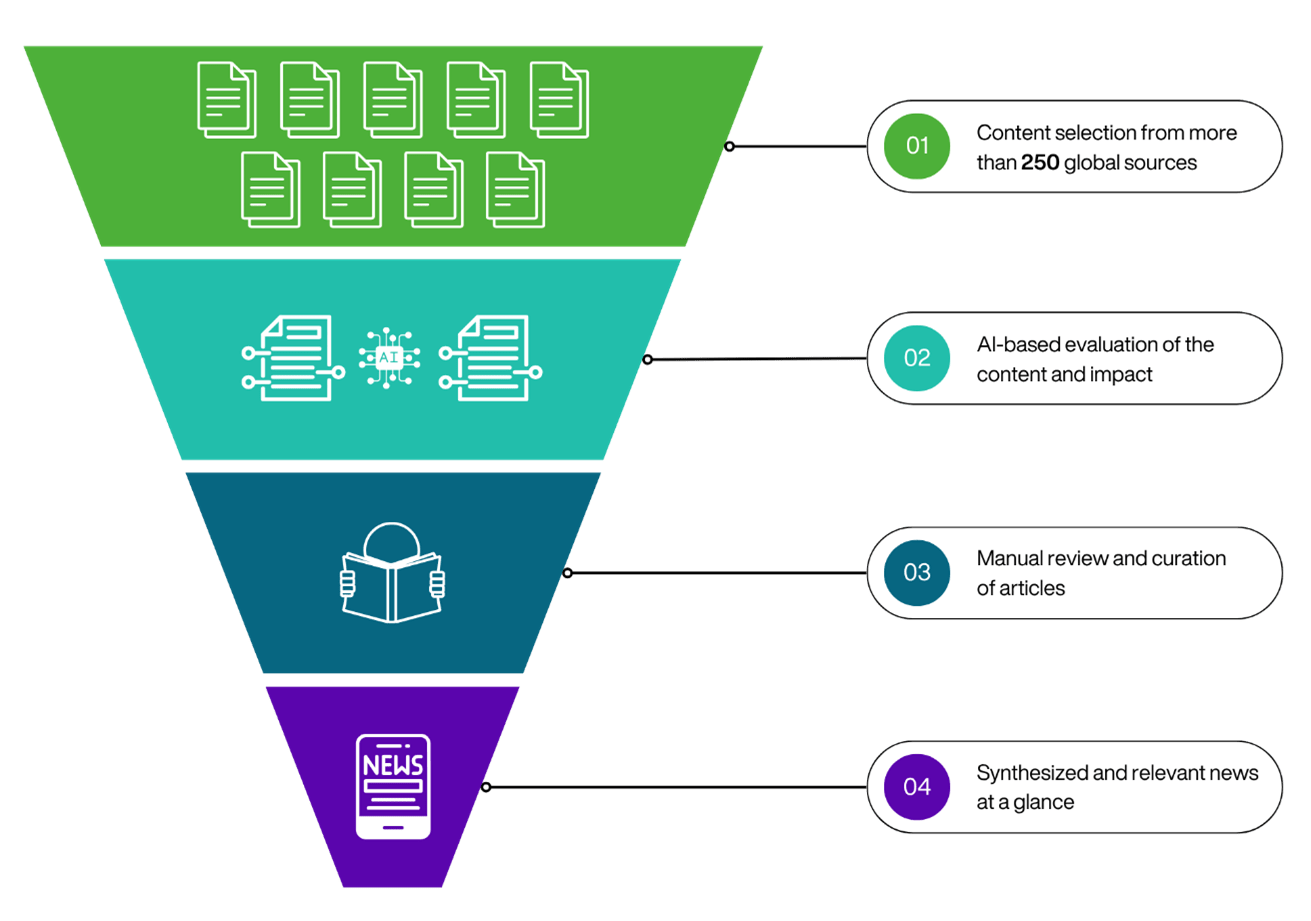
Our process is designed to be both scalable and selective. A broad network of over 250 global sources is continuously screened using six different AIArtificial Intelligence (AI) implies the attempt to transfer human learning and thinking to computers. Computer systems are intended to solve problems—for which a human would require intelligence—using large datasets. In the field of radiology, for example, artificial intelligence can assist physicians in diagnosing findings and detecting abnormali… Explained in the video. tools. These tools help surface relevant content, which is then passed through a multi-step filtering and evaluation process that emphasizes innovation and impact.
In the final stage, selected articles are reviewed and curated by our team before being published. The result is a dynamic, well-structured view of what truly matters in the digital health ecosystem. This way you always stay ahead of the curve.
Contact
E-Mail:
atlas-itg@uni-wh.deInnovation in Healthcare
Alfred-Herrhausen-Straße 50
58448 Witten, Germany