DIGI-HEALTH MONITOR Calendar Week 49, 2025
DIGI-HEALTH MONITOR: Calendar Week 49, 2025
Smart Abdominal Patches from Monash Track Fetal Movements with 90% Accuracy
Researchers at Monash University, in collaboration with Monash Health, have trialed wearable AI-enabled abdominal patches that detect fetal movement with over 90% accuracy. Tested on 59 pregnant patients in a hospital setting, the patches use strain sensors and machine learning to detect subtle fetal motion while filtering out maternal activity. These devices address limitations of traditional “kick count” methods by providing passive, continuous, non-invasive monitoring outside the clinic. Clinicians emphasized its use as a complement to prenatal assessments rather than a replacement. The study showed clinical validity in real-world hospital conditions, and researchers plan to extend testing into home settings with an eye toward regulatory clearance. The wearable’s soft form factor supports extended wearability and daily life integration. The project demonstrates practical clinical implementation of wearable AI and suggests strong potential for improving prenatal safety through earlier detection of reduced fetal activity.
Seoul St. Mary’s Hospital Pilots AI Voice Assistant for Clinical Documentation
Seoul St. Mary’s Hospital in South Korea has launched a pilot of an AI medical scribe system called CMC GenNote, developed with startup PuzzleAI. The solution transcribes clinician–patient conversations into structured EMR entries and allows hands-free interaction via voice commands. It uses hospital-specific language models and clinical microphones optimized for noisy environments. Currently in use within outpatient departments, expansion is planned for ER, inpatient, and surgical areas. The pilot involves direct clinician feedback and testing to refine workflow integration. Key outcomes include reduced after-hours documentation and improved provider focus on patient interaction. The system is part of a broader smart hospital strategy aimed at digital transformation. Early response from medical staff has been favorable, and hospital leaders are exploring long-term adoption. Governance includes data security protocols and clinician oversight. This example demonstrates concrete operational use of ambient AI for clinical documentation and provides a scalable model for digital workflow automation.
FDA deploys agentic AI tools agency wide to support review and oversight workflows
The US Food and Drug Administration has transitioned agentic AI tools from limited pilots into an agency-wide deployment that supports regulatory staff in multiple centers, including areas overseeing drugs, devices, and biologics. These AI systems act as workflow “agents” embedded into existing FDA information systems to help reviewers triage large volumes of documents, surface relevant prior decisions, and identify potential safety or quality issues in textual and structured data. Human regulators retain full decision-making authority, with AI used to automate repetitive information gathering and cross-referencing steps, which early internal evaluations link to time savings and faster retrieval of precedent, although detailed quantitative metrics are still emerging. Medical officers, statisticians, and project managers interact with the tools during everyday review tasks and provide feedback on system behavior, forming a continuous human-in-the-loop oversight model. The FDA frames this deployment within federal AI governance requirements, referencing alignment with the NIST AI Risk Management Framework and federal information security standards, including controls for data access, logging, and auditing of AI-generated suggestions. The initiative is described as a way to scale capacity and consistency in handling complex submissions, including digital health and AI-enabled medical devices, potentially shortening certain review phases and enabling more systematic safety surveillance. Lessons and next steps include iterative refinement of prompts and agents based on user feedback, stronger transparency on how AI is used in regulatory decisions, and exploration of additional use cases such as post-market signal detection while ensuring compliance with privacy and confidentiality obligations.
SimonMed Imaging Deploys Custom Foundation Model for Chest X-Ray Analysis Across 175 U.S. Sites in Partnership with Lunit
SimonMed Imaging, one of the largest outpatient imaging providers in the United States, has partnered with Lunit to develop and deploy a site-specific chest X-ray AI foundation model (Lunit FMS) fine-tuned exclusively on SimonMed’s proprietary imaging dataset encompassing diverse patient demographics across 175 locations. The model is trained and monitored in a HIPAA-compliant environment with built-in performance drift detection and alerting mechanisms, enabling it to adapt to local reporting styles, pathology prevalence, and radiologist preferences while maintaining consistency at scale. Radiologists at all SimonMed sites use the model in live clinical workflows for triage, detection augmentation, and reporting standardization, with final diagnostic authority remaining with the human reader. Outcomes reported include markedly faster and more uniform reporting, reduced variability across the national network, and models that can be iteratively refined in weeks rather than months. Leadership highlighted immediate positive impact on radiological efficiency and quality, with no reported accuracy degradation or bias issues. Governance measures emphasize continuous monitoring for drift, HIPAA compliance, and federated learning principles to protect patient data. No significant challenges or safety signals were noted in the rollout. The partnership is actively expanding to mammography and digital breast tomosynthesis foundation models targeted for 2026, demonstrating clear intent to scale custom AI across additional modalities and solidify SimonMed’s position as a leader in deploying highly tailored, production-grade imaging AI at national scale—one of the largest real-world implementations of a custom foundation model in radiology to date.
Independent Primary Care Practices Using Elation Health’s Native AI Suite Report Average >2 Hours Daily Time Savings and Marked Reductions in Burnout
Elation Health, a clinical-first EHR platform for independent primary care, surveyed 69 actively using physicians in November 2025 about its natively built AI tools—Note Assist with Actions (ambient listening → structured notes + orders/tasks), intelligent medication reconciliation, smart forms, and automated visit prep/scheduling. Tools are deeply embedded in the longitudinal primary care workflow with minimal clicks or context switching. Reported outcomes: average >2 hours saved per day on documentation and administrative tasks (consistent with prior Elation studies showing ~12 minutes per visit), 76% of physicians said AI enables better patient care, 61% reported reduced stress/burnout, 61% noted significant time savings, and 67% experienced more joy in practice. Physicians emphasized the low-friction, clinician-designed integration as key to high adoption and real-world impact. The tools are used daily in live patient care across dozens of independent practices nationwide. No adverse events, accuracy issues, or bias signals were mentioned; data handling follows standard EHR privacy standards (HIPAA, ONC certification). Challenges appear minimal due to native design avoiding third-party overlay fatigue. This represents one of the most mature comprehensive ambient + action-oriented AI deployments in the independent primary care segment, with self-reported but consistent physician time, well-being, and care-quality improvements that have kept practices on the platform and driven further AI feature development.
The Global Digi-Health Monitor is our weekly published newsletter featuring curated updates on the latest developments in digital health. With a focus on innovation and relevance, it brings together key news across topics such as AI in healthcare, wearables, telemedicine, cybersecurity, and more.
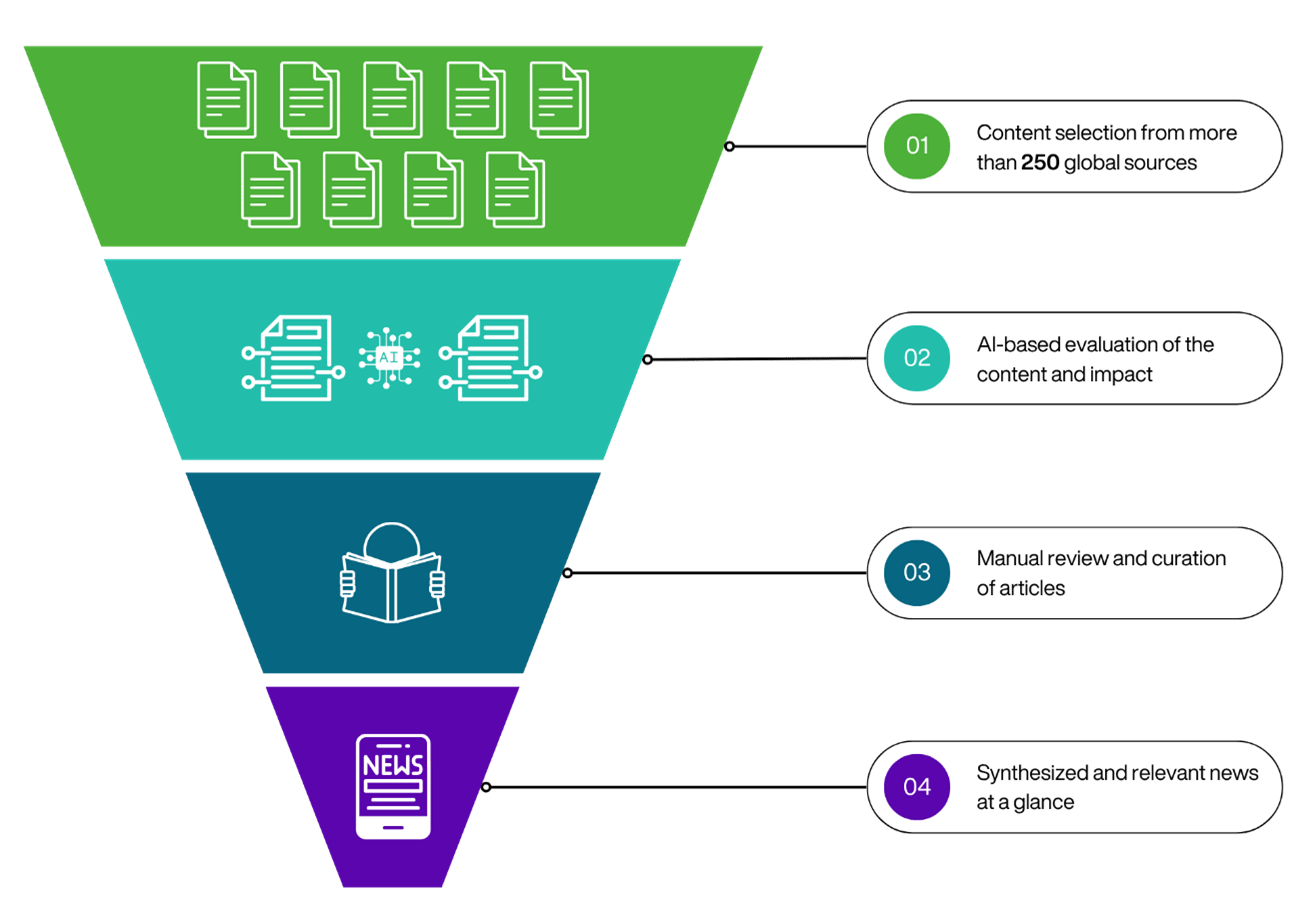
Our process is designed to be both scalable and selective. A broad network of over 250 global sources is continuously screened using six different AI tools. These tools help surface relevant content, which is then passed through a multi-step filtering and evaluation process that emphasizes innovation and impact.
In the final stage, selected articles are reviewed and curated by our team before being published. The result is a dynamic, well-structured view of what truly matters in the digital health ecosystem. This way you always stay ahead of the curve.