

Revolutionizing Nursing Education: AI's Emergent Role in Virtual Reality Simulations
As technology use in nursing and medical education expands, new opportunities open up, incorporating artificial intelligenceArtificial Intelligence (AI) implies the attempt to transfer human learning and thinking to computers. Computer systems are intended to solve problems—for which a human would require intelligence—using large datasets. In the field of radiology, for example, artificial intelligence can assist physicians in diagnosing findings and detecting abnormali… Explained in the video. (AI)Artificial Intelligence (AI) implies the attempt to transfer human learning and thinking to computers. Computer systems are intended to solve problems—for which a human would require intelligence—using large datasets. In the field of radiology, for example, artificial intelligence can assist physicians in diagnosing findings and detecting abnormali… Explained in the video. and virtual realityVirtual Reality (VR) offers a unique visualization context that enhances the perception of volumetric details. Unlike conventional monitor-based visualization, where users typically observe three-dimensional (3D) data as passive observers, VR’s immersive experience allows users to enter their data in a spatially realistic way. First-time VR e… Explained in the video. (VR)Virtual Reality (VR) offers a unique visualization context that enhances the perception of volumetric details. Unlike conventional monitor-based visualization, where users typically observe three-dimensional (3D) data as passive observers, VR’s immersive experience allows users to enter their data in a spatially realistic way. First-time VR e… Explained in the video. into clinical simulation training (1). With VRVirtual Reality (VR) offers a unique visualization context that enhances the perception of volumetric details. Unlike conventional monitor-based visualization, where users typically observe three-dimensional (3D) data as passive observers, VR’s immersive experience allows users to enter their data in a spatially realistic way. First-time VR e… Explained in the video. technology becoming more affordable, its integration into healthcare education is increasingly feasible, offering cost-effective solutions for complex training scenarios in nursing education, such as disaster training, decontamination skills, or maternal-newborn nursing (1, 2).
VRVirtual Reality (VR) offers a unique visualization context that enhances the perception of volumetric details. Unlike conventional monitor-based visualization, where users typically observe three-dimensional (3D) data as passive observers, VR’s immersive experience allows users to enter their data in a spatially realistic way. First-time VR e… Explained in the video. can simulate clinical environments for healthcare education, from screen-based or immersive experiences to mirroring real-life training scenarios. Its simulators can capture tool movements, thus generating large datasets that can be analyzed with machine learningMachine learning is an iterative process and is classified as a subcategory within the field of Artificial Intelligence. Algorithms are programmed to initially learn from datasets and can subsequently develop in a self-learning manner without further explicit intervention. Accordingly, predictions are generated by algorithms based on retrospectivel… Explained in the video. algorithms (3). Therefore, integrated with AI,Artificial Intelligence (AI) implies the attempt to transfer human learning and thinking to computers. Computer systems are intended to solve problems—for which a human would require intelligence—using large datasets. In the field of radiology, for example, artificial intelligence can assist physicians in diagnosing findings and detecting abnormali… Explained in the video. VRVirtual Reality (VR) offers a unique visualization context that enhances the perception of volumetric details. Unlike conventional monitor-based visualization, where users typically observe three-dimensional (3D) data as passive observers, VR’s immersive experience allows users to enter their data in a spatially realistic way. First-time VR e… Explained in the video. can enhance personalized learning, identify knowledge gaps, support teachers, and tailor education (4).
Study investigates AI-powered vs. human-controlled virtual doctors in VRVirtual Reality (VR) offers a unique visualization context that enhances the perception of volumetric details. Unlike conventional monitor-based visualization, where users typically observe three-dimensional (3D) data as passive observers, VR’s immersive experience allows users to enter their data in a spatially realistic way. First-time VR e… Explained in the video. settings
Liaw et al. (2023) explore AIArtificial Intelligence (AI) implies the attempt to transfer human learning and thinking to computers. Computer systems are intended to solve problems—for which a human would require intelligence—using large datasets. In the field of radiology, for example, artificial intelligence can assist physicians in diagnosing findings and detecting abnormali… Explained in the video. integration by comparing the effectiveness of AI-controlled virtual doctors and human-controlled virtual avatars for training in VRVirtual Reality (VR) offers a unique visualization context that enhances the perception of volumetric details. Unlike conventional monitor-based visualization, where users typically observe three-dimensional (3D) data as passive observers, VR’s immersive experience allows users to enter their data in a spatially realistic way. First-time VR e… Explained in the video. settings. The variables studied in the experiment were sepsis care knowledge, communication skills, and self-efficacy among nursing students. They conducted a randomized controlled trial involving 64 participants who received either AIArtificial Intelligence (AI) implies the attempt to transfer human learning and thinking to computers. Computer systems are intended to solve problems—for which a human would require intelligence—using large datasets. In the field of radiology, for example, artificial intelligence can assist physicians in diagnosing findings and detecting abnormali… Explained in the video. or human-led training, with pre- and post-training evaluations to measure progress (5).
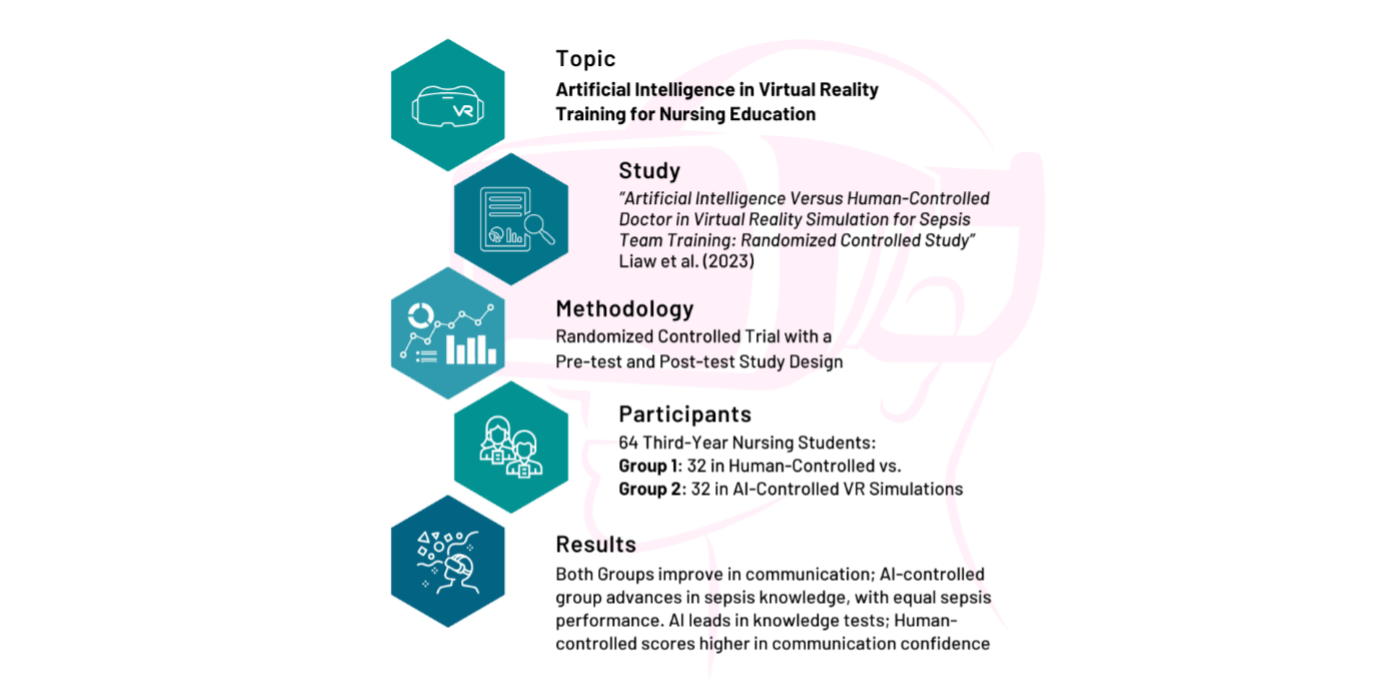
The VRVirtual Reality (VR) offers a unique visualization context that enhances the perception of volumetric details. Unlike conventional monitor-based visualization, where users typically observe three-dimensional (3D) data as passive observers, VR’s immersive experience allows users to enter their data in a spatially realistic way. First-time VR e… Explained in the video. simulations replicated high-stakes interprofessional clinical scenarios, demanding timely diagnosis and management of sepsis alongside efficient team communication. Both AI- and human-led training significantly improved communication skills and self-confidence. However, the AI-powered group exhibited a significantly greater enhancement in sepsis care knowledge, while the human-led group reported higher self-efficacy in interprofessional communication (5).
Necessity for advancements in Human-AI social interactions
The participants in the human-controlled group, unlike those in the AI-powered groups, had opportunities for social interactions through role-playing and debriefing sessions. Despite efforts to improve the AIArtificial Intelligence (AI) implies the attempt to transfer human learning and thinking to computers. Computer systems are intended to solve problems—for which a human would require intelligence—using large datasets. In the field of radiology, for example, artificial intelligence can assist physicians in diagnosing findings and detecting abnormali… Explained in the video. doctor’s facial expressions and conversational understanding, achieving realistic human-AI interactions remains challenging (5). Nevertheless, AI-powered VRVirtual Reality (VR) offers a unique visualization context that enhances the perception of volumetric details. Unlike conventional monitor-based visualization, where users typically observe three-dimensional (3D) data as passive observers, VR’s immersive experience allows users to enter their data in a spatially realistic way. First-time VR e… Explained in the video. training effectively improves knowledge, as further supported by qualitative data where nursing students viewed the AIArtificial Intelligence (AI) implies the attempt to transfer human learning and thinking to computers. Computer systems are intended to solve problems—for which a human would require intelligence—using large datasets. In the field of radiology, for example, artificial intelligence can assist physicians in diagnosing findings and detecting abnormali… Explained in the video. doctor as more knowledgeable than its human-operated counterpart (6).
Investing in VRVirtual Reality (VR) offers a unique visualization context that enhances the perception of volumetric details. Unlike conventional monitor-based visualization, where users typically observe three-dimensional (3D) data as passive observers, VR’s immersive experience allows users to enter their data in a spatially realistic way. First-time VR e… Explained in the video. Education: Long-term benefits outweigh initial costs
Besides AI/VR’s shown benefits and qualitative effectiveness in nursing education, considering its economic impact on healthcare training is crucial. Key considerations for its economic viability include • the longevity and scalability of training programs, • cost distribution among trainees or staff, hence lowering costs per user, and • comparative analysis against traditional training methods’ ongoing costs and logistical challenges (2).
VRVirtual Reality (VR) offers a unique visualization context that enhances the perception of volumetric details. Unlike conventional monitor-based visualization, where users typically observe three-dimensional (3D) data as passive observers, VR’s immersive experience allows users to enter their data in a spatially realistic way. First-time VR e… Explained in the video. training becomes more economical per participant due to its scalability and reduced marginal costs for additional training sessions when amortized over the years. Its long-term cost-efficiency, coupled with its effectiveness in enhancing learning outcomes, solidifies its value as a high-quality educational tool in healthcare (2).
Concluding remarks
AI-driven VRVirtual Reality (VR) offers a unique visualization context that enhances the perception of volumetric details. Unlike conventional monitor-based visualization, where users typically observe three-dimensional (3D) data as passive observers, VR’s immersive experience allows users to enter their data in a spatially realistic way. First-time VR e… Explained in the video. simulations offer an innovative method for continuous medical training, notably enhancing knowledge and communication skills in complex clinical situations like sepsis care. While there is room for improvement in human-AI social interaction, AI-powered doctors have already outperformed human-controlled agents in knowledge enhancement. The study’s findings highlight AI’s substantial potential to enrich nursing education, further positioning VRVirtual Reality (VR) offers a unique visualization context that enhances the perception of volumetric details. Unlike conventional monitor-based visualization, where users typically observe three-dimensional (3D) data as passive observers, VR’s immersive experience allows users to enter their data in a spatially realistic way. First-time VR e… Explained in the video. as a potentially cost-effective and high quality alternative to traditional training methods.

Contact
E-Mail:
atlas-itg@uni-wh.deInnovation in Healthcare
Alfred-Herrhausen-Straße 50
58448 Witten, Germany