

The Potential of AI-Based Mobile Tailored Interventions in Addressing Nurse Burnout: Evidence from South Korea
The rising prevalence of nurse burnout increasingly threatens the efficiency and effectiveness of healthcare systems, are there promising approaches to address this issue?
Over the past decade, nurses have increasingly suffered from burnout syndrome, a condition that not only diminishes their well-being but also has far-reaching consequences for the healthcare system [1]. Burnout among nurses leads to reduced quality of patient care, lower productivity, higher turnover rates, and increased healthcare costs [1–3]. This pressing issue has spurred a significant amount of research aimed at developing more effective solutions to mitigate its impact.
In recent years, technological innovations, particularly in the fields of artificial intelligenceArtificial Intelligence (AI) implies the attempt to transfer human learning and thinking to computers. Computer systems are intended to solve problems—for which a human would require intelligence—using large datasets. In the field of radiology, for example, artificial intelligence can assist physicians in diagnosing findings and detecting abnormali… Explained in the video. (AI)Artificial Intelligence (AI) implies the attempt to transfer human learning and thinking to computers. Computer systems are intended to solve problems—for which a human would require intelligence—using large datasets. In the field of radiology, for example, artificial intelligence can assist physicians in diagnosing findings and detecting abnormali… Explained in the video. and mobile healthmHealth is defined as a sub-discipline of eHealth. It describes the provision of medical information and services via mobile devices that are capable of communicating with other devices on a technological basis. Existing definitions differentiate mHealth according to the technologies used (wearables, sensors, etc.) and the type of mobile data trans… (mHealth),mHealth is defined as a sub-discipline of eHealth. It describes the provision of medical information and services via mobile devices that are capable of communicating with other devices on a technological basis. Existing definitions differentiate mHealth according to the technologies used (wearables, sensors, etc.) and the type of mobile data trans… have emerged as promising solutions to the complex issue of burnout. Unlike traditional interventions, which often adopt a generalized, one-size-fits-all approach, these technologies enable the development of more personalized and adaptive strategies [2, 4, 5]. Historically, burnout reduction programs have aimed to offer universal solutions without recognizing that burnout often results from a complex interaction of various individual factors [4]. Despite the potential of AIArtificial Intelligence (AI) implies the attempt to transfer human learning and thinking to computers. Computer systems are intended to solve problems—for which a human would require intelligence—using large datasets. In the field of radiology, for example, artificial intelligence can assist physicians in diagnosing findings and detecting abnormali… Explained in the video. and mHealth,mHealth is defined as a sub-discipline of eHealth. It describes the provision of medical information and services via mobile devices that are capable of communicating with other devices on a technological basis. Existing definitions differentiate mHealth according to the technologies used (wearables, sensors, etc.) and the type of mobile data trans… many existing interventions have not fully addressed the specific dimensions and unique characteristics of burnout. This underscores the need for more tailored and targeted approaches to effectively address this pervasive issue [2, 6].
AI-Based Mobile Intervention: A New Paradigm
Cho et al. provided valuable insights into the potential of AI-based mobile applications for creating personalized interventions to reduce nurse burnout [2]. Their research identified four evidence-based therapies: Mindfulness Meditation, Storytelling and Reflective Writing, Laughter Therapy, and Acceptance and Commitment Therapy (ACT). The team developed an AI-driven mobile program that tailored therapeutic recommendations to users’ individual characteristics, following a structured sequence. In the Pretest stage, participants provided demographic and job-related data, as well as burnout and stress metrics, which the AI-Based Program Recommendation System (APRS) used to recommend one of the four therapies. Upon completing Program 1, participants’ burnout levels and satisfaction were reassessed, leading to a second therapy recommendation from the remaining options.
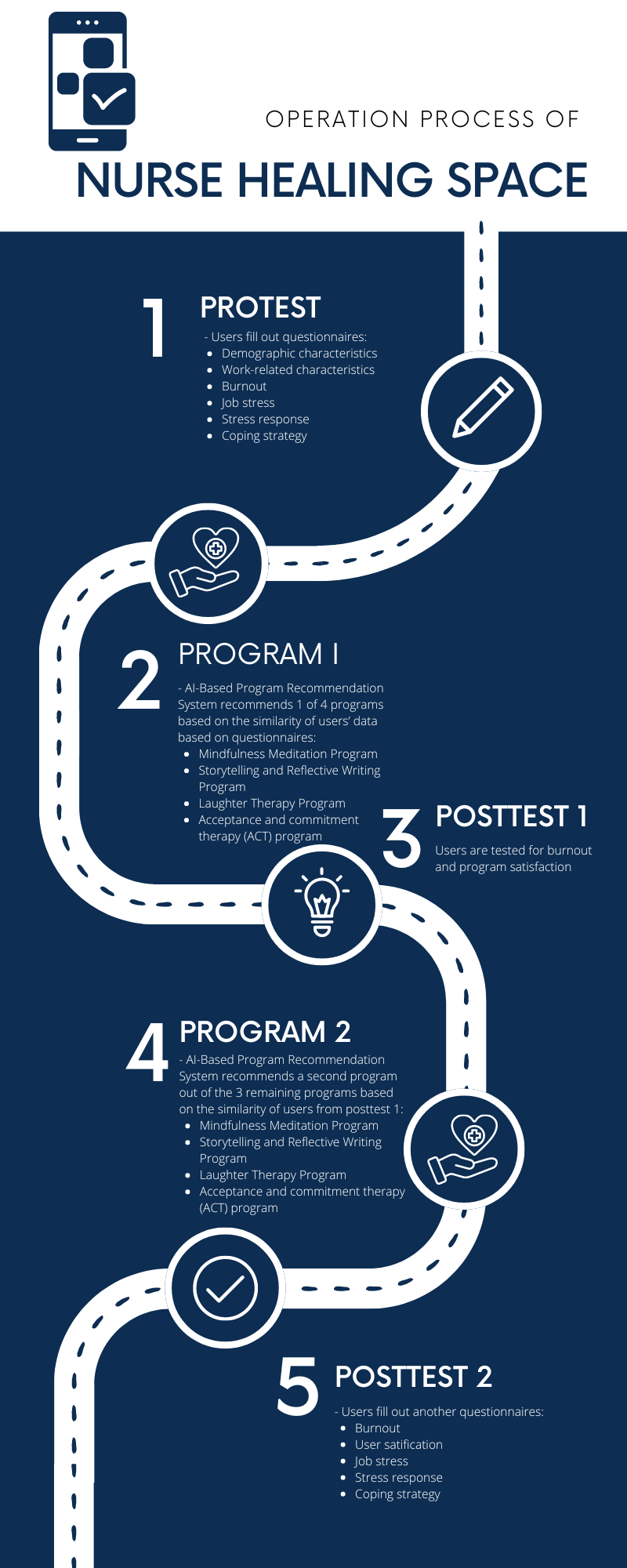
The study, involving 300 participants, revealed that the APRS consistently recommended appropriate therapies for users with similar characteristics. Participants expressed high satisfaction with the app’s usability, design, and content but noted dissatisfaction with the lack of alerts, notifications, and customization features. Longitudinal analysis showed significant improvements in burnout, job stress, and coping strategies across both programs. ACT produced the greatest reduction in overall burnout, while laughter therapy was most effective for personal burnout, and storytelling combined with reflective writing, alongside ACT, reduced work-related burnout. Storytelling and reflective writing also garnered the highest satisfaction levels, with overall satisfaction higher during Program 2 than Program 1. This study underscores the potential of AIArtificial Intelligence (AI) implies the attempt to transfer human learning and thinking to computers. Computer systems are intended to solve problems—for which a human would require intelligence—using large datasets. In the field of radiology, for example, artificial intelligence can assist physicians in diagnosing findings and detecting abnormali… Explained in the video. in tailoring interventions to alleviate caregiver burnout, highlighting its value in improving healthcare professionals’ well-being.
Conclusion
This study demonstrates the potential of AI-powered, personalized digital interventions to reduce caregiver burnout while enhancing user satisfaction. By tailoring care to individual needs, AI-driven measures can improve healthcare systems and promote more patient-centered services. These approaches also extend to areas like patient engagement, physician burnout, and healthcare efficiency, representing a significant step toward more responsive and effective healthcare delivery.
Despite the potential of AI-driven advancements, several challenges remain. A significant issue is the lack of standardized assessment tools for evaluating digital interventions, particularly those focused on patient-centered outcomes [7, 8]. Additionally, the large-scale generation of health dataHealth data, also referred to as patient data, encompasses all information relating to the health status of a person. This includes demographic records as well as medical history, vaccination status, and advance directives. Health data constitutes a special category of personal data under GDPR Article 9, subject to strict additional regulations due… raises serious concerns about data security and privacy [9]. Given the high value of healthcare data and increasing security breaches, the implementation of robust data protection laws is crucial [10–12]. For instance, while new cybersecurityCybersecurity represents an extension of information security. It goes beyond the boundaries of traditional information security and encompasses, in addition to the protection of information resources, also the protection of other assets including the individual. In cybersecurity, the human factor gains an additional dimension: the person as a pote… Explained in the video. regulations are frequently introduced in Europe, researchers argue that the existing EU legislative measures do not fully address the complexities of cybersecurityCybersecurity represents an extension of information security. It goes beyond the boundaries of traditional information security and encompasses, in addition to the protection of information resources, also the protection of other assets including the individual. In cybersecurity, the human factor gains an additional dimension: the person as a pote… Explained in the video. [13]. They emphasize the need for a more comprehensive and effective cybersecurityCybersecurity represents an extension of information security. It goes beyond the boundaries of traditional information security and encompasses, in addition to the protection of information resources, also the protection of other assets including the individual. In cybersecurity, the human factor gains an additional dimension: the person as a pote… Explained in the video. strategy. Nonetheless, AI-driven, data-based initiatives are moving toward more personalized care, which can effectively reduce healthcare worker burnout, lower turnover rates, and mitigate inefficiencies caused by workforce shortages in healthcare services [5].
References
Contact
E-Mail:
atlas-itg@uni-wh.deInnovation in Healthcare
Alfred-Herrhausen-Straße 50
58448 Witten, Germany