

Turning Medical Data into Decision Capacity: A Practical Blueprint for a Cloud-Based Platform in Anesthesiology
Anesthesiologists make rapid decisions under time pressure, often with incomplete information. Can cloud-based platforms help translate available data into practical decision support?
Background
Rising surgical volumes, aging populations, and multimorbidity make anesthesiology a high-risk, time-critical, team-based decision arena.[1] Clinicians must synthesize comorbidities, procedure details, drug choices and doses, and rapidly changing perioperative signals under severe time pressure—yet key information is scattered across systems, encouraging reliance on habit and subjective judgment and limiting traceability and improvement [1,2]. Although perioperative data now enable data-driven risk assessment, ,[2,3] platforms that integrate data into searchable, continuously learning decision support remain scarce.[4]
If we could integrate dispersed clinical data into a computable, searchable, continuously learnable platform, enabling the system to provide more structured risk prompts and strategic recommendations at key nodes, could anesthesiology decision-making shift from “relying on memory” to “relying on evidence”?
A Practical Architecture Blueprint
Zhang et al., after reviewing progress in big-data platforms within anesthesiology, further propose a practical architectural blueprint for a cloud-based Anesthesiology Decision Analysis Platform [4]. Building on existing big-data application directions in anesthesiology, the authors propose a feasible cloud-based decision analysis platform architecture. By integrating and processing data from multiple sources, the platform turns perioperative information into searchable and usable decision support. In the workflow, the platform uses the case number as the entry point to extract parameters and detect abnormalities, outputs editable anesthesia strategies, and feeds physicians’ confirmations/modifications back into a feedback-learning closed loop. The authors also emphasize that the platform’s value lies not only in algorithms but in a continuously learning system of “data integration—decision support—feedback-driven iteration,” and they suggest that future advancement requires technology, governance, and clinical co-creation to proceed in parallel.
Implications
This article presents not a single “more accurate model,” but a system blueprint that turns anesthesiology knowledge and perioperative data into cloud-based decision capability—integrating multi-source data, enabling search and analysis, generating outputs at decision points, and capturing clinician feedback in a continuously improving loop.
Its key implication is that decision support should be run as a sustainable platform, not a one-off modeling effort [5][6]. Value emerges from a continuous cycle of collecting data, generating recommendations, capturing feedback, and refining the system over time [5][7]. Because such systems influence real clinical decisions, governance and accountability must be designed upfront: bias, limited representativeness, and unclear causality constrain credibility, while cloud personalization raises privacy, security, and liability concerns[5][8]. The authors therefore call for governance mechanisms (access control, auditing, quality control, risk stratification, consent) and clear responsibility boundaries[5][8]. They also position anesthesiologists as co-developers—improving data quality, providing clinical context for interpretability, and shaping patient communication—highlighting that clinical AIArtificial Intelligence (AI) implies the attempt to transfer human learning and thinking to computers. Computer systems are intended to solve problems—for which a human would require intelligence—using large datasets. In the field of radiology, for example, artificial intelligence can assist physicians in diagnosing findings and detecting abnormali… Explained in the video. success depends on coordinated capability across clinical practice, data, and governance[6][7].
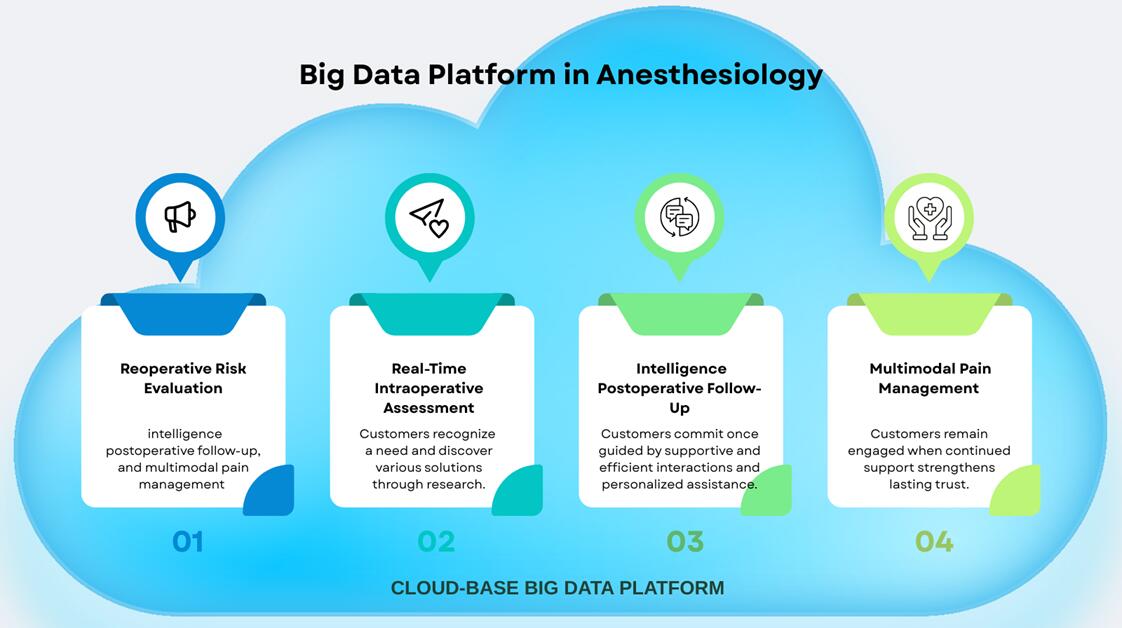
Figure. Big Data Platform in Anesthesiology
References
[1] Duran HT, Kingeter M, Reale C, Weinger MB, Salwei ME. Decision-making in anesthesiology: will artificial intelligenceArtificial Intelligence (AI) implies the attempt to transfer human learning and thinking to computers. Computer systems are intended to solve problems—for which a human would require intelligence—using large datasets. In the field of radiology, for example, artificial intelligence can assist physicians in diagnosing findings and detecting abnormali… Explained in the video. make intraoperative care safer? Curr Opin Anaesthesiol 2023; 36(6): 691–697.
[https://doi.org/10.1097/ACO.0000000000001318][PMID: 37865848]
[2] Cai J, Li P, Li W, Zhu T. Outcomes of clinical decision support systems in real-world perioperative care: a systematic review and meta-analysis. Int J Surg 2024; 110(12): 8057–8072.
[https://doi.org/10.1097/JS9.0000000000001821][PMID: 39037722]
[3] Lim L, Lee H, Jung C-W, Sim D, Borrat X, Pollard TJ, et al. INSPIRE, a publicly available research dataset for perioperative medicine. Sci Data 2024; 11(1): 655.
[https://doi.org/10.1038/s41597-024-03517-4][PMID: 38906912]
[4] Zhang S, Li H, Jing Q, Shen W, Luo W, Dai R. Anesthesia decision analysis using a cloud-based big data platform. Eur J Med Res 2024; 29(1): 201.
[https://doi.org/10.1186/s40001-024-01764-0][PMID: 38528564]
[5] Rajagopal A, Ayanian S, Ryu AJ, Qian R, Legler SR, Peeler EA, et al. Machine LearningMachine learning is an iterative process and is classified as a subcategory within the field of Artificial Intelligence. Algorithms are programmed to initially learn from datasets and can subsequently develop in a self-learning manner without further explicit intervention. Accordingly, predictions are generated by algorithms based on retrospectivel… Explained in the video. Operations in Health Care: A Scoping Review. Mayo Clin Proc Digit Health 2024; 2(3): 421–437 [https://doi.org/10.1016/j.mcpdig.2024.06.009][PMID: 40206123]
[6] Preti LM, Ardito V, Compagni A, Petracca F, Cappellaro G. Implementation of Machine LearningMachine learning is an iterative process and is classified as a subcategory within the field of Artificial Intelligence. Algorithms are programmed to initially learn from datasets and can subsequently develop in a self-learning manner without further explicit intervention. Accordingly, predictions are generated by algorithms based on retrospectivel… Explained in the video. Applications in Health Care Organizations: Systematic Review of Empirical Studies. J Med Internet Res 2024; 26: e55897 [https://doi.org/10.2196/55897][PMID: 39586084]
[7] Trinkley KE, Maw AM, Huebner Torres C, Huebschmann AG, Glasgow RE. Applying Implementation Science to Advance Electronic Health Record–Driven Learning Health Systems: Case Studies, Challenges, and Recommendations. J Med Internet Res 2024; 26: e55472 [https://doi.org/10.2196/55472][PMID: 39374069]
[8] Zhang J, Zhang ZM. Ethics and governance of trustworthy medical artificial intelligence.Artificial Intelligence (AI) implies the attempt to transfer human learning and thinking to computers. Computer systems are intended to solve problems—for which a human would require intelligence—using large datasets. In the field of radiology, for example, artificial intelligence can assist physicians in diagnosing findings and detecting abnormali… Explained in the video. BMC Med Inform Decis Mak 2023; 23(1): 7 [https://doi.org/10.1186/s12911-023-02103-9][PMID: 36639799]

Contact
E-Mail:
atlas-itg@uni-wh.deInnovation in Healthcare
Alfred-Herrhausen-Straße 50
58448 Witten, Germany