

Lessons Learned From Multidomain mHealth Development Practice in Application of Lifestyle Management
While multidomain lifestyle mHealthmHealth is defined as a sub-discipline of eHealth. It describes the provision of medical information and services via mobile devices that are capable of communicating with other devices on a technological basis. Existing definitions differentiate mHealth according to the technologies used (wearables, sensors, etc.) and the type of mobile data trans… interventions offer great promise for public health, their impact is often limited in the development process. Current research frequently overlooks micro-level design elements, leaving developers with few evidence-based lessons to draw from past experiences.
Background
Smartphone ownership and internet access are increasing. Together, these trends give mHealthmHealth is defined as a sub-discipline of eHealth. It describes the provision of medical information and services via mobile devices that are capable of communicating with other devices on a technological basis. Existing definitions differentiate mHealth according to the technologies used (wearables, sensors, etc.) and the type of mobile data trans… interventions strong public health potential. mHealthmHealth is defined as a sub-discipline of eHealth. It describes the provision of medical information and services via mobile devices that are capable of communicating with other devices on a technological basis. Existing definitions differentiate mHealth according to the technologies used (wearables, sensors, etc.) and the type of mobile data trans… has also evolved over time. It has shifted from tools mainly supporting clinical services to broader applications [1, 2]. These include disease prevention, health promotion, diagnosis, treatment, and long-term monitoring. A growing body of evidence shows that mHealthmHealth is defined as a sub-discipline of eHealth. It describes the provision of medical information and services via mobile devices that are capable of communicating with other devices on a technological basis. Existing definitions differentiate mHealth according to the technologies used (wearables, sensors, etc.) and the type of mobile data trans… can be effective in chronic disease management and lifestyle behavior change. It may also be cost-effective [3, 4]. However, as mHealthmHealth is defined as a sub-discipline of eHealth. It describes the provision of medical information and services via mobile devices that are capable of communicating with other devices on a technological basis. Existing definitions differentiate mHealth according to the technologies used (wearables, sensors, etc.) and the type of mobile data trans… interventions expand toward multidomain lifestyle management, multiple barriers have emerged. Poor usability, changing user needs, unsatisfactory user experience, technical failures, and concerns about privacy and security often lead users to abandon apps after a short period.
Therefore, for mHealthmHealth is defined as a sub-discipline of eHealth. It describes the provision of medical information and services via mobile devices that are capable of communicating with other devices on a technological basis. Existing definitions differentiate mHealth according to the technologies used (wearables, sensors, etc.) and the type of mobile data trans… to generate sustainable health impact, success depends largely on whether effective engagement strategies are embedded at the design level. Although frameworks such as IDEAS and MRC provide macro-level development guidance, they often lack operational detail regarding the “how-to” of featureA dataset can be understood as a collection of data objects, also referred to as points, vectors, observations, or entities. Each data object is described by a set of characteristics known as features. A feature is therefore a single measurable property or characteristic of an observed phenomenon. In machine learning and data science, features serv… implementation. Specifically, there is a shortage of evidence-based guidance on how to select and integrate micro-level design elements that are essential for managing multiple lifestyle domains simultaneously, such as specific behavior change techniques and user interface triggers [2]. This leads to a more specific question: when developing multidomain mHealthmHealth is defined as a sub-discipline of eHealth. It describes the provision of medical information and services via mobile devices that are capable of communicating with other devices on a technological basis. Existing definitions differentiate mHealth according to the technologies used (wearables, sensors, etc.) and the type of mobile data trans… interventions for lifestyle management, which key factors and challenges should developers prioritize?
Lessons From Practice
Drawing on their direct involvement in two smartphone-based lifestyle intervention projects, Weber et.al. (2025) summarized key considerations for developing multidomain lifestyle mHealthmHealth is defined as a sub-discipline of eHealth. It describes the provision of medical information and services via mobile devices that are capable of communicating with other devices on a technological basis. Existing definitions differentiate mHealth according to the technologies used (wearables, sensors, etc.) and the type of mobile data trans… interventions [2]. The two projects were DELIA, a digital lifestyle intervention for community-dwelling adults aged 65 and above, and QUALUCA, a digital lifestyle intervention for survivors of non-small cell lung cancer after rehabilitation.
Based on their development experience, the authors grouped common challenges into four areas. They also proposed practical strategies for each. First, developers should clearly identify differences in preferences and needs across target populations. Personalization mechanisms and content delivery should be designed accordingly. Second, user engagement and testing pathways should be carefully planned. Early and continuous usability and experience testing can improve product fit. Third, human support should be deliberately designed and allocated. This can enhance engagement and intervention effectiveness, while still considering scalability. Fourth, at the organizational and governance level of multidomain interventions, teams must manage interdisciplinary collaboration, necessary trade-offs, and adaptive adjustments. Core teams and resource investment must be ensured.
Overall, the authors emphasize that successful multidomain mHealthmHealth is defined as a sub-discipline of eHealth. It describes the provision of medical information and services via mobile devices that are capable of communicating with other devices on a technological basis. Existing definitions differentiate mHealth according to the technologies used (wearables, sensors, etc.) and the type of mobile data trans… implementation depends on delivering the right content, to the right person, at the right time. This must be balanced with the use of frameworks and guidelines, regulatory compliance, resource allocation, and a core team capable of interdisciplinary collaboration and continuous iteration.
Implications
For practice, this study offers actionable insights for developers and researchers.
First, before designing any feature, teams should define the target user profile and use context [5, 6]. They should systematically assess users’ digital and health literacy,Health literacy refers to the ability to understand health-related information and apply it accordingly. In the context of health promotion, health literacy encompasses more than informed decision-making: knowledge and skills relating to health and illness foster a more engaged and conscious approach to one’s own health and well-being in ever… Explained in the video. language preferences, daily routines, and sensitivity to privacy. These assessments should guide decisions about content presentation and interaction complexity.
Second, personalization should not be limited to surface-level content recommendations [7, 8]. It should be built as a sustainable system capability. This can include tiered or parallel intervention pathways, feedback-based dynamic adjustments, and user-configurable options such as reminder frequency or font size. These features allow different users to achieve suitable experiences within the same product.
Third, a tiered support strategy should be established. Most common issues should be addressed with scalable solutions. Limited human support resources should be reserved for critical moments and high-risk users [2]. This approach balances engagement, effectiveness, and scalability.
Finally, interdisciplinary collaboration is not optional. It is a foundational condition for successful multidomain interventions [2]. Time and budget should explicitly account for it. Shared language and shared goals should be established. A core team capable of responding quickly to uncertainty is essential for sustained iteration and implementation.
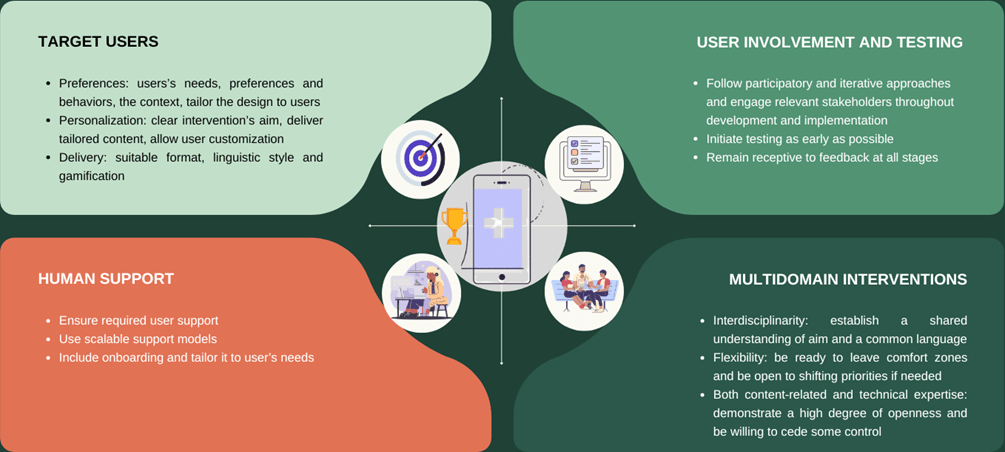
Figure. Key Considerations in the Development of mHealthmHealth is defined as a sub-discipline of eHealth. It describes the provision of medical information and services via mobile devices that are capable of communicating with other devices on a technological basis. Existing definitions differentiate mHealth according to the technologies used (wearables, sensors, etc.) and the type of mobile data trans… Interventions
References
[1] Ali EE, Chew L, Yap KY-L. Evolution and current status of mhealthmHealth is defined as a sub-discipline of eHealth. It describes the provision of medical information and services via mobile devices that are capable of communicating with other devices on a technological basis. Existing definitions differentiate mHealth according to the technologies used (wearables, sensors, etc.) and the type of mobile data trans… research: a systematic review. BMJ Innov 2016; 2(1): 33–40
[https://doi.org/10.1136/bmjinnov-2015-000096]
[2] Weber M, Mattli R, Raab AM, et al. What to Consider When Developing Multidomain Mobile HealthmHealth is defined as a sub-discipline of eHealth. It describes the provision of medical information and services via mobile devices that are capable of communicating with other devices on a technological basis. Existing definitions differentiate mHealth according to the technologies used (wearables, sensors, etc.) and the type of mobile data trans… Interventions for Lifestyle Management. JMIR MhealthmHealth is defined as a sub-discipline of eHealth. It describes the provision of medical information and services via mobile devices that are capable of communicating with other devices on a technological basis. Existing definitions differentiate mHealth according to the technologies used (wearables, sensors, etc.) and the type of mobile data trans… Uhealth 2025; 13: e63573
[https://doi.org/10.2196/63573][PMID: 40854233]
[3] Carrandi A, Hu Y, Karger S, et al. Systematic review on the cost and cost-effectiveness of mHealthmHealth is defined as a sub-discipline of eHealth. It describes the provision of medical information and services via mobile devices that are capable of communicating with other devices on a technological basis. Existing definitions differentiate mHealth according to the technologies used (wearables, sensors, etc.) and the type of mobile data trans… interventions supporting women during pregnancy. Women Birth 2023; 36(1): 3–10
[https://doi.org/10.1016/j.wombi.2022.03.007][PMID: 35339412]
[6] Giebel GD, Abels C, Plescher F, et al. Problems and Barriers Related to the Use of mHealthmHealth is defined as a sub-discipline of eHealth. It describes the provision of medical information and services via mobile devices that are capable of communicating with other devices on a technological basis. Existing definitions differentiate mHealth according to the technologies used (wearables, sensors, etc.) and the type of mobile data trans… Apps From the Perspective of Patients: Focus Group and Interview Study. J Med Internet Res 2024; 26: e49982
[https://doi.org/10.2196/49982][PMID: 38652508]
[7] Rivera-Romero O, Gabarron E, Ropero J, Denecke K. Designing personalised mHealthmHealth is defined as a sub-discipline of eHealth. It describes the provision of medical information and services via mobile devices that are capable of communicating with other devices on a technological basis. Existing definitions differentiate mHealth according to the technologies used (wearables, sensors, etc.) and the type of mobile data trans… solutions: An overview. J Biomed Inform 2023; 146: 104500
[https://doi.org/10.1016/j.jbi.2023.104500][PMID: 37722446] [8] Jakob R, Harperink S, Rudolf AM, et al. Factors Influencing Adherence to mHealthmHealth is defined as a sub-discipline of eHealth. It describes the provision of medical information and services via mobile devices that are capable of communicating with other devices on a technological basis. Existing definitions differentiate mHealth according to the technologies used (wearables, sensors, etc.) and the type of mobile data trans… Apps for Prevention or Management of Noncommunicable Diseases: Systematic Review. J Med Internet Res 2022; 24(5): e35371
[https://doi.org/10.2196/35371][PMID: 35612886
Contact
E-Mail:
atlas-itg@uni-wh.deInnovation in Healthcare
Alfred-Herrhausen-Straße 50
58448 Witten, Germany