

DIGI-HEALTH MONITOR Calendar Week 14
DIGI-HEALTH MONITOR:
Calendar Week 14, 2026
Texas Children’s Hospital pharmacies save $14 million annually with RFID
Texas Children’s Hospital, one of the largest pediatric health systems in the United States, implemented an RFID-based medication tracking and inventory management system to address the previous lack of real-time visibility into stock levels, locations, lots, and expiration dates. Medications are tagged upon receipt and tracked continuously in RFID-enabled refrigerators, cabinets, and storage areas, with full integration into the Epic Willow pharmacy system for closed-loop documentation, dispensing, and billing. Pharmacy technicians handle tagging (averaging seven seconds per item) and automated cycle counts, while pharmacists use real-time dashboards for proactive decisions on shortages, recalls, and reallocations.
The 12-step manual inventory process was reduced to two steps, shifting staff time from counting to value-added tasks such as managing short-dated stock and optimizing purchases. Concrete results include $14 million in annual savings on high-cost Factor VII and Factor VIII products despite 30% higher utilization, significant reductions in waste from expired drugs, and seconds-long automated counts replacing hours of manual work. Challenges included prior inaccuracies in high-value therapies (costing $80,000–$1 million each) and broader U.S. drug shortage impacts. Governance relies on automated chain-of-custody for accountability and accurate billing. Clinicians (pharmacists and technicians) are directly involved in daily operations and decision-making. Lessons emphasize that benefits arise from combining RFID visibility with workflow redesign and EHR integration rather than technology alone. This scalable model for high-cost inventory management in complex pediatric settings demonstrates strong operational and financial impact with potential replication across hospital pharmacies.
How Mass General Brigham Decides Which AIArtificial Intelligence (AI) implies the attempt to transfer human learning and thinking to computers. Computer systems are intended to solve problems—for which a human would require intelligence—using large datasets. In the field of radiology, for example, artificial intelligence can assist physicians in diagnosing findings and detecting abnormali… Explained in the video. Tools Are Worth Deploying
Mass General Brigham, a major Boston-based academic health system, has scaled several generative AIArtificial Intelligence (AI) implies the attempt to transfer human learning and thinking to computers. Computer systems are intended to solve problems—for which a human would require intelligence—using large datasets. In the field of radiology, for example, artificial intelligence can assist physicians in diagnosing findings and detecting abnormali… Explained in the video. tools through a deliberate governance framework focused on measurable system impact, safety, and workflow fit. Key deployments include Microsoft Copilot for drafting emails, summarizing information, and generating presentations, alongside a secure internal large-language-model environment that enables safe experimentation with protected health information. This environment supported development of a custom AIArtificial Intelligence (AI) implies the attempt to transfer human learning and thinking to computers. Computer systems are intended to solve problems—for which a human would require intelligence—using large datasets. In the field of radiology, for example, artificial intelligence can assist physicians in diagnosing findings and detecting abnormali… Explained in the video. agent capable of condensing decades of a new patient’s medical records into a concise pre-visit summary for clinicians. Tools were rolled out after aligning people, processes, and technology, supported by system-wide education on safe usage. Clinicians actively incorporate these in ambulatory and other settings, with governance requiring real-time monitoring during care (to catch hallucinations immediately), short-term retrospective reviews, and ongoing performance tracking. Every tool must demonstrate positive impact on productivity, burnout reduction, or care quality without compromising privacy or security. Uptake of Copilot has been strong, and the record-summarization agent is operational. Challenges include maintaining data privacy, preventing over-reliance, managing hallucination risks (benchmarked against human error rates, such as in discharge summaries), and ensuring tools integrate without disrupting complex workflows. Governance prioritizes clinician involvement in evaluation and emphasizes education and monitored scaling over perfection. Lessons stress cautious, evidence-driven adoption and the value of internal secure environments for innovation. Next steps involve continued expansion of monitored applications while tracking outcomes like administrative time savings and care quality. This approach provides a mature model for responsible AIArtificial Intelligence (AI) implies the attempt to transfer human learning and thinking to computers. Computer systems are intended to solve problems—for which a human would require intelligence—using large datasets. In the field of radiology, for example, artificial intelligence can assist physicians in diagnosing findings and detecting abnormali… Explained in the video. integration in a large, complex academic health system, balancing innovation with rigorous oversight.
Collaborative Pediatric Diagnosis: Clinician-Supervised AIArtificial Intelligence (AI) implies the attempt to transfer human learning and thinking to computers. Computer systems are intended to solve problems—for which a human would require intelligence—using large datasets. In the field of radiology, for example, artificial intelligence can assist physicians in diagnosing findings and detecting abnormali… Explained in the video. Outperforms Standalone Human Assessment in Complex Cases
Large Language Models (LLMs) have transitioned from theoretical research to a structured diagnostic aid in pediatric medicine. A recent multi-site study involving 78 clinicians across 50 complex cases demonstrates that while AIArtificial Intelligence (AI) implies the attempt to transfer human learning and thinking to computers. Computer systems are intended to solve problems—for which a human would require intelligence—using large datasets. In the field of radiology, for example, artificial intelligence can assist physicians in diagnosing findings and detecting abnormali… Explained in the video. alone remains inferior to experienced doctors, the combination of “human-plus-AI” significantly raises the ceiling for diagnostic accuracy. At participating hospitals, clinicians integrated four advanced AIArtificial Intelligence (AI) implies the attempt to transfer human learning and thinking to computers. Computer systems are intended to solve problems—for which a human would require intelligence—using large datasets. In the field of radiology, for example, artificial intelligence can assist physicians in diagnosing findings and detecting abnormali… Explained in the video. models into their workflow to tackle both common and ultra-rare pediatric conditions. The workflow required clinicians to input granular data, including lab results and imaging markers, while the AIArtificial Intelligence (AI) implies the attempt to transfer human learning and thinking to computers. Computer systems are intended to solve problems—for which a human would require intelligence—using large datasets. In the field of radiology, for example, artificial intelligence can assist physicians in diagnosing findings and detecting abnormali… Explained in the video. generated ranked hypotheses. Results showed the clinician-AI union achieved a 94.3% Top-5 accuracy, identifying rare diseases that were initially overlooked by humans. This deployment highlighted a critical governance lesson: “variability in responses” (hallucination risks) necessitates that AIArtificial Intelligence (AI) implies the attempt to transfer human learning and thinking to computers. Computer systems are intended to solve problems—for which a human would require intelligence—using large datasets. In the field of radiology, for example, artificial intelligence can assist physicians in diagnosing findings and detecting abnormali… Explained in the video. remain a supervised advisory tool rather than a diagnostic lead. Under the EU AIArtificial Intelligence (AI) implies the attempt to transfer human learning and thinking to computers. Computer systems are intended to solve problems—for which a human would require intelligence—using large datasets. In the field of radiology, for example, artificial intelligence can assist physicians in diagnosing findings and detecting abnormali… Explained in the video. Act, this implementation was treated as a high-risk application, requiring rigorous transparency logs. Next steps involve scaling this “second-opinion” protocol across regional pediatric networks to reduce the time-to-diagnosis for rare genetic disorders.
Virtual care provider makes big gains with Zoom AIArtificial Intelligence (AI) implies the attempt to transfer human learning and thinking to computers. Computer systems are intended to solve problems—for which a human would require intelligence—using large datasets. In the field of radiology, for example, artificial intelligence can assist physicians in diagnosing findings and detecting abnormali… Explained in the video. clinical tools
PocketRN, a virtual care provider focused on older adults with chronic conditions, integrated Zoom Workplace for Clinicians and Zoom Clinical Notes (including ambient AIArtificial Intelligence (AI) implies the attempt to transfer human learning and thinking to computers. Computer systems are intended to solve problems—for which a human would require intelligence—using large datasets. In the field of radiology, for example, artificial intelligence can assist physicians in diagnosing findings and detecting abnormali… Explained in the video. capture) into its existing telehealthTelemedicine encompasses various healthcare delivery concepts characterized by direct patient care across geographical distances or time delays. This includes diagnostic, therapeutic, rehabilitative, and consultative services delivered through information and communication technologies. Particularly with regard to rural areas, telemedicine offers s… Explained in the video. workflow to scale relationship-based nursing while preserving care quality. Nurses schedule visits in their system, which triggers Zoom meetings via API; the platform captures conversations, generates structured clinical note drafts with specialty templates and multilingual support, and passes them for immediate nurse review, editing, and finalization before EHR integration.
This keeps full clinical responsibility with nurses in a human-in-the-loop model. Documentation time dropped approximately 60%, from nearly 20 minutes to under 10 minutes per note. Comprehensive assessment visits shortened by 15 minutes each. The team saves roughly 33 hours per day, translating to about $27,720 in monthly administrative cost reductions. Additionally, 92% of nurses rated the features (matching, review, note-taking, call-joining) positively, and onboarding time halved from over four weeks to two weeks.
Challenges included maintaining human connection during virtual visits, supporting patients with varying digital literacy and connectivity, and avoiding documentation burdens that pull focus from patients. Governance relies on nurses as the final reviewers to ensure accuracy and quality. Clinician involvement centers on nurses, who reinvest saved time in direct patient support, care coordination, and caregiver education. The implementation succeeds by embedding AIArtificial Intelligence (AI) implies the attempt to transfer human learning and thinking to computers. Computer systems are intended to solve problems—for which a human would require intelligence—using large datasets. In the field of radiology, for example, artificial intelligence can assist physicians in diagnosing findings and detecting abnormali… Explained in the video. within a familiar unified environment rather than introducing fragmented tools. Lessons highlight that AIArtificial Intelligence (AI) implies the attempt to transfer human learning and thinking to computers. Computer systems are intended to solve problems—for which a human would require intelligence—using large datasets. In the field of radiology, for example, artificial intelligence can assist physicians in diagnosing findings and detecting abnormali… Explained in the video. adoption scales better with seamless video-communication-documentation integration and retained human oversight. No explicit next steps are outlined, but the model offers transferable value for virtual nursing or chronic care telemedicineTelemedicine encompasses various healthcare delivery concepts characterized by direct patient care across geographical distances or time delays. This includes diagnostic, therapeutic, rehabilitative, and consultative services delivered through information and communication technologies. Particularly with regard to rural areas, telemedicine offers s… Explained in the video. programs seeking efficiency without compromising relational care.
Samsung Medical Center sets new bar in smart hospital transformation with AI-ready systems
Samsung Medical Center in South Korea achieved revalidation at Stage 7 of the HIMSS Infrastructure Adoption Model (INFRAM) through a large-scale infrastructure overhaul that supports AI-ready operations while strengthening cybersecurity. A major element was relocating its Internet Data Centre with only about 20 minutes of downtime and no interruption to clinical services. This move cut latency by 50%, freed physical space for patient-care areas, and better accommodated GPU-intensive AIArtificial Intelligence (AI) implies the attempt to transfer human learning and thinking to computers. Computer systems are intended to solve problems—for which a human would require intelligence—using large datasets. In the field of radiology, for example, artificial intelligence can assist physicians in diagnosing findings and detecting abnormali… Explained in the video. workloads and high-volume clinical data processing, including medical imaging sharing.
Concurrently, the center deployed AI-enabled Security Information and Event Management (SIEM) capabilities, shifting cybersecurityCybersecurity represents an extension of information security. It goes beyond the boundaries of traditional information security and encompasses, in addition to the protection of information resources, also the protection of other assets including the individual. In cybersecurity, the human factor gains an additional dimension: the person as a pote… Explained in the video. from reactive log monitoring to predictive, intelligence-driven processes with anomaly detection and automation. Time-to-detection improved from minutes to seconds, and the security operations center reduced manual log reviews, boosting efficiency. Security policies now apply adaptively based on system criticality and potential clinical impact rather than uniformly.
The upgrade integrates IT infrastructure, cybersecurity, data management, and operational teams through refined governance and cross-functional decision-making tied directly to hospital workflows. Staff reported increased confidence in proactive issue resolution and system stability. Challenges included executing the data-center migration without disrupting care. Clinician and operational involvement occurs through aligned workflows that prioritize clinical continuity. Lessons underscore treating infrastructure and cybersecurityCybersecurity represents an extension of information security. It goes beyond the boundaries of traditional information security and encompasses, in addition to the protection of information resources, also the protection of other assets including the individual. In cybersecurity, the human factor gains an additional dimension: the person as a pote… Explained in the video. as foundational to clinical resilience, AIArtificial Intelligence (AI) implies the attempt to transfer human learning and thinking to computers. Computer systems are intended to solve problems—for which a human would require intelligence—using large datasets. In the field of radiology, for example, artificial intelligence can assist physicians in diagnosing findings and detecting abnormali… Explained in the video. scalability, and operational efficiency rather than isolated functions. Next steps involve deeper analysis of service usage patterns and patient feedback to refine infrastructure and support emerging digital services. The case illustrates enterprise-scale integration of AI-ready systems with minimal disruption in a live, high-volume hospital environment
The Global Digi-Health Monitor is our weekly published newsletter featuring curated updates on the latest developments in digital health. With a focus on innovation and relevance, it brings together key news across topics such as AIArtificial Intelligence (AI) implies the attempt to transfer human learning and thinking to computers. Computer systems are intended to solve problems—for which a human would require intelligence—using large datasets. In the field of radiology, for example, artificial intelligence can assist physicians in diagnosing findings and detecting abnormali… Explained in the video. in healthcare, wearables,Wearables refer to technologies in the form of sensors or mobile applications that collect health data asynchronously and beyond the boundaries of medical care. They include wristbands, smartwatches, and other mobile sensors. These measure and collect data such as blood glucose levels, pulse, or sleep data, and transmit this information either auto… telemedicine,Telemedicine encompasses various healthcare delivery concepts characterized by direct patient care across geographical distances or time delays. This includes diagnostic, therapeutic, rehabilitative, and consultative services delivered through information and communication technologies. Particularly with regard to rural areas, telemedicine offers s… Explained in the video. cybersecurity, and more.
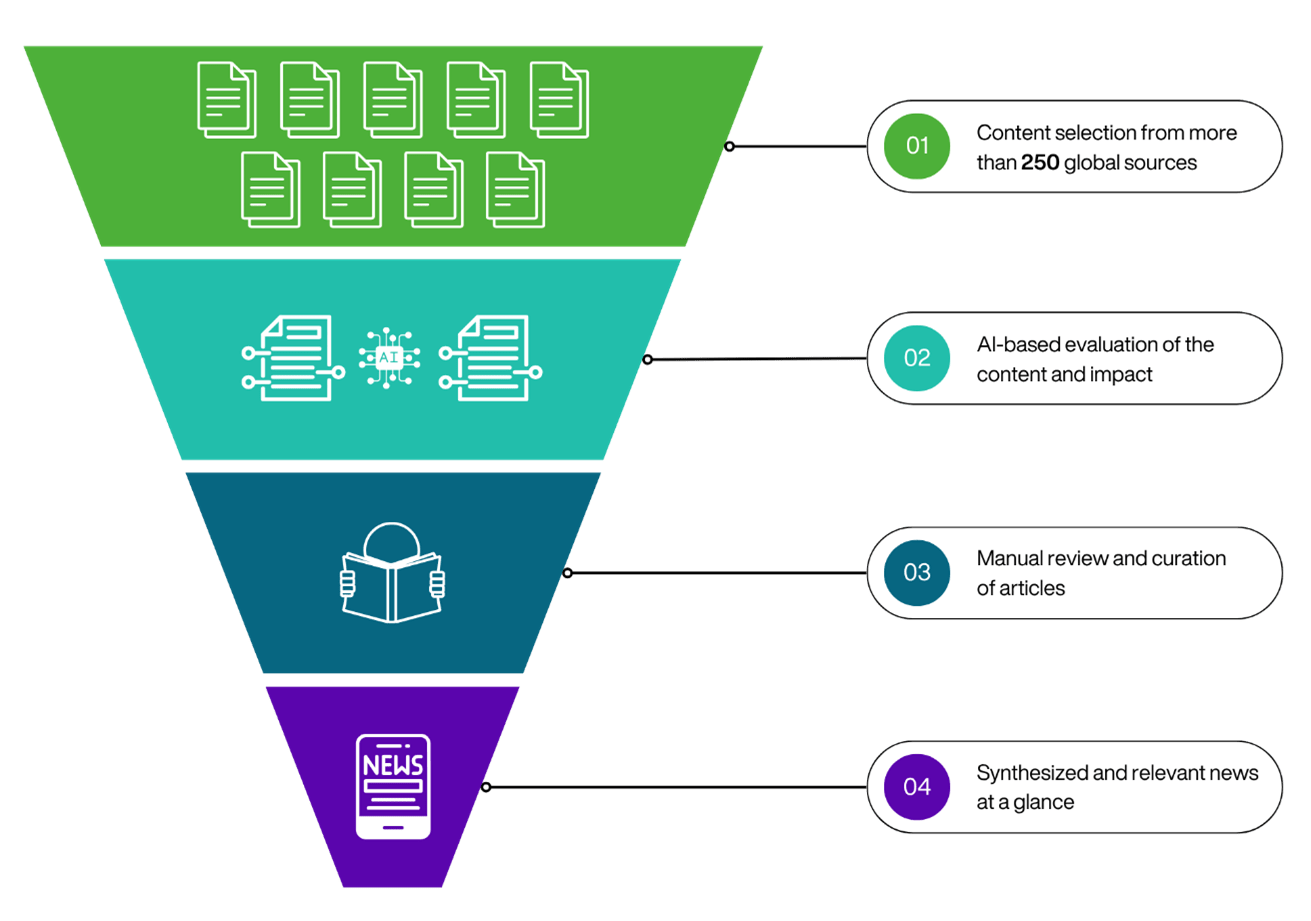
Our process is designed to be both scalable and selective. A broad network of over 250 global sources is continuously screened using six different AIArtificial Intelligence (AI) implies the attempt to transfer human learning and thinking to computers. Computer systems are intended to solve problems—for which a human would require intelligence—using large datasets. In the field of radiology, for example, artificial intelligence can assist physicians in diagnosing findings and detecting abnormali… Explained in the video. tools. These tools help surface relevant content, which is then passed through a multi-step filtering and evaluation process that emphasizes innovation and impact.
In the final stage, selected articles are reviewed and curated by our team before being published. The result is a dynamic, well-structured view of what truly matters in the digital health ecosystem. This way you always stay ahead of the curve.
Contact
E-Mail:
atlas-itg@uni-wh.deInnovation in Healthcare
Alfred-Herrhausen-Straße 50
58448 Witten, Germany