

DIGI-HEALTH MONITOR Calendar Week 13
DIGI-HEALTH MONITOR:
Calendar Week 13, 2026
Effect of a Clinical Decision Support System on Stroke Care Quality and Outcomes in Patients with Acute Ischaemic Stroke (GOLDEN BRIDGE II): Cluster Randomised Clinical Trial
A cluster-randomised trial conducted across 77 hospitals in China enrolled 21,603 patients with acute ischaemic stroke (January 2021–June 2023). Thirty-eight hospitals implemented an AI-based clinical decision support system (CDSS) integrated into existing hospital information systems (radiology PACS, laboratory, and electronic medical records), enabling automatic data extraction without extra clinician input. The CDSS provided AI-assisted imaging analysis for infarct evaluation, aetiology classification per Chinese criteria, and evidence-based treatment recommendations. Neurologists received pre-trial training plus a two-week transition phase. Control hospitals (39) continued usual care.
In the intervention arm (11,054 patients), new vascular events (ischaemic/haemorrhagic stroke, myocardial infarction, or vascular death) at three months occurred in 2.9% versus 3.9% in controls (adjusted HR 0.74, 26% relative reduction), with sustained benefit at 12 months (4.0% vs 5.5%). Adherence to a composite of eight evidence-based stroke performance measures improved significantly (91.4% vs 89.8%). Disability and all-cause mortality showed no difference; bleeding events were comparable. Governance included an international steering committee, executive committee, and independent data safety monitoring board. Challenges noted were the hospital-level randomisation (possible outpatient care confounding) and the need for ongoing model updates as guidelines evolve. The implementation demonstrated scalability across varied hospital settings in a high-burden region. Clinicians retained full decision responsibility. Next steps include replication studies, guideline integration, and policy support for wider adoption in resource-constrained systems. This large trial shows measurable improvements in care quality and long-term vascular outcomes from embedded AI-CDS.
Evaluating eRAMP telecareTelemedicine encompasses various healthcare delivery concepts characterized by direct patient care across geographical distances or time delays. This includes diagnostic, therapeutic, rehabilitative, and consultative services delivered through information and communication technologies. Particularly with regard to rural areas, telemedicine offers s… Explained in the video. for diabetes in outpatient clinics: a hybrid effectiveness-implementation study
The Hong Kong Hospital Authority’s New Territories West Cluster implemented eRAMP, a telecare-enhanced hybrid consultation model, across seven public general outpatient clinics serving adults with type 2 diabetes. In a single-blind, non-inferiority randomised controlled trial with hybrid effectiveness-implementation design, 786 patients were randomised to either the intervention arm (alternating telecareTelemedicine encompasses various healthcare delivery concepts characterized by direct patient care across geographical distances or time delays. This includes diagnostic, therapeutic, rehabilitative, and consultative services delivered through information and communication technologies. Particularly with regard to rural areas, telemedicine offers s… Explained in the video. and in-person visits over 84 weeks) or the control arm (standard in-person care only). A multidisciplinary team including doctors, nurses, optometrists, dietitians, podiatrists, physiotherapists, and patient-care assistants delivered care through secure telecareTelemedicine encompasses various healthcare delivery concepts characterized by direct patient care across geographical distances or time delays. This includes diagnostic, therapeutic, rehabilitative, and consultative services delivered through information and communication technologies. Particularly with regard to rural areas, telemedicine offers s… Explained in the video. platforms fully integrated into routine clinic workflows, supporting remote monitoring, medication review, and patient education.
The hybrid model proved non-inferior for glycaemic control (HbA1c) while delivering consistently lower blood pressure readings in the intervention group and maintaining stable medication adherence (adherence declined in the control arm mid-trial). Operational costs remained comparable to usual care, and the model was judged feasible in a high-volume public system. All seven clinics elected to continue the telecareTelemedicine encompasses various healthcare delivery concepts characterized by direct patient care across geographical distances or time delays. This includes diagnostic, therapeutic, rehabilitative, and consultative services delivered through information and communication technologies. Particularly with regard to rural areas, telemedicine offers s… Explained in the video. approach after trial completion, demonstrating successful sustained embedding. Strong leadership commitment and reliable digital infrastructure served as key facilitators. Challenges included variable patient digital literacy and increased staff workload associated with technology-supported visits. Governance occurred under the Hospital Authority’s central oversight, with standardised protocols, data security measures, and attention to equity across diverse populations. Lessons learned emphasise that well-supported hybrid telecareTelemedicine encompasses various healthcare delivery concepts characterized by direct patient care across geographical distances or time delays. This includes diagnostic, therapeutic, rehabilitative, and consultative services delivered through information and communication technologies. Particularly with regard to rural areas, telemedicine offers s… Explained in the video. models can maintain chronic disease management quality while improving access. Next steps include broader scaling within Hong Kong’s public outpatient network and adaptation as a template for other long-term conditions. This study provides rigorous real-world evidence of a scalable telemedicineTelemedicine encompasses various healthcare delivery concepts characterized by direct patient care across geographical distances or time delays. This includes diagnostic, therapeutic, rehabilitative, and consultative services delivered through information and communication technologies. Particularly with regard to rural areas, telemedicine offers s… Explained in the video. implementation with measured patient and system-level outcomes.
Streamline point-of-care workflows and strengthen patient relationships using UpToDate Expert AIArtificial Intelligence (AI) implies the attempt to transfer human learning and thinking to computers. Computer systems are intended to solve problems—for which a human would require intelligence—using large datasets. In the field of radiology, for example, artificial intelligence can assist physicians in diagnosing findings and detecting abnormali… Explained in the video.
PeaceHealth Medical Group in Eugene, Oregon, piloted UpToDate Expert AI,Artificial Intelligence (AI) implies the attempt to transfer human learning and thinking to computers. Computer systems are intended to solve problems—for which a human would require intelligence—using large datasets. In the field of radiology, for example, artificial intelligence can assist physicians in diagnosing findings and detecting abnormali… Explained in the video. a generative AIArtificial Intelligence (AI) implies the attempt to transfer human learning and thinking to computers. Computer systems are intended to solve problems—for which a human would require intelligence—using large datasets. In the field of radiology, for example, artificial intelligence can assist physicians in diagnosing findings and detecting abnormali… Explained in the video. clinical decision support tool layered on the established evidence-based UpToDate platform. The goal was to enable fast natural-language querying within daily workflows while minimising risks of unvetted shadow AI.Artificial Intelligence (AI) implies the attempt to transfer human learning and thinking to computers. Computer systems are intended to solve problems—for which a human would require intelligence—using large datasets. In the field of radiology, for example, artificial intelligence can assist physicians in diagnosing findings and detecting abnormali… Explained in the video. Family physician and medical informaticist Dr. Lorne Bigley acted as an early adopter, keeping the tool open on a second screen during patient visits for rapid queries on care plans, pathophysiology (e.g., myeloma treatment details), or patient education (e.g., explaining elevated PSA results). It was also used for pre-visit chart preparation. The AIArtificial Intelligence (AI) implies the attempt to transfer human learning and thinking to computers. Computer systems are intended to solve problems—for which a human would require intelligence—using large datasets. In the field of radiology, for example, artificial intelligence can assist physicians in diagnosing findings and detecting abnormali… Explained in the video. draws exclusively from peer-reviewed UpToDate content, supports follow-up questions, and delivers concise, transparent summaries that clinicians can share on-screen with patients and families.
Clinicians described the tool as quick and accurate, matching traditional UpToDate while reducing search time and enabling real-time evidence-based discussions that preserve the human connection. Governance leverages the enterprise-grade, clinically validated platform to address security, privacy, and patient-safety concerns. Qualitative feedback highlighted improved workflow efficiency and decision-making confidence, with particular anticipated value for new nurse practitioners and physician assistants. Challenges centred on the general risk of unsanctioned AIArtificial Intelligence (AI) implies the attempt to transfer human learning and thinking to computers. Computer systems are intended to solve problems—for which a human would require intelligence—using large datasets. In the field of radiology, for example, artificial intelligence can assist physicians in diagnosing findings and detecting abnormali… Explained in the video. tools, addressed through controlled rollout to build trust. Next steps include scaling beyond early adopters to all UpToDate users system-wide. This pilot demonstrates a low-disruption approach to embedding generative AIArtificial Intelligence (AI) implies the attempt to transfer human learning and thinking to computers. Computer systems are intended to solve problems—for which a human would require intelligence—using large datasets. In the field of radiology, for example, artificial intelligence can assist physicians in diagnosing findings and detecting abnormali… Explained in the video. into existing clinical processes with strong clinician engagement and governance safeguards.
Artesia General Hospital Brings Ambient AIArtificial Intelligence (AI) implies the attempt to transfer human learning and thinking to computers. Computer systems are intended to solve problems—for which a human would require intelligence—using large datasets. In the field of radiology, for example, artificial intelligence can assist physicians in diagnosing findings and detecting abnormali… Explained in the video. to Rural Communities to Restore Patient-Physician Connection and Improve Care
Artesia General Hospital, a rural facility, deployed Microsoft Dragon Copilot ambient AIArtificial Intelligence (AI) implies the attempt to transfer human learning and thinking to computers. Computer systems are intended to solve problems—for which a human would require intelligence—using large datasets. In the field of radiology, for example, artificial intelligence can assist physicians in diagnosing findings and detecting abnormali… Explained in the video. clinical documentation technology fully integrated with the TruBridge electronic health record. The tool uses ambient listening to capture physician-patient conversations (including multi-party recognition and real-time translation for Spanish-speaking patients), automatically generates structured notes, and embeds them directly into the EHR. Clinicians review and finalise notes on their laptop without leaving the platform or performing manual entry.
Family medicine physician Dr. Peter Jewell and physician assistant Elizabeth Muñoz reported 50–75% less time spent on documentation compared with previous non-integrated dictation tools. This reduction allows greater focus on patients, improves detection of subtle cues, and enhances interaction quality so patients feel heard. The system supports diverse populations by minimising screen time during visits and enabling natural conversation flow. Governance relies on clinician review for accuracy and accountability plus seamless EHR integration to maintain workflow continuity. The hospital is actively tracking key performance indicators. Challenges in the rural setting (e.g., infrastructure) were implied but not explicitly detailed. Next steps include further expansion and exploration of additional AIArtificial Intelligence (AI) implies the attempt to transfer human learning and thinking to computers. Computer systems are intended to solve problems—for which a human would require intelligence—using large datasets. In the field of radiology, for example, artificial intelligence can assist physicians in diagnosing findings and detecting abnormali… Explained in the video. use cases to better serve local patients. This deployment illustrates practical ambient AIArtificial Intelligence (AI) implies the attempt to transfer human learning and thinking to computers. Computer systems are intended to solve problems—for which a human would require intelligence—using large datasets. In the field of radiology, for example, artificial intelligence can assist physicians in diagnosing findings and detecting abnormali… Explained in the video. adoption in a smaller rural hospital, delivering tangible reductions in documentation burden and positive impacts on clinician experience and patient connection with measurable time savings.
The Global Digi-Health Monitor is our weekly published newsletter featuring curated updates on the latest developments in digital health. With a focus on innovation and relevance, it brings together key news across topics such as AIArtificial Intelligence (AI) implies the attempt to transfer human learning and thinking to computers. Computer systems are intended to solve problems—for which a human would require intelligence—using large datasets. In the field of radiology, for example, artificial intelligence can assist physicians in diagnosing findings and detecting abnormali… Explained in the video. in healthcare, wearables,Wearables refer to technologies in the form of sensors or mobile applications that collect health data asynchronously and beyond the boundaries of medical care. They include wristbands, smartwatches, and other mobile sensors. These measure and collect data such as blood glucose levels, pulse, or sleep data, and transmit this information either auto… telemedicine,Telemedicine encompasses various healthcare delivery concepts characterized by direct patient care across geographical distances or time delays. This includes diagnostic, therapeutic, rehabilitative, and consultative services delivered through information and communication technologies. Particularly with regard to rural areas, telemedicine offers s… Explained in the video. cybersecurity, and more.
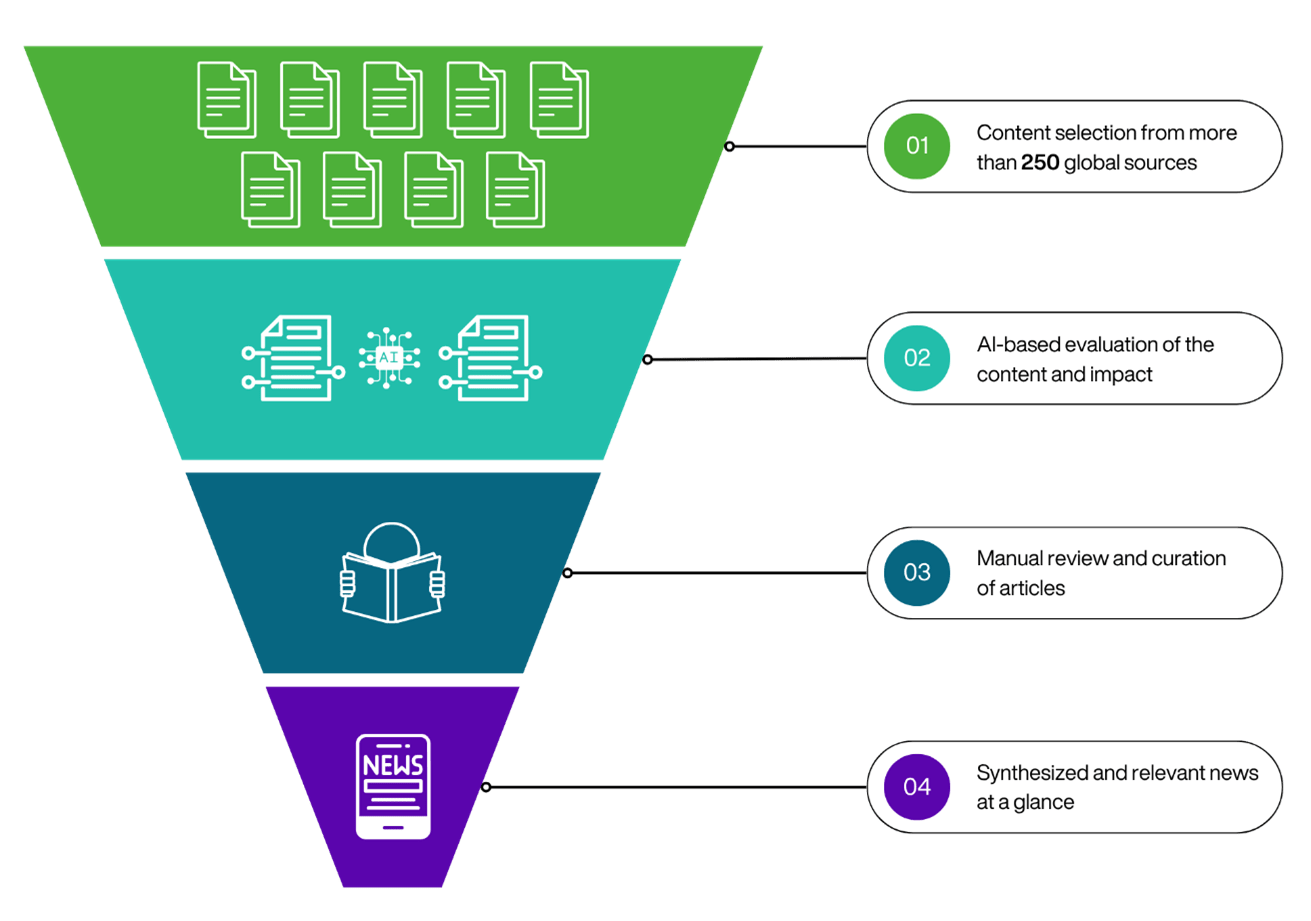
Our process is designed to be both scalable and selective. A broad network of over 250 global sources is continuously screened using six different AIArtificial Intelligence (AI) implies the attempt to transfer human learning and thinking to computers. Computer systems are intended to solve problems—for which a human would require intelligence—using large datasets. In the field of radiology, for example, artificial intelligence can assist physicians in diagnosing findings and detecting abnormali… Explained in the video. tools. These tools help surface relevant content, which is then passed through a multi-step filtering and evaluation process that emphasizes innovation and impact.
In the final stage, selected articles are reviewed and curated by our team before being published. The result is a dynamic, well-structured view of what truly matters in the digital health ecosystem. This way you always stay ahead of the curve.
Contact
E-Mail:
atlas-itg@uni-wh.deInnovation in Healthcare
Alfred-Herrhausen-Straße 50
58448 Witten, Germany