

The Last Mile of Imaging AI: How to Support Physicians in Making Informed Adoption?
Technological advances in medical imaging AIArtificial Intelligence (AI) implies the attempt to transfer human learning and thinking to computers. Computer systems are intended to solve problems—for which a human would require intelligence—using large datasets. In the field of radiology, for example, artificial intelligence can assist physicians in diagnosing findings and detecting abnormali… Explained in the video. are continuously setting new benchmarks, yet in many hospitals it remains confined to pilot demonstrations or use by a small number of clinicians, still some distance from routine clinical practice. When physicians sit at the center of adoption decisions, what clear and actionable support do they need to both dare to use and be able to choose AI,Artificial Intelligence (AI) implies the attempt to transfer human learning and thinking to computers. Computer systems are intended to solve problems—for which a human would require intelligence—using large datasets. In the field of radiology, for example, artificial intelligence can assist physicians in diagnosing findings and detecting abnormali… Explained in the video. and to truly embed it into everyday diagnostic workflows?
Background
Artificial intelligenceArtificial Intelligence (AI) implies the attempt to transfer human learning and thinking to computers. Computer systems are intended to solve problems—for which a human would require intelligence—using large datasets. In the field of radiology, for example, artificial intelligence can assist physicians in diagnosing findings and detecting abnormali… Explained in the video. (AI)Artificial Intelligence (AI) implies the attempt to transfer human learning and thinking to computers. Computer systems are intended to solve problems—for which a human would require intelligence—using large datasets. In the field of radiology, for example, artificial intelligence can assist physicians in diagnosing findings and detecting abnormali… Explained in the video. in medical imaging has advanced rapidly and promises better accuracy, fewer misses, and reduced radiology workload [1-2]. Yet real-world deployment and routine use remain slow: tools are often “available but rarely used” or confined to niche users and scenarios [2-4]. The gap is not only technical performance but practical adoption frictions [2,5]. Radiologists sit at the center of adoption decisions and carry clinical responsibility, but they often lack practical, context-specific support to assess AIArtificial Intelligence (AI) implies the attempt to transfer human learning and thinking to computers. Computer systems are intended to solve problems—for which a human would require intelligence—using large datasets. In the field of radiology, for example, artificial intelligence can assist physicians in diagnosing findings and detecting abnormali… Explained in the video. value and limitations [2,4,6]. Drawing on recent qualitative research, this article summarizes key measures that together form a physician-centered orientation framework for AIArtificial Intelligence (AI) implies the attempt to transfer human learning and thinking to computers. Computer systems are intended to solve problems—for which a human would require intelligence—using large datasets. In the field of radiology, for example, artificial intelligence can assist physicians in diagnosing findings and detecting abnormali… Explained in the video. adoption in medical imaging [4,6].
How can physicians make adoption decisions and help AIArtificial Intelligence (AI) implies the attempt to transfer human learning and thinking to computers. Computer systems are intended to solve problems—for which a human would require intelligence—using large datasets. In the field of radiology, for example, artificial intelligence can assist physicians in diagnosing findings and detecting abnormali… Explained in the video. move smoothly into implementation?
In a recent study, Hennrich et. al. (2025) move beyond asking why physicians resist AIArtificial Intelligence (AI) implies the attempt to transfer human learning and thinking to computers. Computer systems are intended to solve problems—for which a human would require intelligence—using large datasets. In the field of radiology, for example, artificial intelligence can assist physicians in diagnosing findings and detecting abnormali… Explained in the video. and instead identify actionable ways to support informed adoption and smooth implementation [4]. Based on a literature review and interviews with five current and potential radiologist users and nine AIArtificial Intelligence (AI) implies the attempt to transfer human learning and thinking to computers. Computer systems are intended to solve problems—for which a human would require intelligence—using large datasets. In the field of radiology, for example, artificial intelligence can assist physicians in diagnosing findings and detecting abnormali… Explained in the video. experts, they developed a physician adoption support checklist with 11 measures. Nine measures target pre-adoption readiness bystrengthening AIArtificial Intelligence (AI) implies the attempt to transfer human learning and thinking to computers. Computer systems are intended to solve problems—for which a human would require intelligence—using large datasets. In the field of radiology, for example, artificial intelligence can assist physicians in diagnosing findings and detecting abnormali… Explained in the video. literacy, self-efficacy, and trust. They include education and hands-on training, physician involvement in development, greater transparency and explainability, high-quality evidence of clinical and business value, and central expert panels and cross-disciplinary teams. Two additional measures address post-adoption implementation via AIArtificial Intelligence (AI) implies the attempt to transfer human learning and thinking to computers. Computer systems are intended to solve problems—for which a human would require intelligence—using large datasets. In the field of radiology, for example, artificial intelligence can assist physicians in diagnosing findings and detecting abnormali… Explained in the video. catalogs or marketplaces and standardized guidelines and processes. Ethics and organizational readiness still require broader governance.
Implications
Beyond medical imaging, the study suggests a broader lesson for healthcare AI:Artificial Intelligence (AI) implies the attempt to transfer human learning and thinking to computers. Computer systems are intended to solve problems—for which a human would require intelligence—using large datasets. In the field of radiology, for example, artificial intelligence can assist physicians in diagnosing findings and detecting abnormali… Explained in the video. slow uptake is not simply due to “physician resistance,” but reflects a decision-making process that requires systematic support [4,5,7]. Clinicians often hesitate because they lack actionable mechanisms, from understanding and hands-on trialing to evidence appraisal and clear accountability [5,7,8].
The paper’s eleven measures can be understood as a practical playbook. They emphasize shifting efforts upstream to pre-adoption empowerment, such as AIArtificial Intelligence (AI) implies the attempt to transfer human learning and thinking to computers. Computer systems are intended to solve problems—for which a human would require intelligence—using large datasets. In the field of radiology, for example, artificial intelligence can assist physicians in diagnosing findings and detecting abnormali… Explained in the video. literacy and practical training, transparency and uncertainty cues, independent high-quality evidence of clinical value, and a clear business case including time- and cost-savings and reimbursement pathways [2,4].
In addition the study highlights the value of specialty-specific expert panels with cross-disciplinary teams to support evaluation and workflow intergration rather than a one-off purchase [2,4]. After adoption, AIArtificial Intelligence (AI) implies the attempt to transfer human learning and thinking to computers. Computer systems are intended to solve problems—for which a human would require intelligence—using large datasets. In the field of radiology, for example, artificial intelligence can assist physicians in diagnosing findings and detecting abnormali… Explained in the video. should be embedded through implementable guidelines, SOPs, and traceability to avoid “available but rarely used” pilots [4,8]. Finally, ethics and organizational readiness are not solvable by individual physicians alone; managers and policymakers must strengthen data governance, define accountability, invest in infrastructure, and allocate operational resources [5,8,9]. Routine use will require both clinician decision empowerment and organizational implementation capability [5,9].
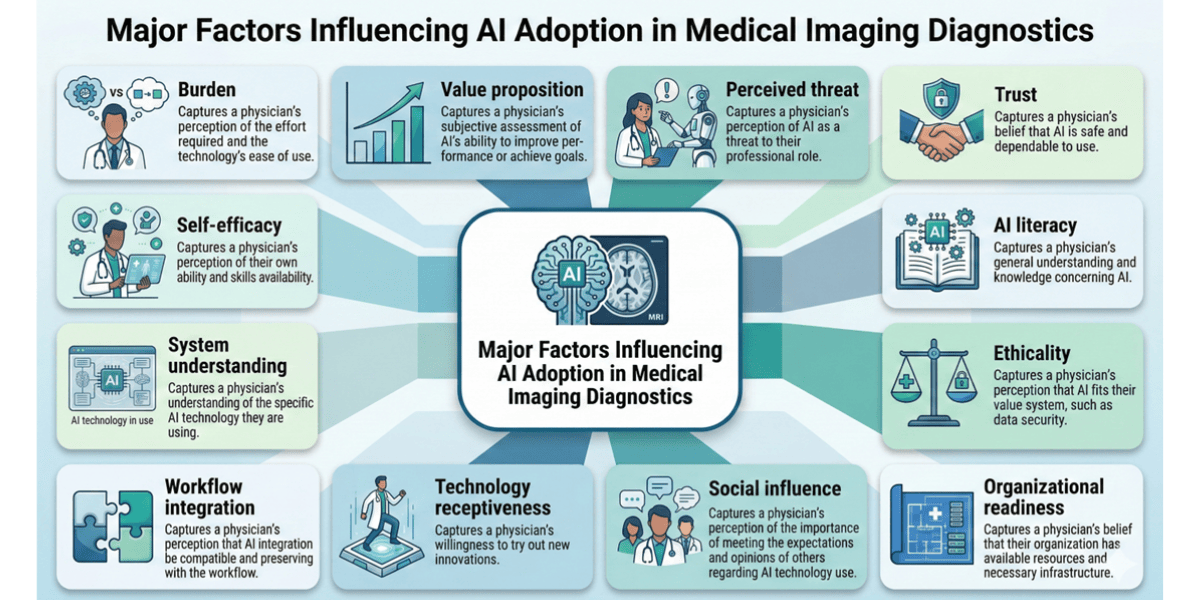
Major Factors Influencing AIArtificial Intelligence (AI) implies the attempt to transfer human learning and thinking to computers. Computer systems are intended to solve problems—for which a human would require intelligence—using large datasets. In the field of radiology, for example, artificial intelligence can assist physicians in diagnosing findings and detecting abnormali… Explained in the video. Adoption in Medical Imaging Diagnostics
References
[1] Obuchowicz R, Lasek J, Wodziński M, Piórkowski A, Strzelecki M, Nurzynska K. Artificial Intelligence-Empowered Radiology—Current Status and Critical Review. Diagnostics (Basel) 2025;15(3):282 [https://doi.org/10.3390/diagnostics15030282][PMID: 39941212]
[2] Wenderott K, Krups J, Weigl M, Wooldridge AR.Augmented Reality (AR) enables an extension of reality, enriched by technically generated virtual information that can address all human senses. At any point in time, however, the individual reality of the user remains central and is experienced in real time — it is never fully replaced by the digital layer. AR is most commonly implemented …… Facilitators and Barriers to Implementing AIArtificial Intelligence (AI) implies the attempt to transfer human learning and thinking to computers. Computer systems are intended to solve problems—for which a human would require intelligence—using large datasets. In the field of radiology, for example, artificial intelligence can assist physicians in diagnosing findings and detecting abnormali… Explained in the video. in Routine Medical Imaging: Systematic Review and Qualitative Analysis. J Med Internet Res 2025;27:e63649 [https://doi.org/10.2196/63649][PMID: 40690758]
[3] Goldburgh M, LaChance M, Komissarchik J, Patriarche J, Chapa J, Chen O, Deshpande P, Geeslin M, Kottler N, Sommer J, Ayers M, Vujic V. 2023 Industry Perceptions Survey on AIArtificial Intelligence (AI) implies the attempt to transfer human learning and thinking to computers. Computer systems are intended to solve problems—for which a human would require intelligence—using large datasets. In the field of radiology, for example, artificial intelligence can assist physicians in diagnosing findings and detecting abnormali… Explained in the video. Adoption and Return on Investment.The abbreviation ROI stands for Return on Investment, which literally translates to “return on the investment made” In business, the term refers to the rate of return on capital and is a metric used to determine the success of an investment. The standard formula is: ROI (%) = (net program benefit / program costs) × … Continued J Imaging Inform Med 2025;38(2):663-670 [https://doi.org/10.1007/s10278-024-01147-1][PMID: 39164452]
[4] Hennrich J, Doctor E, Körner MF, Lederman R, Eymann T. Enabling Physicians to Make an Informed Adoption Decision on Artificial IntelligenceArtificial Intelligence (AI) implies the attempt to transfer human learning and thinking to computers. Computer systems are intended to solve problems—for which a human would require intelligence—using large datasets. In the field of radiology, for example, artificial intelligence can assist physicians in diagnosing findings and detecting abnormali… Explained in the video. Applications in Medical Imaging Diagnostics: Qualitative Study. J Med Internet Res 2025;27:e63668 [https://doi.org/10.2196/63668][PMID: 40795316]
[5] Hassan M, Kushniruk A, Borycki E. Barriers to and Facilitators of Artificial IntelligenceArtificial Intelligence (AI) implies the attempt to transfer human learning and thinking to computers. Computer systems are intended to solve problems—for which a human would require intelligence—using large datasets. In the field of radiology, for example, artificial intelligence can assist physicians in diagnosing findings and detecting abnormali… Explained in the video. Adoption in Health Care: Scoping Review. JMIR Hum Factors 2024;11:e48633 [https://doi.org/10.2196/48633][PMID: 39207831]
[6] Owoyemi A, Osuchukwu J, Salwei ME, Boyd A. Checklist Approach to Developing and Implementing AIArtificial Intelligence (AI) implies the attempt to transfer human learning and thinking to computers. Computer systems are intended to solve problems—for which a human would require intelligence—using large datasets. In the field of radiology, for example, artificial intelligence can assist physicians in diagnosing findings and detecting abnormali… Explained in the video. in Clinical Settings: Instrument Development Study. JMIRx Med 2025;6:e65565 [https://doi.org/10.2196/65565][PMID: 39977249]
[7] Scipion CEA, Manchester MA, Federman A, Wang Y, Arias JJ. Barriers to and facilitators of clinician acceptance and use of artificial intelligenceArtificial Intelligence (AI) implies the attempt to transfer human learning and thinking to computers. Computer systems are intended to solve problems—for which a human would require intelligence—using large datasets. In the field of radiology, for example, artificial intelligence can assist physicians in diagnosing findings and detecting abnormali… Explained in the video. in healthcare settings: a scoping review. BMJ Open 2025;15(4):e092624 [https://doi.org/10.1136/bmjopen-2024-092624][PMID: 40233955]
[8] Saenz AD, McCoy T, et al. Establishing responsible use of AIArtificial Intelligence (AI) implies the attempt to transfer human learning and thinking to computers. Computer systems are intended to solve problems—for which a human would require intelligence—using large datasets. In the field of radiology, for example, artificial intelligence can assist physicians in diagnosing findings and detecting abnormali… Explained in the video. guidelines: a comprehensive case study for healthcare institutions. NPJ Digit Med 2024;7:348 [https://doi.org/10.1038/s41746-024-01300-8][PMID: 39616269]
[9] Kim JY, et al. Establishing organizational AIArtificial Intelligence (AI) implies the attempt to transfer human learning and thinking to computers. Computer systems are intended to solve problems—for which a human would require intelligence—using large datasets. In the field of radiology, for example, artificial intelligence can assist physicians in diagnosing findings and detecting abnormali… Explained in the video. governance in healthcare: a case study in Canada. NPJ Digit Med 2025;8(1):522 [https://doi.org/10.1038/s41746-025-01909-3][PMID: 40817280]

Contact
E-Mail:
atlas-itg@uni-wh.deInnovation in Healthcare
Alfred-Herrhausen-Straße 50
58448 Witten, Germany