

DIGI-HEALTH MONITOR Calendar Week 7, 2026
DIGI-HEALTH MONITOR:
Calendar Week 7, 2026
MultiCare Health System Completes Enterprise-Wide Deployment of Ambient AIArtificial Intelligence (AI) implies the attempt to transfer human learning and thinking to computers. Computer systems are intended to solve problems—for which a human would require intelligence—using large datasets. In the field of radiology, for example, artificial intelligence can assist physicians in diagnosing findings and detecting abnormali… Explained in the video. Across 1,500 Clinicians
MultiCare Health System, a major provider based in Tacoma, Washington, announced the enterprise-wide expansion of the Ambience Healthcare AIArtificial Intelligence (AI) implies the attempt to transfer human learning and thinking to computers. Computer systems are intended to solve problems—for which a human would require intelligence—using large datasets. In the field of radiology, for example, artificial intelligence can assist physicians in diagnosing findings and detecting abnormali… Explained in the video. platform to 1,500 clinicians across all specialties and care settings. This implementation followed a year-long competitive “bakeoff” involving 550 clinicians where the technology was tested for its ability to automate clinical documentation, coding, and workflow management. The system is deeply integrated into the Epic electronic health record (EHR), allowing it to capture care activity in real-time and reduce the manual documentation burden that frequently contributes to provider exhaustion. The operational outcomes reported as of February 9, 2026, are substantial, including a 33% reduction in total documentation time and a 17% increase in face-to-face patient time. Financially, the system supported a 5% increase in work Relative Value Units (wRVUs), suggesting more complete documentation of clinical services provided. Clinician well-being improved dramatically, with user surveys showing that self-reported burnout rates dropped from 25% to less than 4%, while job satisfaction scores rose from 8% to 36%. MultiCare’s leadership emphasized that the solution was selected as a favorite by frontline staff because it directly simplifies their daily workflow, enabling a shift in focus back to bedside care.
Nebraska Methodist gains $2 million from AI-assisted coding
Nebraska Methodist Health System implemented AIArtificial Intelligence (AI) implies the attempt to transfer human learning and thinking to computers. Computer systems are intended to solve problems—for which a human would require intelligence—using large datasets. In the field of radiology, for example, artificial intelligence can assist physicians in diagnosing findings and detecting abnormali… Explained in the video. to modernize revenue cycle work where manual claim status checking and downstream denials were consuming staff time and slowing cash flow. The deployment, described as a human-in-the-loop model, aimed to keep final judgment with experienced revenue cycle staff while using automation as a consistent second set of eyes. The health system integrated the technology into existing revenue cycle workflows and systems, including EHR and revenue cycle tooling, rather than forcing a standalone workflow, and used dashboards to monitor performance and ROI.The abbreviation ROI stands for Return on Investment, which literally translates to “return on the investment made” In business, the term refers to the rate of return on capital and is a metric used to determine the success of an investment. The standard formula is: ROI (%) = (net program benefit / program costs) × … Continued Two main use cases are described: automating high volume, rules-based claim status activity after billing, and applying generative AIArtificial Intelligence (AI) implies the attempt to transfer human learning and thinking to computers. Computer systems are intended to solve problems—for which a human would require intelligence—using large datasets. In the field of radiology, for example, artificial intelligence can assist physicians in diagnosing findings and detecting abnormali… Explained in the video. earlier in the mid-cycle to support pre-bill coding review and reduce rework, denials, and underpayments. Reported outcomes include freeing the equivalent of 24 FTE over two years, removing 71% of accounts from staff queues, and redeploying teams to complex claim resolution rather than cutting headcount. The article also reports more than $2 million in realized gross revenue, a cumulative CMI lift of +1.17, and more than 1,800 additional quality indicators flagged, alongside an operational claim that the organization added more than 100 beds without increasing business office FTE.
1,600+ Pharmacies Using EQUIPP Copilot Report Up to 4x Revenue Boost, Close More Care Gaps
Pharmacy Quality Solutions (PQS), an Innovaccer company, rolled out EQUIPP Copilot, an AI-driven platform, to over 1,600 independent and chain pharmacies throughout the United States starting from its early release in September 2025. The technology seamlessly embeds into existing pharmacy management systems, delivering real-time intelligence for identifying care gaps, automating adherence interventions, and streamlining documentation without necessitating extra logins or platform transitions. Pharmacists and technicians incorporate it into routine workflows to execute quality programs and engage patients more effectively, allowing clinicians to dedicate more time to high-value activities like patient counseling instead of administrative duties. Key results encompass up to a 4x revenue increase for adopters compared to non-users, savings of at least 4 minutes per patient in documentation, closure of up to 4x more care gaps, and elevated adherence scores in payer programs, ultimately fostering improved patient outcomes and incentive fulfillment. A lead pharmacy technician from Kashat Pharmacy in Metro Detroit highlighted the tool’s efficiency in saving time and integrating smoothly. Challenges remain unaddressed in the report, though potential risks like data integration accuracy are implicitly managed via PQS’s role as a neutral intermediary between payers and pharmacies, ensuring governance through secure, compliant data handling. Clinician involvement centers on pharmacists reviewing AI-generated insights before action. Lessons learned emphasize the value of workflow-embedded AIArtificial Intelligence (AI) implies the attempt to transfer human learning and thinking to computers. Computer systems are intended to solve problems—for which a human would require intelligence—using large datasets. In the field of radiology, for example, artificial intelligence can assist physicians in diagnosing findings and detecting abnormali… Explained in the video. in expanding pharmacy roles in value-based care. Next steps involve enhancing features for additional clinical services, advancing automation depth, pursuing third-party integrations, and strengthening payer partnerships to amplify scalability across the pharmacy sector.
As AIArtificial Intelligence (AI) implies the attempt to transfer human learning and thinking to computers. Computer systems are intended to solve problems—for which a human would require intelligence—using large datasets. In the field of radiology, for example, artificial intelligence can assist physicians in diagnosing findings and detecting abnormali… Explained in the video. enters the operating room, reports arise of botched surgeries and misidentified body parts
Reuters investigates the real-world entry of AI-enabled medical devices into operating rooms, emphasizing patient safety signals, governance gaps, and the difficulty of assigning causality when software changes intersect with high risk clinical work. The report highlights Acclarent’s TruDi Navigation System, used in chronic sinusitis procedures, where the company said it added a machine-learning algorithmAn algorithm is a solution procedure in the form of a systematic rule or approach. A problem is solved by means of a defined sequence of procedural steps. In computer science, algorithms form a fundamental basis of programming. Examples of algorithms include the calculation of the Body Mass Index (BMI), instruction manuals, or rules of … Con… to assist ENT specialists. Reuters reports that FDA received more malfunction and adverse event reports after the AIArtificial Intelligence (AI) implies the attempt to transfer human learning and thinking to computers. Computer systems are intended to solve problems—for which a human would require intelligence—using large datasets. In the field of radiology, for example, artificial intelligence can assist physicians in diagnosing findings and detecting abnormali… Explained in the video. featureA dataset can be understood as a collection of data objects, also referred to as points, vectors, observations, or entities. Each data object is described by a set of characteristics known as features. A feature is therefore a single measurable property or characteristic of an observed phenomenon. In machine learning and data science, features serv… was added, citing unconfirmed reports of at least 100 malfunctions and adverse events, and at least 10 injuries between late 2021 and November 2025. Examples described include alleged mislocalization of instruments, cerebrospinal fluid leak, an alleged puncture of the base of the skull, and alleged strokes linked to arterial injury. A key governance point is that FDA device reports can be incomplete and are not designed to determine causes, so it is unclear what role AIArtificial Intelligence (AI) implies the attempt to transfer human learning and thinking to computers. Computer systems are intended to solve problems—for which a human would require intelligence—using large datasets. In the field of radiology, for example, artificial intelligence can assist physicians in diagnosing findings and detecting abnormali… Explained in the video. played in specific events, yet lawsuits allege the AIArtificial Intelligence (AI) implies the attempt to transfer human learning and thinking to computers. Computer systems are intended to solve problems—for which a human would require intelligence—using large datasets. In the field of radiology, for example, artificial intelligence can assist physicians in diagnosing findings and detecting abnormali… Explained in the video. contributed to injuries. This is less a single implementation story than a system-level lesson: once AIArtificial Intelligence (AI) implies the attempt to transfer human learning and thinking to computers. Computer systems are intended to solve problems—for which a human would require intelligence—using large datasets. In the field of radiology, for example, artificial intelligence can assist physicians in diagnosing findings and detecting abnormali… Explained in the video. is embedded in devices, post-market surveillance,In epidemiology, surveillance refers to the monitoring of diseases. In particular, infectious diseases are continuously and systematically recorded by collecting, analysing, and interpreting relevant data. As a result, medical measures to contain a disease can be initiated, for example. transparency, clinician training, and accountable oversight become central, because harms may surface at scale across multiple sites.
Barnsley’s Data-Driven Approach Delivers 50% Efficiency Gain in Mortality Reviews
Barnsley Hospital NHS Foundation Trust reported on February 5, 2026, that it has halved the time required for mortality reviews by overhauling its data quality, clinical coding, and benchmarking processes. Previously, the trust faced inefficient workflows where clinicians might spend 10 days reviewing 120 sets of notes only to find no care issues. By adopting a modern benchmarking tool and retraining ward clerks to ensure genuine clinical episodes are captured in full, the trust has stabilized its expected mortality modeling and eliminated misleading alerts. The operational results show that monthly time spent on mortality reviews has decreased from 13.5 hours to just 5.5 hours, while the number of individual patient-level reviews required has fallen from 40 to 20. This 50% efficiency gain has released clinical and administrative time for higher-value safety work, such as deeper Structured Judgement Reviews (SJRs) and targeted quality-of-care investigations. Furthermore, the system now automatically pulls all historical comorbidities into each admission, improving diagnostic accuracy for a population with high levels of frailty and multimorbidity. This approach aligns with the national Patient Safety Incident Response Framework (PSIRF) and demonstrates how better data orchestration can create a more sustainable model for hospital mortality surveillance.In epidemiology, surveillance refers to the monitoring of diseases. In particular, infectious diseases are continuously and systematically recorded by collecting, analysing, and interpreting relevant data. As a result, medical measures to contain a disease can be initiated, for example.
The Global Digi-Health Monitor is our weekly published newsletter featuring curated updates on the latest developments in digital health. With a focus on innovation and relevance, it brings together key news across topics such as AIArtificial Intelligence (AI) implies the attempt to transfer human learning and thinking to computers. Computer systems are intended to solve problems—for which a human would require intelligence—using large datasets. In the field of radiology, for example, artificial intelligence can assist physicians in diagnosing findings and detecting abnormali… Explained in the video. in healthcare, wearables,Wearables refer to technologies in the form of sensors or mobile applications that collect health data asynchronously and beyond the boundaries of medical care. They include wristbands, smartwatches, and other mobile sensors. These measure and collect data such as blood glucose levels, pulse, or sleep data, and transmit this information either auto… telemedicine,Telemedicine encompasses various healthcare delivery concepts characterized by direct patient care across geographical distances or time delays. This includes diagnostic, therapeutic, rehabilitative, and consultative services delivered through information and communication technologies. Particularly with regard to rural areas, telemedicine offers s… Explained in the video. cybersecurity, and more.
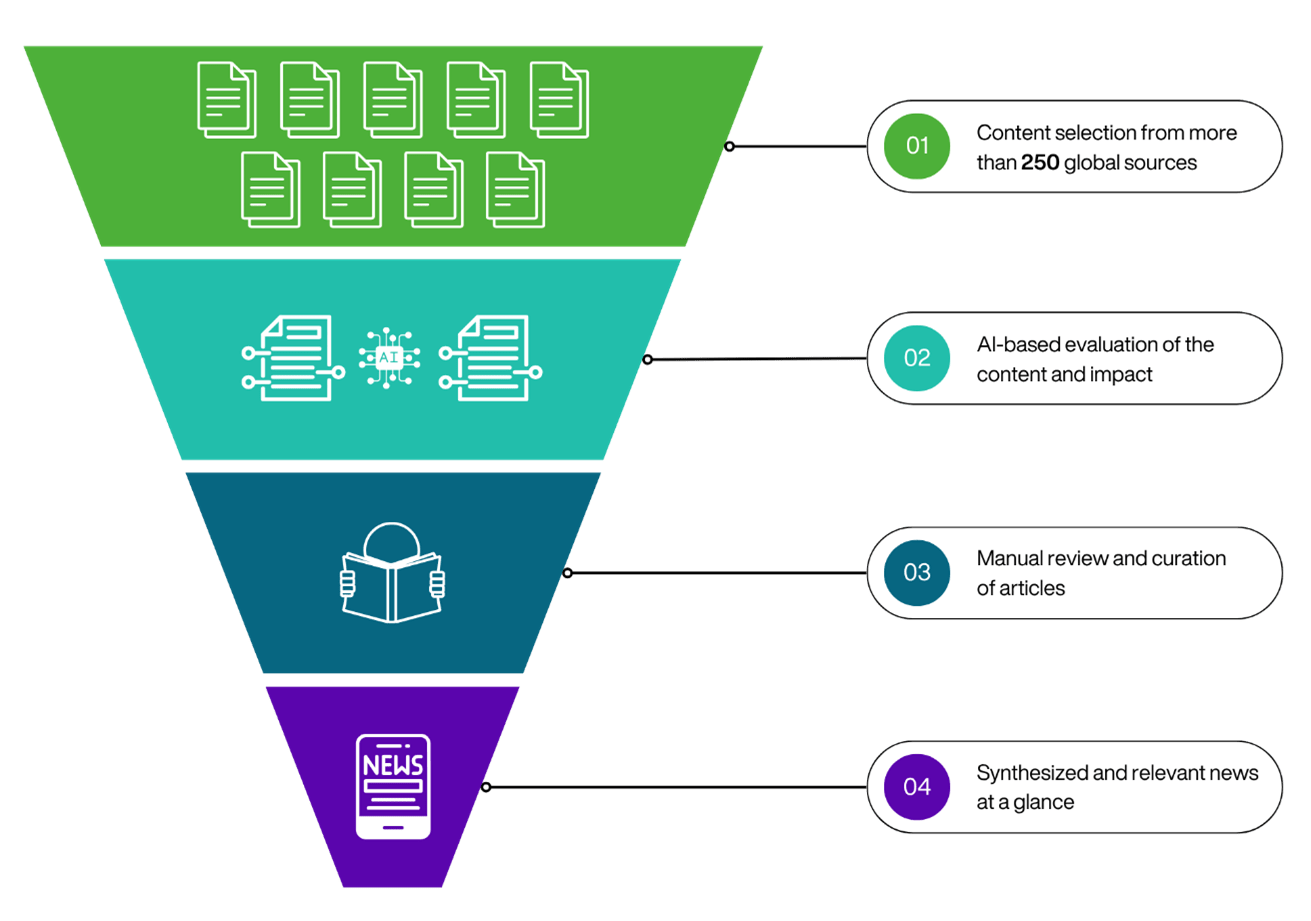
Our process is designed to be both scalable and selective. A broad network of over 250 global sources is continuously screened using six different AIArtificial Intelligence (AI) implies the attempt to transfer human learning and thinking to computers. Computer systems are intended to solve problems—for which a human would require intelligence—using large datasets. In the field of radiology, for example, artificial intelligence can assist physicians in diagnosing findings and detecting abnormali… Explained in the video. tools. These tools help surface relevant content, which is then passed through a multi-step filtering and evaluation process that emphasizes innovation and impact.
In the final stage, selected articles are reviewed and curated by our team before being published. The result is a dynamic, well-structured view of what truly matters in the digital health ecosystem. This way you always stay ahead of the curve.
Contact
E-Mail:
atlas-itg@uni-wh.deInnovation in Healthcare
Alfred-Herrhausen-Straße 50
58448 Witten, Germany