

DIGI-HEALTH MONITOR Calendar Week 5, 2026
DIGI-HEALTH MONITOR:
Calendar Week 5, 2026
New Evidence-Based AIArtificial Intelligence (AI) implies the attempt to transfer human learning and thinking to computers. Computer systems are intended to solve problems—for which a human would require intelligence—using large datasets. In the field of radiology, for example, artificial intelligence can assist physicians in diagnosing findings and detecting abnormali… Explained in the video. Tools Can Help Detect Dementia Earlier
AI-powered digital cognitive assessments are emerging as tools to detect early signs of dementia during routine primary care visits. Linus Health’s platform analyzes speech, memory, and task performance to identify subtle changes linked to Alzheimer’s pathology. The approach supports earlier referrals, proactive planning, and reduced specialist bottlenecks, particularly in underserved areas. While peer-reviewed evidence is cited, the article provides limited detail on specific pilots, deployment scale, or governance practices. Privacy, bias mitigation, and workflow integration challenges are mentioned only briefly. The technology is promising, but remains earlier-stage compared with higher-ranked, system-wide deployments.
The Rise of AIArtificial Intelligence (AI) implies the attempt to transfer human learning and thinking to computers. Computer systems are intended to solve problems—for which a human would require intelligence—using large datasets. In the field of radiology, for example, artificial intelligence can assist physicians in diagnosing findings and detecting abnormali… Explained in the video. Clinicians: Collaboration in Complex Diagnoses
AIArtificial Intelligence (AI) implies the attempt to transfer human learning and thinking to computers. Computer systems are intended to solve problems—for which a human would require intelligence—using large datasets. In the field of radiology, for example, artificial intelligence can assist physicians in diagnosing findings and detecting abnormali… Explained in the video. is increasingly being deployed as a collaborative diagnostic partner rather than an autonomous decision-maker, with real-world examples from major health systems. Mayo Clinic is highlighted for deploying an AI-enabled digital stethoscope that doubles detection rates for pregnancy-related heart failure compared with traditional methods. Additional deployments include AI-assisted CT analysis for pulmonary nodules, achieving high sensitivity and specificity in routine workflows. These tools process large volumes of imaging, genomic, and clinical data, reducing cognitive load for clinicians and allowing more focus on interpretation, treatment planning, and patient interaction. The article emphasizes clinician oversight, noting that AIArtificial Intelligence (AI) implies the attempt to transfer human learning and thinking to computers. Computer systems are intended to solve problems—for which a human would require intelligence—using large datasets. In the field of radiology, for example, artificial intelligence can assist physicians in diagnosing findings and detecting abnormali… Explained in the video. lacks moral judgment, accountability, and contextual understanding. Governance considerations include explainability, bias monitoring, equity audits, and continuous validation across diverse populations. Challenges remain in integration, performance variability, and trust. The article’s strength lies in concrete clinical use cases with measurable diagnostic improvement, though it is less focused on system-wide deployment or operational scaling beyond flagship institutions.
What Does OpenAI and Anthropic’s Healthcare Push Mean for the Future of Medical AI?
OpenAI and Anthropic are expanding from general-purpose AIArtificial Intelligence (AI) implies the attempt to transfer human learning and thinking to computers. Computer systems are intended to solve problems—for which a human would require intelligence—using large datasets. In the field of radiology, for example, artificial intelligence can assist physicians in diagnosing findings and detecting abnormali… Explained in the video. into healthcare through pilots embedded in clinical and patient-facing workflows. Health systems are testing conversational agents for intake, symptom triage, care navigation, and clinician documentation support within EHR environments. The article highlights active pilots involving real clinicians, while emphasizing governance concerns around hallucinations, bias, and the regulatory boundary between information tools and medical devices. Health leaders describe oversight structures, human-in-the-loop requirements, and policies governing AI-generated content before it enters clinical records. Data use agreements and model fine-tuning on protected health information are identified as unresolved challenges. The piece balances opportunity with risk, noting scalability benefits alongside dependency concerns when relying on a small number of foundational model providers. While early-stage, the implementations described reflect real operational experimentation shaping future clinical AIArtificial Intelligence (AI) implies the attempt to transfer human learning and thinking to computers. Computer systems are intended to solve problems—for which a human would require intelligence—using large datasets. In the field of radiology, for example, artificial intelligence can assist physicians in diagnosing findings and detecting abnormali… Explained in the video. architectures.
ECRI Names Misuse of AIArtificial Intelligence (AI) implies the attempt to transfer human learning and thinking to computers. Computer systems are intended to solve problems—for which a human would require intelligence—using large datasets. In the field of radiology, for example, artificial intelligence can assist physicians in diagnosing findings and detecting abnormali… Explained in the video. Chatbots as Top Health Tech Hazard for 2026
ECRI has identified misuse of AIArtificial Intelligence (AI) implies the attempt to transfer human learning and thinking to computers. Computer systems are intended to solve problems—for which a human would require intelligence—using large datasets. In the field of radiology, for example, artificial intelligence can assist physicians in diagnosing findings and detecting abnormali… Explained in the video. chatbots as the leading health technology hazard for 2026, reflecting their rapid, ungoverned adoption in clinical and patient-facing contexts. The article documents real scenarios where clinicians and patients use publicly available chatbots to interpret lab results, draft patient communications, or seek clinical guidance. ECRI highlights failure modes including hallucinated advice, documentation errors, and inappropriate recommendations that can propagate through care workflows. CybersecurityCybersecurity represents an extension of information security. It goes beyond the boundaries of traditional information security and encompasses, in addition to the protection of information resources, also the protection of other assets including the individual. In cybersecurity, the human factor gains an additional dimension: the person as a pote… Explained in the video. risks are also emphasized, particularly when staff enter sensitive data into third-party tools or when adversarial prompts influence outputs. Safety experts advocate for explicit organizational policies, approved AIArtificial Intelligence (AI) implies the attempt to transfer human learning and thinking to computers. Computer systems are intended to solve problems—for which a human would require intelligence—using large datasets. In the field of radiology, for example, artificial intelligence can assist physicians in diagnosing findings and detecting abnormali… Explained in the video. environments, staff training, and continuous monitoring. While the article focuses more on risk than innovation, its relevance is high due to widespread, informal AIArtificial Intelligence (AI) implies the attempt to transfer human learning and thinking to computers. Computer systems are intended to solve problems—for which a human would require intelligence—using large datasets. In the field of radiology, for example, artificial intelligence can assist physicians in diagnosing findings and detecting abnormali… Explained in the video. use already occurring in healthcare organizations. The recommendations directly inform governance, procurement, and incident response strategies across health systems.
Health-ISAC 2026 Report Details Rising Cyber Threats Across Global Health Sector
Health-ISAC’s 2026 Global Health Sector Threat Landscape Report documents a sharp rise in ransomware attacks and exploitation of third-party suppliers across healthcare organizations worldwide. The report identifies 455 ransomware incidents and highlights emerging tactics such as QR-code phishing and AI-enabled social engineering. As healthcare infrastructure becomes increasingly cloud-based and interconnected, the attack surface continues to expand, turning cybersecurityCybersecurity represents an extension of information security. It goes beyond the boundaries of traditional information security and encompasses, in addition to the protection of information resources, also the protection of other assets including the individual. In cybersecurity, the human factor gains an additional dimension: the person as a pote… Explained in the video. incidents into patient safety and business continuity risks. While the report is grounded in real incident tracking and draws on data from member organizations, it functions primarily as an analytical overview rather than a description of specific defensive deployments or workflow changes. Recommendations emphasize treating cybersecurityCybersecurity represents an extension of information security. It goes beyond the boundaries of traditional information security and encompasses, in addition to the protection of information resources, also the protection of other assets including the individual. In cybersecurity, the human factor gains an additional dimension: the person as a pote… Explained in the video. as a core component of clinical resilience, but implementation detail, governance structures, and lessons learned from specific health systems are limited. The article is valuable for situational awareness and executive briefing purposes, but weaker on practical transfer of deployment knowledge compared with higher-ranked items.
The Global Digi-Health Monitor is our weekly published newsletter featuring curated updates on the latest developments in digital health. With a focus on innovation and relevance, it brings together key news across topics such as AIArtificial Intelligence (AI) implies the attempt to transfer human learning and thinking to computers. Computer systems are intended to solve problems—for which a human would require intelligence—using large datasets. In the field of radiology, for example, artificial intelligence can assist physicians in diagnosing findings and detecting abnormali… Explained in the video. in healthcare, wearables,Wearables refer to technologies in the form of sensors or mobile applications that collect health data asynchronously and beyond the boundaries of medical care. They include wristbands, smartwatches, and other mobile sensors. These measure and collect data such as blood glucose levels, pulse, or sleep data, and transmit this information either auto… telemedicine,Telemedicine encompasses various healthcare delivery concepts characterized by direct patient care across geographical distances or time delays. This includes diagnostic, therapeutic, rehabilitative, and consultative services delivered through information and communication technologies. Particularly with regard to rural areas, telemedicine offers s… Explained in the video. cybersecurity, and more.
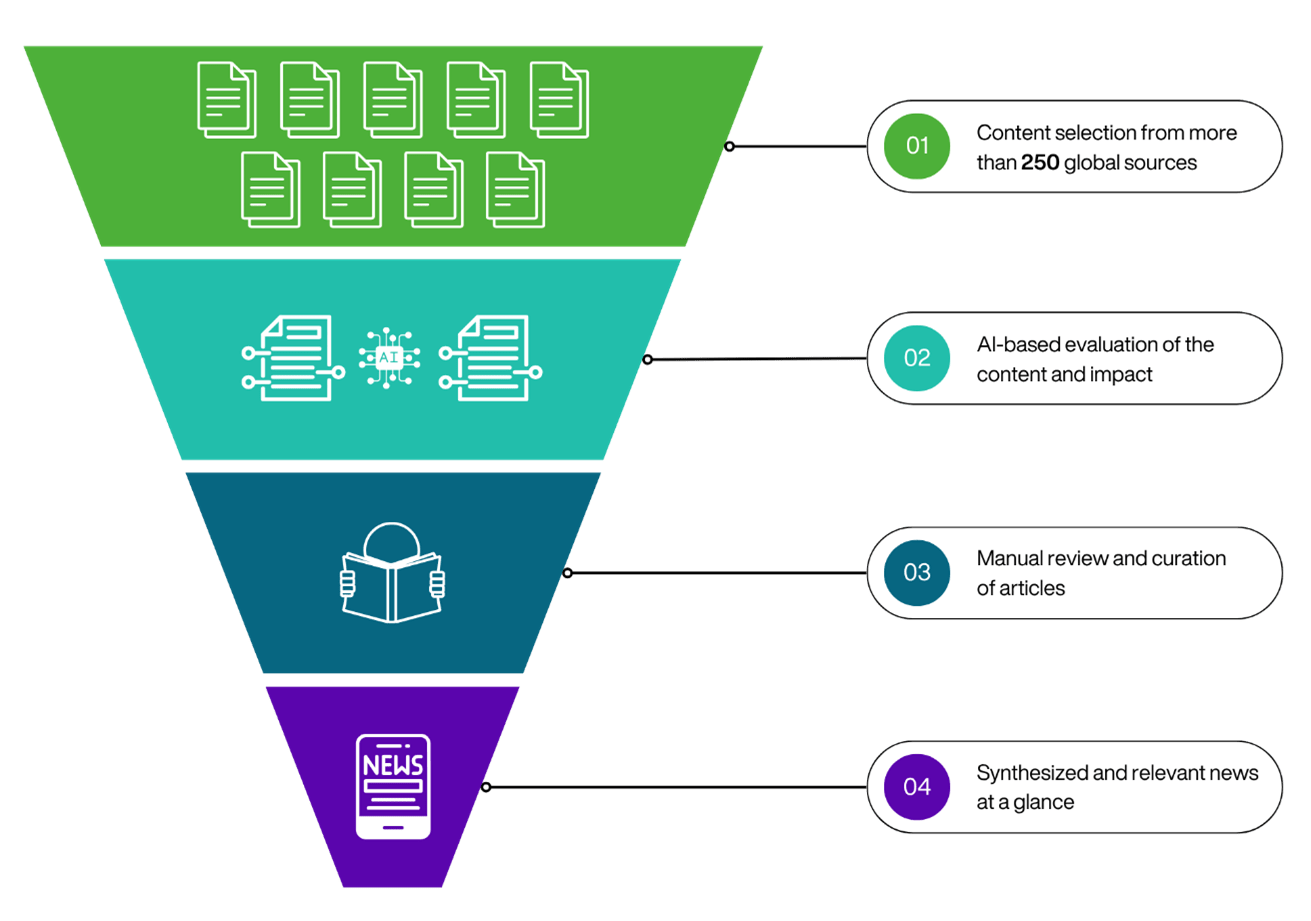
Our process is designed to be both scalable and selective. A broad network of over 250 global sources is continuously screened using six different AIArtificial Intelligence (AI) implies the attempt to transfer human learning and thinking to computers. Computer systems are intended to solve problems—for which a human would require intelligence—using large datasets. In the field of radiology, for example, artificial intelligence can assist physicians in diagnosing findings and detecting abnormali… Explained in the video. tools. These tools help surface relevant content, which is then passed through a multi-step filtering and evaluation process that emphasizes innovation and impact.
In the final stage, selected articles are reviewed and curated by our team before being published. The result is a dynamic, well-structured view of what truly matters in the digital health ecosystem. This way you always stay ahead of the curve.
Contact
E-Mail:
atlas-itg@uni-wh.deInnovation in Healthcare
Alfred-Herrhausen-Straße 50
58448 Witten, Germany