

DIGI-HEALTH MONITOR Calendar Week 4, 2026
DIGI-HEALTH MONITOR:
Calendar Week 4, 2026
NHS backs AIArtificial Intelligence (AI) implies the attempt to transfer human learning and thinking to computers. Computer systems are intended to solve problems—for which a human would require intelligence—using large datasets. In the field of radiology, for example, artificial intelligence can assist physicians in diagnosing findings and detecting abnormali… Explained in the video. notetaking to free up more face-to-face care
NHS England, the public health authority overseeing healthcare services in England, has endorsed ambient voice AIArtificial Intelligence (AI) implies the attempt to transfer human learning and thinking to computers. Computer systems are intended to solve problems—for which a human would require intelligence—using large datasets. In the field of radiology, for example, artificial intelligence can assist physicians in diagnosing findings and detecting abnormali… Explained in the video. notetaking technologies to reduce administrative burdens and enhance patient-clinician interactions. A national registrySpecifically, a registry is a database system in which information relating to a particular disease or population is collected. In Germany, for example, there is an epidemiological cancer registry that maps the spread of cancer. It shows, among other things, how often a particular type of cancer occurs in a region. The information serves as… of 19 self-certified suppliers compliant with clinical safety, reliability, and data protection standards has been established to facilitate adoption. Great Ormond Street Hospital for Children NHS Foundation Trust’s Innovation Unit led a pilot study across nine NHS sites in London, encompassing hospitals, general practices, mental health services, and ambulance teams. The implementation involved over 17,000 real patient encounters where clinicians, including doctors, nurses, and paramedics, used the AIArtificial Intelligence (AI) implies the attempt to transfer human learning and thinking to computers. Computer systems are intended to solve problems—for which a human would require intelligence—using large datasets. In the field of radiology, for example, artificial intelligence can assist physicians in diagnosing findings and detecting abnormali… Explained in the video. tools during consultations. The technology captures conversations in the background, transcribes them, and generates editable clinical summaries for integration into electronic health records. Key outcomes include a 23.5% increase in direct patient interaction time, an 8.2% reduction in appointment duration, and a 13.4% rise in patients seen per shift in accident and emergency departments, equating to 2-3 minutes saved per consultation. This could enable additional patient appointments and yield financial savings in the millions if scaled nationally, improving operational efficiency and patient satisfaction. No adverse safety events occurred. Governance relies on NHS standards for risk mitigation, including data security. Next steps involve promoting registrySpecifically, a registry is a database system in which information relating to a particular disease or population is collected. In Germany, for example, there is an epidemiological cancer registry that maps the spread of cancer. It shows, among other things, how often a particular type of cancer occurs in a region. The information serves as… use for widespread NHS adoption to alleviate workforce pressures and ensure equitable care delivery.
AIArtificial Intelligence (AI) implies the attempt to transfer human learning and thinking to computers. Computer systems are intended to solve problems—for which a human would require intelligence—using large datasets. In the field of radiology, for example, artificial intelligence can assist physicians in diagnosing findings and detecting abnormali… Explained in the video. adoption in hospitals clusters regionally, lags in underserved areas: Report
Hospitals throughout the United States have integrated AI-based predictive models into clinical operations, with 48.8% of surveyed facilities reporting usage based on 2023-2024 data from 3,560 hospitals in the American Hospital Association’s IT Supplement. These models, often supplied by electronic health record vendors, primarily forecast patient health trajectories to support decision-making and streamline care delivery. Adoption varies regionally, forming “hotspots” in areas like the South Atlantic Division and “coldspots” in underserved regions such as the West South Central Division and Health Professional Shortage Areas, where workforce constraints exacerbate gaps. Clinicians engage with these tools in daily workflows, though 47.4% of hospitals skip performance evaluations and 51.4% neglect bias assessments. Outcomes focus on adoption disparities rather than direct clinical metrics, revealing uneven access that may hinder equity in care quality. Challenges include regional clustering, potential selection bias from a 58.4% response rate, and insufficient model scrutiny, risking inaccuracies and biases. Governance is limited, with calls for standardized metrics and context-aware strategies. Lessons learned emphasize targeting underserved areas for interventions to promote scalable, replicable AIArtificial Intelligence (AI) implies the attempt to transfer human learning and thinking to computers. Computer systems are intended to solve problems—for which a human would require intelligence—using large datasets. In the field of radiology, for example, artificial intelligence can assist physicians in diagnosing findings and detecting abnormali… Explained in the video. use across systems, potentially improving population health in high-need communities. Next steps involve mapping adoption patterns to guide policy and resource allocation for broader, equitable implementation.
Samaritan Medical Center Launches Nation’s First Deployment of GE HealthCare’s Portrait Mobile Continuous Wireless Patient Monitoring Technology
Samaritan Medical Center in Watertown, New York achieved the first deployment in the United States of GE HealthCare’s Portrait Ecosystem on January 16, 2026. This system includes Portrait VSM vital signs monitors and Portrait Mobile, a continuous wireless wearable monitoring solution. The technology replaced aging monitoring equipment and enables real-time continuous monitoring of blood pressure, pulse rate, oxygen saturation, body temperature, and respiratory rate without limiting patient mobility. Portrait Mobile allows patients to move freely throughout the ward while medical personnel continuously track vital signs through wireless connectivity. The data integrates seamlessly with the Electronic Medical Record (EMR), eliminating delays from manual data entry. The platform is designed to help clinicians detect patient deterioration early and is particularly valuable for continuous pulse oximetry monitoring. The implementation was achieved through collaboration between GE HealthCare and Samaritan’s Information Technology and Biomed teams. Portrait Mobile and Portrait VSM units have been deployed across several medical/surgical units, with additional devices scheduled for rollout in coming weeks. John Green, Vice President of Patient Care Services, characterized this as a significant advancement in patient care, workflow efficiency, and clinical insight.
The Landscape of AIArtificial Intelligence (AI) implies the attempt to transfer human learning and thinking to computers. Computer systems are intended to solve problems—for which a human would require intelligence—using large datasets. In the field of radiology, for example, artificial intelligence can assist physicians in diagnosing findings and detecting abnormali… Explained in the video. Implementation in US Hospitals: Baseline Evidence of Geographical Disparities and Spatial Clustering
A nationwide geospatial study published in Nature Health on January 15, 2026 analyzed AIArtificial Intelligence (AI) implies the attempt to transfer human learning and thinking to computers. Computer systems are intended to solve problems—for which a human would require intelligence—using large datasets. In the field of radiology, for example, artificial intelligence can assist physicians in diagnosing findings and detecting abnormali… Explained in the video. implementation patterns across 3,560 U.S. hospitals using 2023-2024 American Hospital Association data. Researchers from Stanford Medicine and partners examined where AI-based predictive models were deployed and identified factors associated with implementation. Of surveyed hospitals, 48.8% adopted AI-based predictive models, 16.0% used non-AI predictive models, and 29.3% reported using no predictive models. The study revealed pronounced geographical disparities: hospitals in areas with healthcare provider shortages (health professional shortage areas) and medically underserved areas showed significantly lower AIArtificial Intelligence (AI) implies the attempt to transfer human learning and thinking to computers. Computer systems are intended to solve problems—for which a human would require intelligence—using large datasets. In the field of radiology, for example, artificial intelligence can assist physicians in diagnosing findings and detecting abnormali… Explained in the video. adoption rates, with implementation ratios ranging from 0.40 to 0.85, indicating that high-need regions had substantially lower AIArtificial Intelligence (AI) implies the attempt to transfer human learning and thinking to computers. Computer systems are intended to solve problems—for which a human would require intelligence—using large datasets. In the field of radiology, for example, artificial intelligence can assist physicians in diagnosing findings and detecting abnormali… Explained in the video. deployment. The South Atlantic census division showed the highest AIArtificial Intelligence (AI) implies the attempt to transfer human learning and thinking to computers. Computer systems are intended to solve problems—for which a human would require intelligence—using large datasets. In the field of radiology, for example, artificial intelligence can assist physicians in diagnosing findings and detecting abnormali… Explained in the video. adoption, while regions with greater healthcare access needs demonstrated consistently lower implementation. Interoperability capabilities (measured by “core index” and “friction index”) emerged as the strongest predictors of AIArtificial Intelligence (AI) implies the attempt to transfer human learning and thinking to computers. Computer systems are intended to solve problems—for which a human would require intelligence—using large datasets. In the field of radiology, for example, artificial intelligence can assist physicians in diagnosing findings and detecting abnormali… Explained in the video. adoption. The analysis identified specific hotspots and coldspots of AIArtificial Intelligence (AI) implies the attempt to transfer human learning and thinking to computers. Computer systems are intended to solve problems—for which a human would require intelligence—using large datasets. In the field of radiology, for example, artificial intelligence can assist physicians in diagnosing findings and detecting abnormali… Explained in the video. implementation through spatial clustering methods, providing geographical targets for policy intervention. Geographically weighted regression revealed that factors influencing AIArtificial Intelligence (AI) implies the attempt to transfer human learning and thinking to computers. Computer systems are intended to solve problems—for which a human would require intelligence—using large datasets. In the field of radiology, for example, artificial intelligence can assist physicians in diagnosing findings and detecting abnormali… Explained in the video. adoption vary substantially by region, suggesting that one-size-fits-all deployment strategies may be ineffective. The researchers emphasized that higher AIArtificial Intelligence (AI) implies the attempt to transfer human learning and thinking to computers. Computer systems are intended to solve problems—for which a human would require intelligence—using large datasets. In the field of radiology, for example, artificial intelligence can assist physicians in diagnosing findings and detecting abnormali… Explained in the video. adoption does not necessarily indicate better outcomes, as implementation quality and local appropriateness remain critical unmeasured factors. The study provides baseline data for understanding early-stage AIArtificial Intelligence (AI) implies the attempt to transfer human learning and thinking to computers. Computer systems are intended to solve problems—for which a human would require intelligence—using large datasets. In the field of radiology, for example, artificial intelligence can assist physicians in diagnosing findings and detecting abnormali… Explained in the video. deployment patterns and highlights the need for regionally tailored implementation strategies addressing local contexts and healthcare capacity constraints.
CommonSpirit CEO Signals New Divestitures, Highlights AIArtificial Intelligence (AI) implies the attempt to transfer human learning and thinking to computers. Computer systems are intended to solve problems—for which a human would require intelligence—using large datasets. In the field of radiology, for example, artificial intelligence can assist physicians in diagnosing findings and detecting abnormali… Explained in the video. Wins and Challenges at JPM2026
CommonSpirit Health (a ~$40B Catholic health system) described enterprise-wide AIArtificial Intelligence (AI) implies the attempt to transfer human learning and thinking to computers. Computer systems are intended to solve problems—for which a human would require intelligence—using large datasets. In the field of radiology, for example, artificial intelligence can assist physicians in diagnosing findings and detecting abnormali… Explained in the video. deployment progress and measurable operational/clinical impacts shared in the JPM2026 context. CEO Wright Lassiter said the organization is running 242 AIArtificial Intelligence (AI) implies the attempt to transfer human learning and thinking to computers. Computer systems are intended to solve problems—for which a human would require intelligence—using large datasets. In the field of radiology, for example, artificial intelligence can assist physicians in diagnosing findings and detecting abnormali… Explained in the video. tools spanning clinical and operational workflows—examples called out include automated clinical note-taking, patient call processing, and AI-supported triage for neurologic emergencies. Reported outcomes included ~$100M in annual value attributed to these AIArtificial Intelligence (AI) implies the attempt to transfer human learning and thinking to computers. Computer systems are intended to solve problems—for which a human would require intelligence—using large datasets. In the field of radiology, for example, artificial intelligence can assist physicians in diagnosing findings and detecting abnormali… Explained in the video. initiatives and a >40% reduction in door-to-treatment times for neuro-emergency triage across more than 50 facilities. The system also highlighted an AI-enabled sepsis monitoring program (active since 2015) that it said contributed to saving 3,655 patients in fiscal year 2025. Governance and workforce readiness were positioned as core constraints/risks: Lassiter emphasized “responsible AI” and warned against using AIArtificial Intelligence (AI) implies the attempt to transfer human learning and thinking to computers. Computer systems are intended to solve problems—for which a human would require intelligence—using large datasets. In the field of radiology, for example, artificial intelligence can assist physicians in diagnosing findings and detecting abnormali… Explained in the video. purely for cost/profit protection at the expense of patient care, while also noting the need to mitigate workforce disruption through training. CommonSpirit launched an AIArtificial Intelligence (AI) implies the attempt to transfer human learning and thinking to computers. Computer systems are intended to solve problems—for which a human would require intelligence—using large datasets. In the field of radiology, for example, artificial intelligence can assist physicians in diagnosing findings and detecting abnormali… Explained in the video. Workforce Readiness Academy (reported as ~18 months prior) to reskill/upskill several thousand employees, framing this as necessary both for safe deployment and for maintaining the health system’s role as a major local employer.
The Global Digi-Health Monitor is our weekly published newsletter featuring curated updates on the latest developments in digital health. With a focus on innovation and relevance, it brings together key news across topics such as AIArtificial Intelligence (AI) implies the attempt to transfer human learning and thinking to computers. Computer systems are intended to solve problems—for which a human would require intelligence—using large datasets. In the field of radiology, for example, artificial intelligence can assist physicians in diagnosing findings and detecting abnormali… Explained in the video. in healthcare, wearables,Wearables refer to technologies in the form of sensors or mobile applications that collect health data asynchronously and beyond the boundaries of medical care. They include wristbands, smartwatches, and other mobile sensors. These measure and collect data such as blood glucose levels, pulse, or sleep data, and transmit this information either auto… telemedicine,Telemedicine encompasses various healthcare delivery concepts characterized by direct patient care across geographical distances or time delays. This includes diagnostic, therapeutic, rehabilitative, and consultative services delivered through information and communication technologies. Particularly with regard to rural areas, telemedicine offers s… Explained in the video. cybersecurity, and more.
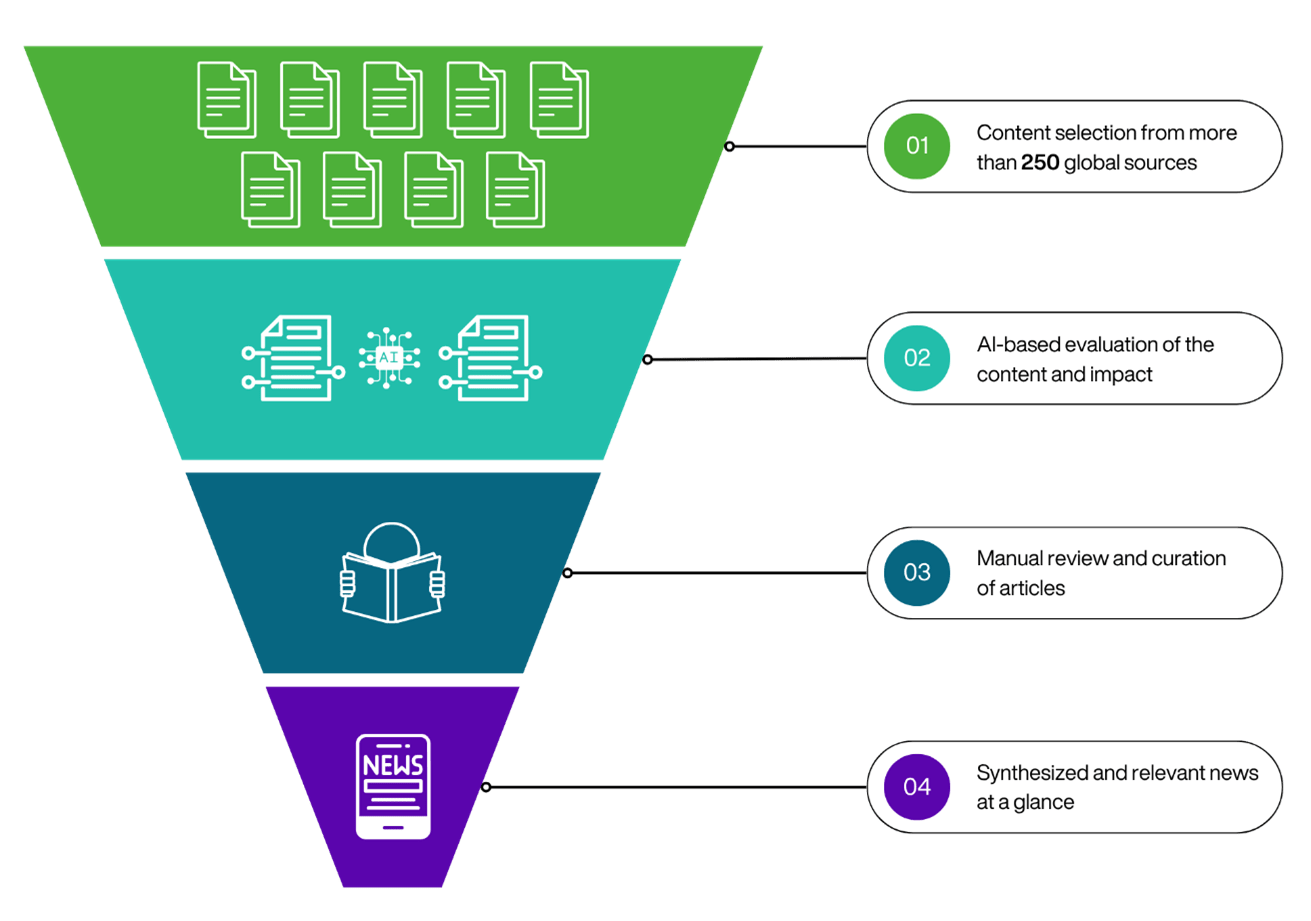
Our process is designed to be both scalable and selective. A broad network of over 250 global sources is continuously screened using six different AIArtificial Intelligence (AI) implies the attempt to transfer human learning and thinking to computers. Computer systems are intended to solve problems—for which a human would require intelligence—using large datasets. In the field of radiology, for example, artificial intelligence can assist physicians in diagnosing findings and detecting abnormali… Explained in the video. tools. These tools help surface relevant content, which is then passed through a multi-step filtering and evaluation process that emphasizes innovation and impact.
In the final stage, selected articles are reviewed and curated by our team before being published. The result is a dynamic, well-structured view of what truly matters in the digital health ecosystem. This way you always stay ahead of the curve.
Contact
E-Mail:
atlas-itg@uni-wh.deInnovation in Healthcare
Alfred-Herrhausen-Straße 50
58448 Witten, Germany