

DIGI-HEALTH MONITOR Calendar Week 3, 2026
DIGI-HEALTH MONITOR:
Calendar Week 3, 2026
Great Ormond Street Hospital launches an in-house platform to generate clinical intelligence from routine health dataHealth data, also referred to as patient data, encompasses all information relating to the health status of a person. This includes demographic records as well as medical history, vaccination status, and advance directives. Health data constitutes a special category of personal data under GDPR Article 9, subject to strict additional regulations due…
Great Ormond Street Hospital (GOSH) describes the launch of PICTURE, an in-house platform built by its DRIVE unit to turn routine EPR data into usable clinical and operational insight. The implementation centers on aggregating de-identified cohort data, transforming it via an ETL library into a local common data model, then applying a library of analytics functions, for example frequency and measures-of-association analyses, to answer user queries. The design choice, using open-source languages such as R and Python, is meant to make analytic capability extensible, so new functions can be added when existing ones do not meet clinical or operational needs. The article links the platform to broader deployment activity at GOSH, including an inpatient portal rollout, Bedside MyChart, with rapid adoption reported as 38% of inpatients engaging in the first month, and a reported saving of more than 24 hours of nursing time, positioning this as a concrete operational outcome tied to digital workflow change. It also references a strong emphasis on safety and governance for related AIArtificial Intelligence (AI) implies the attempt to transfer human learning and thinking to computers. Computer systems are intended to solve problems—for which a human would require intelligence—using large datasets. In the field of radiology, for example, artificial intelligence can assist physicians in diagnosing findings and detecting abnormali… Explained in the video. deployments, citing “detailed and thorough safety checks,” clinician testing, and early phase testing with 100 real patients for an ambient AIArtificial Intelligence (AI) implies the attempt to transfer human learning and thinking to computers. Computer systems are intended to solve problems—for which a human would require intelligence—using large datasets. In the field of radiology, for example, artificial intelligence can assist physicians in diagnosing findings and detecting abnormali… Explained in the video. assistant, alongside plans to scale to 5,000 patients across London settings. Next steps highlighted include potential multi-site federated analytics, enabling collaboration without centralising sensitive data.
Sectra begins implementing its first digital pathology project in Japan at Kameda Medical Center
Sectra reports that it has commenced implementation of its first digital pathology project in Japan, deploying its digital pathology module at Kameda Medical Center in collaboration with distribution partner Matsunami Glass. The implementation follows a contract signed in Sectra’s 2025/2026 fiscal year and moves Kameda toward a comprehensive digital pathology module rather than a scanner-restricted workflow. In practice, the change replaces reliance on physical glass slides viewed under microscopes with a digital workflow that provides instant access, and when needed remote access, to digital tissue images. The solution is described as tightly integrated with AIArtificial Intelligence (AI) implies the attempt to transfer human learning and thinking to computers. Computer systems are intended to solve problems—for which a human would require intelligence—using large datasets. In the field of radiology, for example, artificial intelligence can assist physicians in diagnosing findings and detecting abnormali… Explained in the video. tools, intended to support pathologists’ case review and collaboration, which directly affects clinical workflow by enabling faster sharing, second opinions, and more consistent access to diagnostic images across locations. Clinician involvement is explicit through the hospital’s pathology leadership, with Kameda’s Chair of Pathology highlighting interoperability and data security as key selection criteria, signaling governance priorities around secure handling of diagnostic data. Reported outcomes at this stage are qualitative but concrete: improved access and collaboration around cases enabled by digitisation and integrated AIArtificial Intelligence (AI) implies the attempt to transfer human learning and thinking to computers. Computer systems are intended to solve problems—for which a human would require intelligence—using large datasets. In the field of radiology, for example, artificial intelligence can assist physicians in diagnosing findings and detecting abnormali… Explained in the video. support, with the stated aim of improving cancer diagnostics and decreasing time to treatment. Next steps implied by the announcement are completion of the implementation phase and operationalisation across the pathology service, potentially setting a precedent for wider digital pathology adoption in Japan.
AIArtificial Intelligence (AI) implies the attempt to transfer human learning and thinking to computers. Computer systems are intended to solve problems—for which a human would require intelligence—using large datasets. In the field of radiology, for example, artificial intelligence can assist physicians in diagnosing findings and detecting abnormali… Explained in the video. and RPA Integration in Specialty Care at Gillette Children’s and Southwest General Health Center
Gillette Children’s, a specialty pediatric hospital, implemented RPA for scheduling and access management, alongside generative AIArtificial Intelligence (AI) implies the attempt to transfer human learning and thinking to computers. Computer systems are intended to solve problems—for which a human would require intelligence—using large datasets. In the field of radiology, for example, artificial intelligence can assist physicians in diagnosing findings and detecting abnormali… Explained in the video. for analyzing clinical notes (achieving 99% accuracy on 500 records) and summarizing health information exchange (HIE) data. Led by Chief Enterprise Architect Andy Levesque, clinicians including physicians and nurses integrated these tools into workflows for patient cohorting and analysis. The deployment improved scheduling efficiency and patient satisfaction, with better cohort management enabling personalized care. Outcomes included reduced costs through automation and enhanced outcomes via data-driven insights. Southwest General Health Center adopted AIArtificial Intelligence (AI) implies the attempt to transfer human learning and thinking to computers. Computer systems are intended to solve problems—for which a human would require intelligence—using large datasets. In the field of radiology, for example, artificial intelligence can assist physicians in diagnosing findings and detecting abnormali… Explained in the video. for outbound patient outreach (via a tool named “Hope”) and engagement, overseen by CIO Jae Zayed. Care teams used it for proactive communication, integrating into nursing and provider workflows. Results featured improved access, better patient outcomes, and cost reductions. Both organizations emphasized starting with unsolved problems, prioritizing governance and risk assessments, and providing AIArtificial Intelligence (AI) implies the attempt to transfer human learning and thinking to computers. Computer systems are intended to solve problems—for which a human would require intelligence—using large datasets. In the field of radiology, for example, artificial intelligence can assist physicians in diagnosing findings and detecting abnormali… Explained in the video. literacy training to overcome skepticism. Challenges involved ethical embedding and bias risks, addressed through transparency. No specific regulatory approvals were mentioned, but data governance followed standards like FHIR. Lessons learned focused on quick wins for trust-building and enhancing critical thinking with AI.Artificial Intelligence (AI) implies the attempt to transfer human learning and thinking to computers. Computer systems are intended to solve problems—for which a human would require intelligence—using large datasets. In the field of radiology, for example, artificial intelligence can assist physicians in diagnosing findings and detecting abnormali… Explained in the video. Next steps include scaling across specialties and sharing best practices for wider adoption.
Aggregated Insights from AIArtificial Intelligence (AI) implies the attempt to transfer human learning and thinking to computers. Computer systems are intended to solve problems—for which a human would require intelligence—using large datasets. In the field of radiology, for example, artificial intelligence can assist physicians in diagnosing findings and detecting abnormali… Explained in the video. Deployments in U.S., U.K., and Ireland Healthcare Organizations
Presidio Research surveyed healthcare organizations in the U.S., U.K., and Ireland that deployed AIArtificial Intelligence (AI) implies the attempt to transfer human learning and thinking to computers. Computer systems are intended to solve problems—for which a human would require intelligence—using large datasets. In the field of radiology, for example, artificial intelligence can assist physicians in diagnosing findings and detecting abnormali… Explained in the video. for real-time data use and integration. Organizations, including hospitals and clinics, adopted AIArtificial Intelligence (AI) implies the attempt to transfer human learning and thinking to computers. Computer systems are intended to solve problems—for which a human would require intelligence—using large datasets. In the field of radiology, for example, artificial intelligence can assist physicians in diagnosing findings and detecting abnormali… Explained in the video. in clinical documentation, data analysis, administrative workflows, billing, patient monitoring, and decision support. Clinicians led algorithmAn algorithm is a solution procedure in the form of a systematic rule or approach. A problem is solved by means of a defined sequence of procedural steps. In computer science, algorithms form a fundamental basis of programming. Examples of algorithms include the calculation of the Body Mass Index (BMI), instruction manuals, or rules of … Con… design and nursing integrated into workflows. 34% of U.S. organizations scaled real-time data, 49% in pilots. Outcomes: 58% improved documentation, 57% data analysis, 55% workflows, 52% billing, 51% monitoring and support. Over 90% of clinicians reported enhancements in outcomes tracking, duplicate reduction, staffing, coordination, accuracy, and routing, leading to better patient experience and operational efficiency. Challenges: gap between needs and availability (only 34% scaled), risks of shadow IT without governance. Privacy emphasized data governance for security/transparency, compliance to avoid breaches. Lessons learned: prioritize real-time over pilots for impact; build trust via governance. Next steps: scale across more organizations, focus on clinician training for adoption. No specific locations or approvals mentioned beyond general standards.
Utah permits nation’s first AIArtificial Intelligence (AI) implies the attempt to transfer human learning and thinking to computers. Computer systems are intended to solve problems—for which a human would require intelligence—using large datasets. In the field of radiology, for example, artificial intelligence can assist physicians in diagnosing findings and detecting abnormali… Explained in the video. drug prescriptions
Utah’s Office of Artificial IntelligenceArtificial Intelligence (AI) implies the attempt to transfer human learning and thinking to computers. Computer systems are intended to solve problems—for which a human would require intelligence—using large datasets. In the field of radiology, for example, artificial intelligence can assist physicians in diagnosing findings and detecting abnormali… Explained in the video. Policy launched a live pilot that allows an AIArtificial Intelligence (AI) implies the attempt to transfer human learning and thinking to computers. Computer systems are intended to solve problems—for which a human would require intelligence—using large datasets. In the field of radiology, for example, artificial intelligence can assist physicians in diagnosing findings and detecting abnormali… Explained in the video. system from Doctronic to process prescription renewals for patients with chronic conditions, positioning it as the first U.S. program where refills can be authorized by a bot rather than a physician for a defined list of medications. The workflow keeps clinical guardrails: only refills are eligible, the original prescription must have been written by a human clinician, and certain medication categories are excluded. Patients initiate a renewal through Doctronic’s site, confirm they are in Utah, and complete identity verification using selfies and photo ID, then a chatbot gathers symptoms, medication changes, and relevant history. If eligibility is unclear or criteria are not met, the case is escalated to a human physician via video consult, and during rollout the process includes additional physician review for early prescriptions in each drug class. Reported results include Doctronic’s internal comparison showing the AI’s refill recommendations matched human doctors in more than 99% of cases. Governance is anchored in Utah’s regulatory sandbox approach, where mitigation agreements can temporarily waive rules while the state monitors potential harms, and the state says findings will be shared publicly to inform future policy.
The Global Digi-Health Monitor is our weekly published newsletter featuring curated updates on the latest developments in digital health. With a focus on innovation and relevance, it brings together key news across topics such as AIArtificial Intelligence (AI) implies the attempt to transfer human learning and thinking to computers. Computer systems are intended to solve problems—for which a human would require intelligence—using large datasets. In the field of radiology, for example, artificial intelligence can assist physicians in diagnosing findings and detecting abnormali… Explained in the video. in healthcare, wearables,Wearables refer to technologies in the form of sensors or mobile applications that collect health data asynchronously and beyond the boundaries of medical care. They include wristbands, smartwatches, and other mobile sensors. These measure and collect data such as blood glucose levels, pulse, or sleep data, and transmit this information either auto… telemedicine,Telemedicine encompasses various healthcare delivery concepts characterized by direct patient care across geographical distances or time delays. This includes diagnostic, therapeutic, rehabilitative, and consultative services delivered through information and communication technologies. Particularly with regard to rural areas, telemedicine offers s… Explained in the video. cybersecurity, and more.
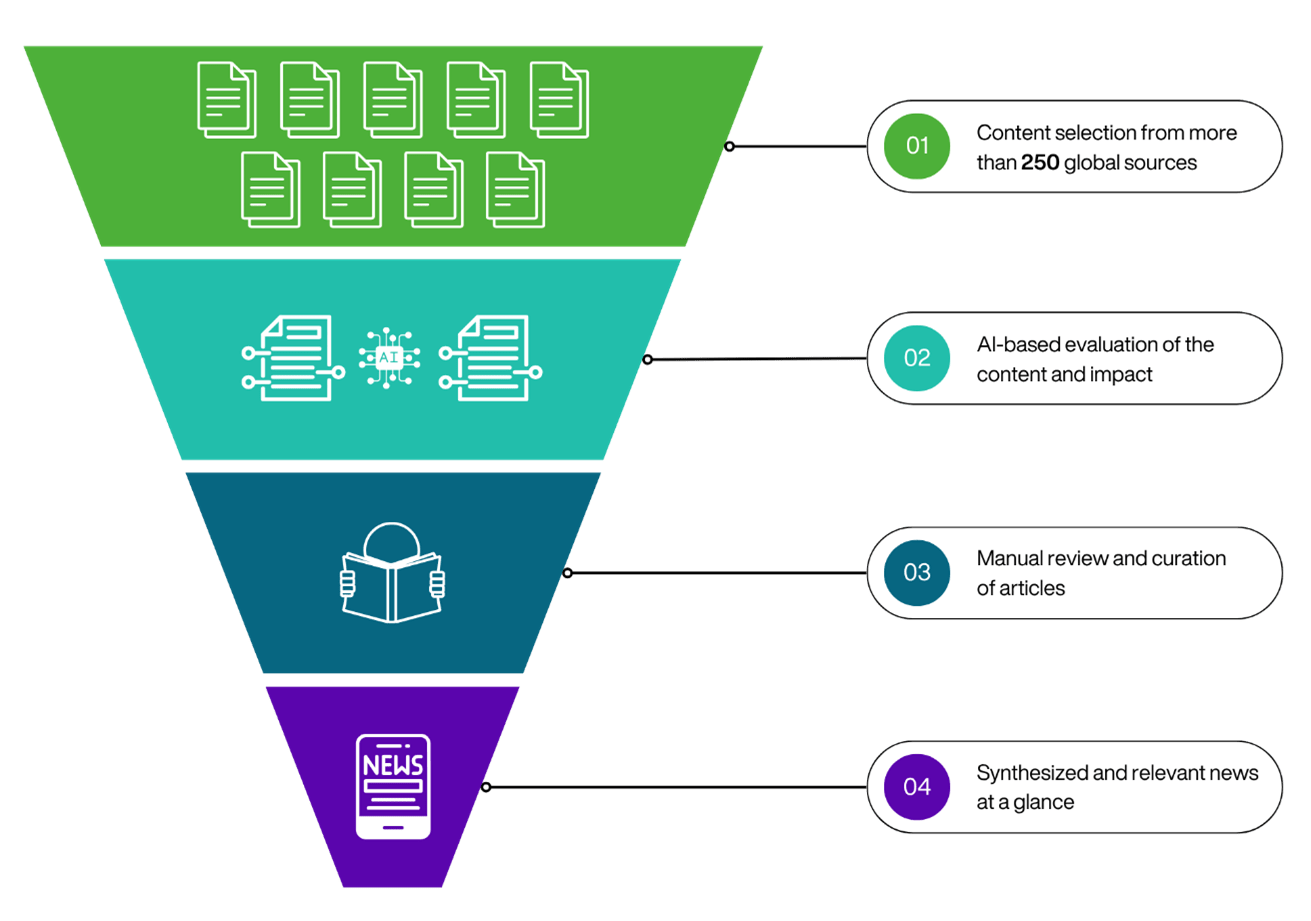
Our process is designed to be both scalable and selective. A broad network of over 250 global sources is continuously screened using six different AIArtificial Intelligence (AI) implies the attempt to transfer human learning and thinking to computers. Computer systems are intended to solve problems—for which a human would require intelligence—using large datasets. In the field of radiology, for example, artificial intelligence can assist physicians in diagnosing findings and detecting abnormali… Explained in the video. tools. These tools help surface relevant content, which is then passed through a multi-step filtering and evaluation process that emphasizes innovation and impact.
In the final stage, selected articles are reviewed and curated by our team before being published. The result is a dynamic, well-structured view of what truly matters in the digital health ecosystem. This way you always stay ahead of the curve.
Contact
E-Mail:
atlas-itg@uni-wh.deInnovation in Healthcare
Alfred-Herrhausen-Straße 50
58448 Witten, Germany