

DIGI-HEALTH MONITOR Calendar Week 2, 2026
DIGI-HEALTH MONITOR:
Calendar Week 2, 2026
MultiCare uses predictive analytics to add 3,200 surgeries in one year
MultiCare Health System addressed fragmentation across its surgical facilities by deploying the LeanTaaS iQueue for Operating Rooms platform. The primary challenge was a decentralized culture where each hospital used unique decision-prioritization frameworks and KPIs, hiding “latent capacity” from staff. MultiCare implemented a central governance structure and standardized metrics across all ORs, using the iQueue dashboards to provide unified visibility into performance benchmarks. The platform facilitates a data-driven approach to block allocation and access management, which allowed the system to add 3,200 surgeries in a single year without expanding physical facilities. Associate Vice President Chris Hunt, RN, emphasized that success required building buy-in among physicians and leadership to align on a shared vision of “systemness.” The transparency provided by the analytics allowed administrators to uncover and activate existing capacity. Challenges included the initial resistance to standardized metrics, which was overcome through forums that shared successful interventions. The program serves as a model for using big data to solve operational inefficiencies in a post-consolidation environment, focusing on evidence-based decision-making.
Stanford Healthcare cuts EHR training time by half while increasing learning retention
Stanford Health Care implemented a blended onboarding model for Epic EHR training that combines shorter instructor led sessions with self paced modules using computer adaptive learning, so training content adjusts to each clinician’s baseline knowledge. The operational focus is practical, reducing time away from patient care while improving competency measurement. The article attributes the program to the informatics education team, led by a nursing informatics leader, and highlights clinician involvement through co presentation with the CMIO, signaling shared ownership between education, nursing, and physician informatics. Reported outcomes include an average 50% reduction in training time while increasing learning retention, with the program designed to generate data on mastery and identify learners who need additional support. The workflow change is explicit, shifting from lengthy class based onboarding toward targeted learning that gets clinicians to the bedside faster, and giving educators better visibility into readiness. The piece also flags lessons for replication, namely tailoring rather than one size fits all, measuring mastery, and designing for adoption, with next steps framed as knowledge sharing at HIMSS26 and continued refinement based on performance data.
Eight U.S. Health Systems Report Measurable AIArtificial Intelligence (AI) implies the attempt to transfer human learning and thinking to computers. Computer systems are intended to solve problems—for which a human would require intelligence—using large datasets. In the field of radiology, for example, artificial intelligence can assist physicians in diagnosing findings and detecting abnormali… Explained in the video. Return on Investment:The abbreviation ROI stands for Return on Investment, which literally translates to “return on the investment made” In business, the term refers to the rate of return on capital and is a metric used to determine the success of an investment. The standard formula is: ROI (%) = (net program benefit / program costs) × … Continued From $20 Million Revenue Impact to 700 Lives Saved in 2025
Eight major U.S. health systems documented concrete AIArtificial Intelligence (AI) implies the attempt to transfer human learning and thinking to computers. Computer systems are intended to solve problems—for which a human would require intelligence—using large datasets. In the field of radiology, for example, artificial intelligence can assist physicians in diagnosing findings and detecting abnormali… Explained in the video. implementation outcomes throughout 2025, demonstrating healthcare’s transition from pilot programs to production-scale artificial intelligenceArtificial Intelligence (AI) implies the attempt to transfer human learning and thinking to computers. Computer systems are intended to solve problems—for which a human would require intelligence—using large datasets. In the field of radiology, for example, artificial intelligence can assist physicians in diagnosing findings and detecting abnormali… Explained in the video. deployment. CommonSpirit Health (Chicago) deployed over 200 AIArtificial Intelligence (AI) implies the attempt to transfer human learning and thinking to computers. Computer systems are intended to solve problems—for which a human would require intelligence—using large datasets. In the field of radiology, for example, artificial intelligence can assist physicians in diagnosing findings and detecting abnormali… Explained in the video. tools systemwide, with their AI-powered care gap closure system automating complex cancer screening guidelines across breast, colorectal, and lung cancer. The system submitted 61,000 care gap closure orders in fiscal year 2025—a fivefold increase over the prior year. Mount Sinai Health System (New York City) achieved approximately $20 million in revenue impact from an internally developed malnutrition detection tool. Tampa General Hospital (Florida) partnered with Palantir to deploy AI-driven care coordination tools that reduced length of stay and saved over 700 lives through improved sepsis detection. Ohio State University Wexner Medical Center (Columbus) implemented DAX Copilot ambient listening technology to reduce administrative documentation burden. Seattle Children’s (Seattle) conducted a 90-day pilot of Abridge ambient AI,Artificial Intelligence (AI) implies the attempt to transfer human learning and thinking to computers. Computer systems are intended to solve problems—for which a human would require intelligence—using large datasets. In the field of radiology, for example, artificial intelligence can assist physicians in diagnosing findings and detecting abnormali… Explained in the video. achieving a 15.5% reduction in time spent on clinical notes per visit and a 77% provider-reported effort reduction. The pilot’s success led to full implementation across 18 specialties. FMOL Health reported significant returns from ambient listening. Nebraska Medicine leveraged predictive analytics to achieve a 5% reduction in average length of stay. University of Utah Health established dedicated AIArtificial Intelligence (AI) implies the attempt to transfer human learning and thinking to computers. Computer systems are intended to solve problems—for which a human would require intelligence—using large datasets. In the field of radiology, for example, artificial intelligence can assist physicians in diagnosing findings and detecting abnormali… Explained in the video. labs for safe, repeatable evaluation processes. All implementations emphasized clinician involvement, with strong provider adoption rates when AIArtificial Intelligence (AI) implies the attempt to transfer human learning and thinking to computers. Computer systems are intended to solve problems—for which a human would require intelligence—using large datasets. In the field of radiology, for example, artificial intelligence can assist physicians in diagnosing findings and detecting abnormali… Explained in the video. tools reduced administrative burden and improved clinical decision-making. The article highlights 2025 as a pivotal year when healthcare AIArtificial Intelligence (AI) implies the attempt to transfer human learning and thinking to computers. Computer systems are intended to solve problems—for which a human would require intelligence—using large datasets. In the field of radiology, for example, artificial intelligence can assist physicians in diagnosing findings and detecting abnormali… Explained in the video. moved beyond experimental phases to deliver measurable clinical, operational, and financial returns across diverse use cases.
Mass General Brigham’s playbook to expand access to behavioral health patients
Mass General Brigham, based in Somerville, Massachusetts, describes a system level effort to expand access to behavioral health care using a mix of operational redesign, workforce expansion, and telehealthTelemedicine encompasses various healthcare delivery concepts characterized by direct patient care across geographical distances or time delays. This includes diagnostic, therapeutic, rehabilitative, and consultative services delivered through information and communication technologies. Particularly with regard to rural areas, telemedicine offers s… Explained in the video. as a delivery channel. The article anchors outcomes in a clear access metric, the system set a goal to grow new patient access by more than 5%, and reports delivering more than 23,000 new patient visits in fiscal year 2025, roughly a 10% to 11% increase, translating to about 90 additional new patients per working day. TelehealthTelemedicine encompasses various healthcare delivery concepts characterized by direct patient care across geographical distances or time delays. This includes diagnostic, therapeutic, rehabilitative, and consultative services delivered through information and communication technologies. Particularly with regard to rural areas, telemedicine offers s… Explained in the video. is positioned as a practical lever that offers flexibility for both patients and providers, and as a way to sustain access amid policy uncertainty related to continued coverage for virtual care, especially for Medicare and Medicaid populations. Clinician involvement is described through leadership commentary from the behavioral health executive, plus operational choices around optimizing the “front door” intake and routing patients to the right level of care. Governance and risk are addressed indirectly via the discussion of reimbursement and regulatory uncertainty, with next steps implied as continued refinement of intake optimization and maintaining virtual care capacity to protect access gains.
Aidoc Scales Clinical AIArtificial Intelligence (AI) implies the attempt to transfer human learning and thinking to computers. Computer systems are intended to solve problems—for which a human would require intelligence—using large datasets. In the field of radiology, for example, artificial intelligence can assist physicians in diagnosing findings and detecting abnormali… Explained in the video. Footprint Through WellSpan Expansion and Strategic Neurosciences
WellSpan Health, a nine hospital health system serving central Pennsylvania and northern Maryland, expanded its Aidoc deployment from an earlier radiology rollout into an enterprise program spanning 250+ care locations, after reporting measured workflow gains in imaging triage and time sensitive diagnosis support. The platform, described as natively integrated with Epic and the imaging environment, analyzed more than 200,000 cases across the system in a year and flagged over 10,000 potentially critical findings such as pulmonary emboli and brain hemorrhage for faster prioritization and routing to the right care teams. The article frames the clinician role as radiologist led validation and change management, with executive sponsorship emphasizing that AIArtificial Intelligence (AI) implies the attempt to transfer human learning and thinking to computers. Computer systems are intended to solve problems—for which a human would require intelligence—using large datasets. In the field of radiology, for example, artificial intelligence can assist physicians in diagnosing findings and detecting abnormali… Explained in the video. augments specialist expertise and supports staffing constrained workflows. It also notes governance and regulatory context through references to FDA status for Aidoc’s broader platform components, alongside operational lessons about scaling beyond pilots, integration quality, alert burden, and sustained adoption. Next steps center on extending AIArtificial Intelligence (AI) implies the attempt to transfer human learning and thinking to computers. Computer systems are intended to solve problems—for which a human would require intelligence—using large datasets. In the field of radiology, for example, artificial intelligence can assist physicians in diagnosing findings and detecting abnormali… Explained in the video. enabled pathways across multiple service lines beyond radiology, plus expanding stroke and neurosciences capabilities through additional algorithmAn algorithm is a solution procedure in the form of a systematic rule or approach. A problem is solved by means of a defined sequence of procedural steps. In computer science, algorithms form a fundamental basis of programming. Examples of algorithms include the calculation of the Body Mass Index (BMI), instruction manuals, or rules of … Con… partnerships.
The Global Digi-Health Monitor is our weekly published newsletter featuring curated updates on the latest developments in digital health. With a focus on innovation and relevance, it brings together key news across topics such as AIArtificial Intelligence (AI) implies the attempt to transfer human learning and thinking to computers. Computer systems are intended to solve problems—for which a human would require intelligence—using large datasets. In the field of radiology, for example, artificial intelligence can assist physicians in diagnosing findings and detecting abnormali… Explained in the video. in healthcare, wearables,Wearables refer to technologies in the form of sensors or mobile applications that collect health data asynchronously and beyond the boundaries of medical care. They include wristbands, smartwatches, and other mobile sensors. These measure and collect data such as blood glucose levels, pulse, or sleep data, and transmit this information either auto… telemedicine,Telemedicine encompasses various healthcare delivery concepts characterized by direct patient care across geographical distances or time delays. This includes diagnostic, therapeutic, rehabilitative, and consultative services delivered through information and communication technologies. Particularly with regard to rural areas, telemedicine offers s… Explained in the video. cybersecurity, and more.
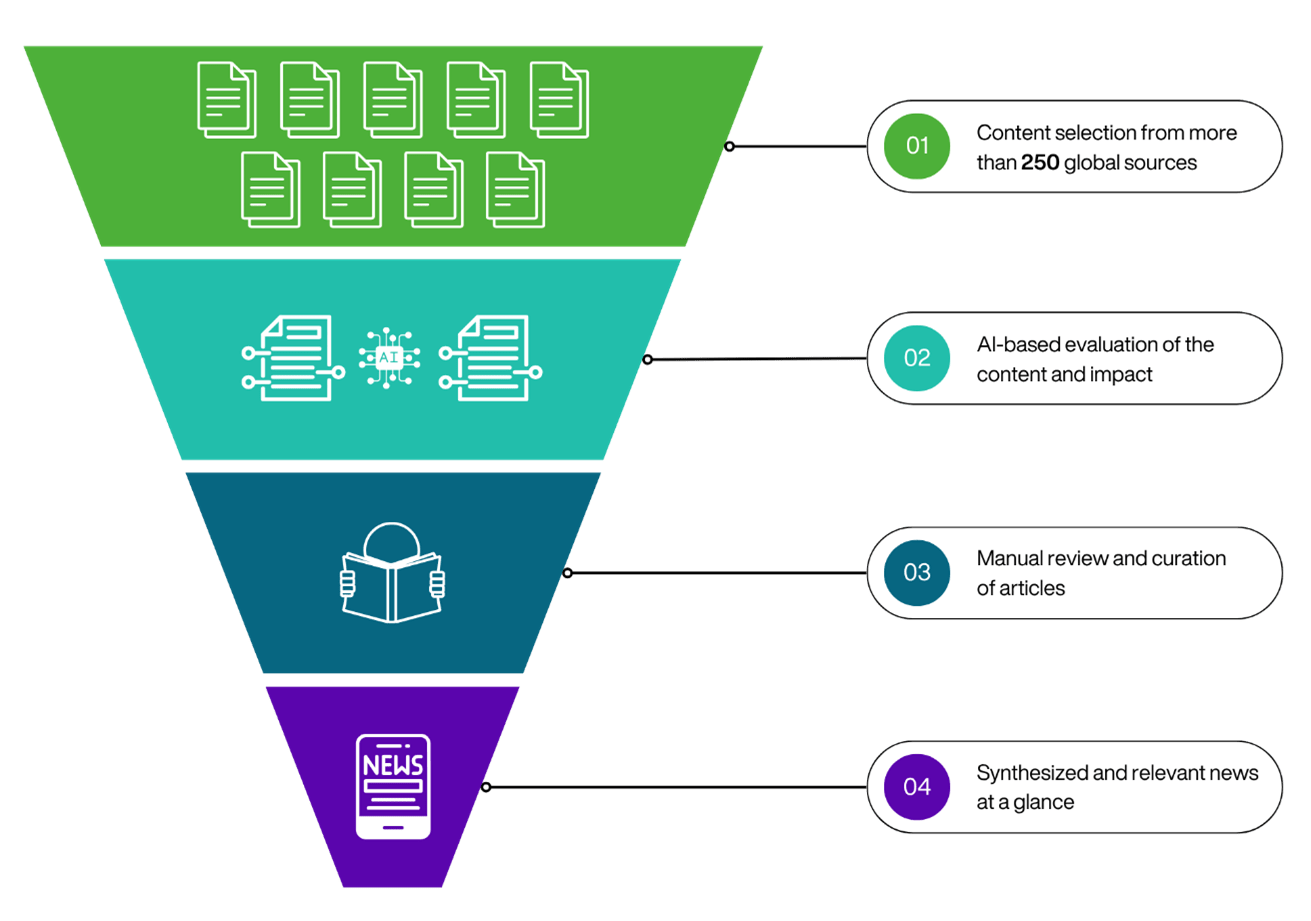
Our process is designed to be both scalable and selective. A broad network of over 250 global sources is continuously screened using six different AIArtificial Intelligence (AI) implies the attempt to transfer human learning and thinking to computers. Computer systems are intended to solve problems—for which a human would require intelligence—using large datasets. In the field of radiology, for example, artificial intelligence can assist physicians in diagnosing findings and detecting abnormali… Explained in the video. tools. These tools help surface relevant content, which is then passed through a multi-step filtering and evaluation process that emphasizes innovation and impact.
In the final stage, selected articles are reviewed and curated by our team before being published. The result is a dynamic, well-structured view of what truly matters in the digital health ecosystem. This way you always stay ahead of the curve.
Contact
E-Mail:
atlas-itg@uni-wh.deInnovation in Healthcare
Alfred-Herrhausen-Straße 50
58448 Witten, Germany