

DIGI-HEALTH MONITOR Calendar Week 39, 2025
DIGI-HEALTH MONITOR:
Calendar Week 39, 2025
Smart deviceSmart devices are small, autonomous intelligent systems networked via the Internet of Things (IoT). They capture physical parameters such as temperature – enabling, for example, medical wearables to measure and monitor body temperature. uses AIArtificial Intelligence (AI) implies the attempt to transfer human learning and thinking to computers. Computer systems are intended to solve problems—for which a human would require intelligence—using large datasets. In the field of radiology, for example, artificial intelligence can assist physicians in diagnosing findings and detecting abnormali… Explained in the video. and bioelectronics to speed up wound healing process
Engineers at the University of California, Santa Cruz, have designed a new wearable device called “a-Heal” that uses a combination of AIArtificial Intelligence (AI) implies the attempt to transfer human learning and thinking to computers. Computer systems are intended to solve problems—for which a human would require intelligence—using large datasets. In the field of radiology, for example, artificial intelligence can assist physicians in diagnosing findings and detecting abnormali… Explained in the video. and bioelectronics to provide personalized, closed-loop wound therapy. The device attaches to a commercially available bandage and is designed to optimize each stage of the healing process. An onboard camera takes photos of the wound every two hours, and an AIArtificial Intelligence (AI) implies the attempt to transfer human learning and thinking to computers. Computer systems are intended to solve problems—for which a human would require intelligence—using large datasets. In the field of radiology, for example, artificial intelligence can assist physicians in diagnosing findings and detecting abnormali… Explained in the video. model analyzes the images in real-time to assess the healing stage. If a lag in healing is detected, the device delivers a topical treatment, which can be either a medication or an electric field. This closed-loop system goes beyond passive data collection to active, real-time intervention, creating a continuous, personalized feedback loop that mimics a physician’s ongoing assessment. The portable, wireless nature of the device is expected to make wound therapy more accessible for patients in remote areas or with limited mobility. In initial preclinical studies, wounds treated with a-Heal healed approximately 25% faster than those with standard care, highlighting the technology’s potential for both acute and chronic wound management.
New AIArtificial Intelligence (AI) implies the attempt to transfer human learning and thinking to computers. Computer systems are intended to solve problems—for which a human would require intelligence—using large datasets. In the field of radiology, for example, artificial intelligence can assist physicians in diagnosing findings and detecting abnormali… Explained in the video. Tool Can Predict a Person’s Risk of More Than 1,000 Diseases: What it is and How it Works
European scientists have developed a groundbreaking generative AIArtificial Intelligence (AI) implies the attempt to transfer human learning and thinking to computers. Computer systems are intended to solve problems—for which a human would require intelligence—using large datasets. In the field of radiology, for example, artificial intelligence can assist physicians in diagnosing findings and detecting abnormali… Explained in the video. tool named Delphi-2M that can predict a person’s risk of developing over 1,000 diseases up to two decades in advance. This AIArtificial Intelligence (AI) implies the attempt to transfer human learning and thinking to computers. Computer systems are intended to solve problems—for which a human would require intelligence—using large datasets. In the field of radiology, for example, artificial intelligence can assist physicians in diagnosing findings and detecting abnormali… Explained in the video. model is a fundamental paradigm shift for healthcare, moving the system away from a reactive model of treating symptoms to one of proactive, personalized, and predictive care. Unlike conventional AIArtificial Intelligence (AI) implies the attempt to transfer human learning and thinking to computers. Computer systems are intended to solve problems—for which a human would require intelligence—using large datasets. In the field of radiology, for example, artificial intelligence can assist physicians in diagnosing findings and detecting abnormali… Explained in the video. tools that might analyze a single dataset, this model was trained on millions of anonymized patient records from two different countries and health systems—the UK Biobank and Denmark’s national registry. Its architecture is similar to a large language model, but instead of predicting text, it analyzes sequences of “medical events” over time, such as diagnoses, lifestyle changes, and medication usage, to forecast future health outcomes with a high degree of accuracy. The tool’s ability to see these “risk trajectories” enables personalized, targeted interventions for individuals whose medical history or lifestyle places them at a higher risk. For healthcare systems, it offers a powerful instrument for population health planning, allowing administrators to anticipate future disease burdens and allocate resources more effectively. This development highlights the immense value of secure, multi-sourced datasets and the necessity of new legal and ethical frameworks to govern data sharing.
Major Advance: Stanford Researchers Use AIArtificial Intelligence (AI) implies the attempt to transfer human learning and thinking to computers. Computer systems are intended to solve problems—for which a human would require intelligence—using large datasets. In the field of radiology, for example, artificial intelligence can assist physicians in diagnosing findings and detecting abnormali… Explained in the video. to Design Viruses, Warn of Dangers if Technology Misused
Researchers at Stanford University and the Arc Institute have made a significant breakthrough by using an artificial intelligenceArtificial Intelligence (AI) implies the attempt to transfer human learning and thinking to computers. Computer systems are intended to solve problems—for which a human would require intelligence—using large datasets. In the field of radiology, for example, artificial intelligence can assist physicians in diagnosing findings and detecting abnormali… Explained in the video. system to design and create functional viral genomes, an achievement described as “the first generative design of complete genomes”. The AIArtificial Intelligence (AI) implies the attempt to transfer human learning and thinking to computers. Computer systems are intended to solve problems—for which a human would require intelligence—using large datasets. In the field of radiology, for example, artificial intelligence can assist physicians in diagnosing findings and detecting abnormali… Explained in the video. system, named Evo, is a large language model similar to ChatGPT that was trained on approximately 2 million bacteriophages. It analyzed genetic patterns and gene order to design 302 new genomes, and 16 of these designs successfully produced working bacteriophages that replicated and killed bacteria in a laboratory setting. According to experts, the AI-created viruses displayed novel genetic arrangements and genes not found in their natural counterparts. The primary benefit of this research is speed, as AIArtificial Intelligence (AI) implies the attempt to transfer human learning and thinking to computers. Computer systems are intended to solve problems—for which a human would require intelligence—using large datasets. In the field of radiology, for example, artificial intelligence can assist physicians in diagnosing findings and detecting abnormali… Explained in the video. can predict protein structures and genome designs in a fraction of the time that traditional drug and genetic research requires. This could drastically accelerate the development of new treatments for bacterial infections, gene therapies, and other complex diseases. However, the power to create new life forms brings significant and immediate safety concerns, with pioneers in synthetic biology expressing “grave concerns” about the potential for misuse for “viral enhancement research” on dangerous pathogens like smallpox or anthrax.
Cyber Countdown: New York Hospitals Face New Data Security Mandates
New York hospitals are preparing for stringent cybersecurityCybersecurity represents an extension of information security. It goes beyond the boundaries of traditional information security and encompasses, in addition to the protection of information resources, also the protection of other assets including the individual. In cybersecurity, the human factor gains an additional dimension: the person as a pote… Explained in the video. regulations that took effect on October 2, 2025, marking a significant escalation in data protection requirements beyond federal HIPAA standards. These mandates, outlined by state authorities, require each hospital to designate a Chief Information Security Officer (CISO) who must annually attest to the adequacy of data security procedures. Additional provisions include conducting comprehensive risk assessments, developing incident response plans, and implementing safeguards for both electronic health records and operational technology systems. The regulations aim to address vulnerabilities exposed by recent ransomware attacks and data breaches, which have disrupted patient care and compromised sensitive information. While the rules currently apply only to New York, they set a precedent that could influence similar legislation in other states, pushing healthcare organizations nationwide toward higher cybersecurityCybersecurity represents an extension of information security. It goes beyond the boundaries of traditional information security and encompasses, in addition to the protection of information resources, also the protection of other assets including the individual. In cybersecurity, the human factor gains an additional dimension: the person as a pote… Explained in the video. maturity. The article provides practical guidance for compliance, emphasizing the need for cross-departmental collaboration and continuous monitoring to avoid penalties, including potential enforcement actions against hospital operating licenses.
Agentic AIArtificial Intelligence (AI) implies the attempt to transfer human learning and thinking to computers. Computer systems are intended to solve problems—for which a human would require intelligence—using large datasets. In the field of radiology, for example, artificial intelligence can assist physicians in diagnosing findings and detecting abnormali… Explained in the video. Could Push Healthcare Into a Legal Gray Area, Attorney Says
A legal expert warns that the increasing use of “agentic AI” in healthcare, where autonomous, task-specific systems perform functions with little to no human intervention, could push the industry into a complex legal gray area concerning liability and patient safety. Lily Li, the founder of law firm Metaverse Law, highlights that in scenarios where an AIArtificial Intelligence (AI) implies the attempt to transfer human learning and thinking to computers. Computer systems are intended to solve problems—for which a human would require intelligence—using large datasets. In the field of radiology, for example, artificial intelligence can assist physicians in diagnosing findings and detecting abnormali… Explained in the video. agent makes an error, such as incorrectly refilling a prescription or mismanaging emergency room triage, it is unclear whether existing medical malpractice insurance would cover the claims, especially if a licensed physician was not directly involved in the decision. This raises fundamental questions about where the responsibility lies when patient harm occurs due to an autonomous system. Li recommends that healthcare organizations incorporate specific risks related to agentic AIArtificial Intelligence (AI) implies the attempt to transfer human learning and thinking to computers. Computer systems are intended to solve problems—for which a human would require intelligence—using large datasets. In the field of radiology, for example, artificial intelligence can assist physicians in diagnosing findings and detecting abnormali… Explained in the video. into their risk assessment models and policies. She also urges AIArtificial Intelligence (AI) implies the attempt to transfer human learning and thinking to computers. Computer systems are intended to solve problems—for which a human would require intelligence—using large datasets. In the field of radiology, for example, artificial intelligence can assist physicians in diagnosing findings and detecting abnormali… Explained in the video. companies to adopt standard communication protocols among their AIArtificial Intelligence (AI) implies the attempt to transfer human learning and thinking to computers. Computer systems are intended to solve problems—for which a human would require intelligence—using large datasets. In the field of radiology, for example, artificial intelligence can assist physicians in diagnosing findings and detecting abnormali… Explained in the video. agents to allow for encryption and identity verification to prevent malicious use of the tools by cybercriminals. In Li’s eyes, the future of agentic AIArtificial Intelligence (AI) implies the attempt to transfer human learning and thinking to computers. Computer systems are intended to solve problems—for which a human would require intelligence—using large datasets. In the field of radiology, for example, artificial intelligence can assist physicians in diagnosing findings and detecting abnormali… Explained in the video. in healthcare might depend less on its technical capabilities and more on how well the industry is able to build trust and accountability.
The Global Digi-Health Monitor is our weekly published newsletter featuring curated updates on the latest developments in digital health. With a focus on innovation and relevance, it brings together key news across topics such as AIArtificial Intelligence (AI) implies the attempt to transfer human learning and thinking to computers. Computer systems are intended to solve problems—for which a human would require intelligence—using large datasets. In the field of radiology, for example, artificial intelligence can assist physicians in diagnosing findings and detecting abnormali… Explained in the video. in healthcare, wearables,Wearables refer to technologies in the form of sensors or mobile applications that collect health data asynchronously and beyond the boundaries of medical care. They include wristbands, smartwatches, and other mobile sensors. These measure and collect data such as blood glucose levels, pulse, or sleep data, and transmit this information either auto… telemedicine,Telemedicine encompasses various healthcare delivery concepts characterized by direct patient care across geographical distances or time delays. This includes diagnostic, therapeutic, rehabilitative, and consultative services delivered through information and communication technologies. Particularly with regard to rural areas, telemedicine offers s… Explained in the video. cybersecurity, and more.
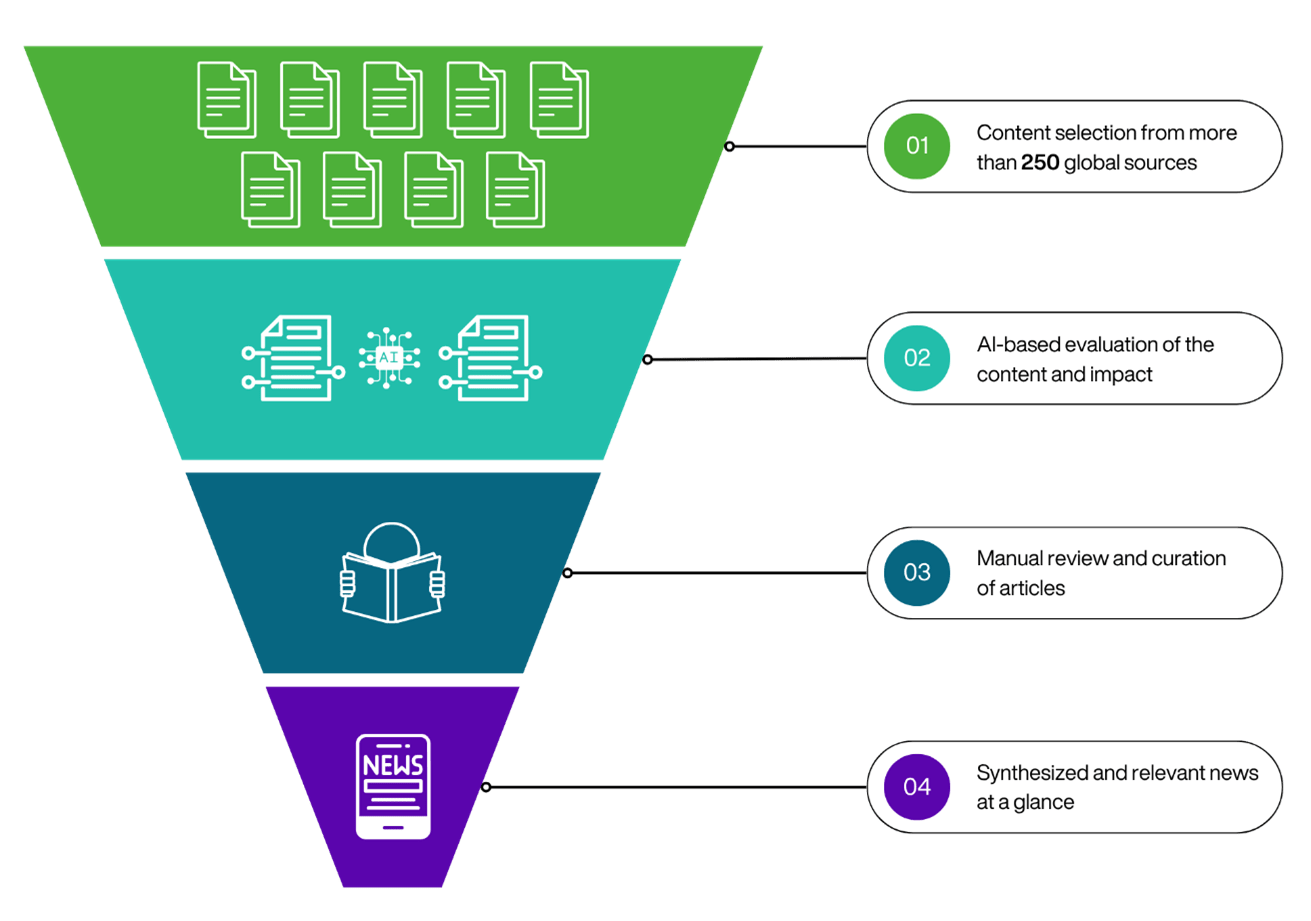
Our process is designed to be both scalable and selective. A broad network of over 250 global sources is continuously screened using six different AIArtificial Intelligence (AI) implies the attempt to transfer human learning and thinking to computers. Computer systems are intended to solve problems—for which a human would require intelligence—using large datasets. In the field of radiology, for example, artificial intelligence can assist physicians in diagnosing findings and detecting abnormali… Explained in the video. tools. These tools help surface relevant content, which is then passed through a multi-step filtering and evaluation process that emphasizes innovation and impact.
In the final stage, selected articles are reviewed and curated by our team before being published. The result is a dynamic, well-structured view of what truly matters in the digital health ecosystem. This way you always stay ahead of the curve.
Contact
E-Mail:
atlas-itg@uni-wh.deInnovation in Healthcare
Alfred-Herrhausen-Straße 50
58448 Witten, Germany