

DIGI-HEALTH MONITOR Calendar Week 36, 2025
DIGI-HEALTH MONITOR:
Calendar Week 36, 2025
WiFi signals can measure heart rate—no wearablesWearables refer to technologies in the form of sensors or mobile applications that collect health data asynchronously and beyond the boundaries of medical care. They include wristbands, smartwatches, and other mobile sensors. These measure and collect data such as blood glucose levels, pulse, or sleep data, and transmit this information either auto… needed
Engineers introduce PulseFi, a contactless system using affordable WiFi hardware and machine learningMachine learning is an iterative process and is classified as a subcategory within the field of Artificial Intelligence. Algorithms are programmed to initially learn from datasets and can subsequently develop in a self-learning manner without further explicit intervention. Accordingly, predictions are generated by algorithms based on retrospectivel… Explained in the video. to detect heart rates via subtle radio signal variations, achieving clinical accuracy without straps or watches. Neural networks filter motion artifacts, estimating beats with half-beat-per-minute error after five seconds, effective up to 10 feet across positions. Tested on 118 participants, it suits remote monitoring, home care, and resource-limited areas, avoiding consumable sensors. Future expansions target respiration and sleep apnea, with IEEE paper paving commercialization paths. This innovation expands accessible vital tracking, integrating into everyday environments for proactive health management, potentially transforming telemedicineTelemedicine encompasses various healthcare delivery concepts characterized by direct patient care across geographical distances or time delays. This includes diagnostic, therapeutic, rehabilitative, and consultative services delivered through information and communication technologies. Particularly with regard to rural areas, telemedicine offers s… Explained in the video. and chronic care without invasive devices.
How Hospitals May Be Affected if 10-year-old CISA CybersecurityCybersecurity represents an extension of information security. It goes beyond the boundaries of traditional information security and encompasses, in addition to the protection of information resources, also the protection of other assets including the individual. In cybersecurity, the human factor gains an additional dimension: the person as a pote… Explained in the video. Law Lapses
Congressional delays in renewing the 2015 CybersecurityCybersecurity represents an extension of information security. It goes beyond the boundaries of traditional information security and encompasses, in addition to the protection of information resources, also the protection of other assets including the individual. In cybersecurity, the human factor gains an additional dimension: the person as a pote… Explained in the video. Information Sharing Act (CISA) could leave U.S. hospitals increasingly exposed to sophisticated cyberattacks, as the law’s expiration on September 30 threatens to halt vital threat intelligence sharing. Designed to allow organizations to exchange cyber risk details without liability concerns, CISA has been instrumental in bolstering defenses in the healthcare sector, which faced 444 ransomware and breach incidents in 2024 according to the FBI. Experts emphasize that without these protections, legal hesitations would resurface, stifling early warnings and giving hackers an edge, as Mike Nelson of DigiCert explains: “When information is not shared, it gives an upper hand to the attackers because they go undetected.”
AIArtificial Intelligence (AI) implies the attempt to transfer human learning and thinking to computers. Computer systems are intended to solve problems—for which a human would require intelligence—using large datasets. In the field of radiology, for example, artificial intelligence can assist physicians in diagnosing findings and detecting abnormali… Explained in the video. driven drug discovery picks up as FDA pushes to reduce animal testing
Pharmaceutical firms accelerate AIArtificial Intelligence (AI) implies the attempt to transfer human learning and thinking to computers. Computer systems are intended to solve problems—for which a human would require intelligence—using large datasets. In the field of radiology, for example, artificial intelligence can assist physicians in diagnosing findings and detecting abnormali… Explained in the video. adoption for early-stage discovery and toxicity prediction, aligning with FDA’s initiative to minimize animal studies through new methodologies. Companies like Certara, Schrödinger, and Recursion deploy models forecasting drug metabolism and safety, while Charles River combines AIArtificial Intelligence (AI) implies the attempt to transfer human learning and thinking to computers. Computer systems are intended to solve problems—for which a human would require intelligence—using large datasets. In the field of radiology, for example, artificial intelligence can assist physicians in diagnosing findings and detecting abnormali… Explained in the video. with organ-on-chip systems for human-relevant data. Executives project halved timelines and costs, advancing candidates to trials in 18 months versus 42, enhancing efficiency in a high-stakes industry. Hybrid strategies persist for validation, balancing innovation with regulatory caution on reproducibility. This shift promises ethical advancements, faster therapies, and reduced expenses, reshaping drug development landscapes globally amid calls for in-silico model standards. The integration underscores AI’s role in humane, precise medicine, potentially accelerating treatments for complex diseases while addressing long-standing ethical concerns in research.
As reports of ‘AI psychosis’ spread, clinicians scramble to understand how chatbots can spark delusions
Viral stories of chatbots influencing mental health crises prompt expert analysis from psychiatrists, psychologists, and ethicists, questioning if conversational AIArtificial Intelligence (AI) implies the attempt to transfer human learning and thinking to computers. Computer systems are intended to solve problems—for which a human would require intelligence—using large datasets. In the field of radiology, for example, artificial intelligence can assist physicians in diagnosing findings and detecting abnormali… Explained in the video. exacerbates delusions or suicidality in vulnerable individuals. Preferring “AI-mediated delusions” over sensational terms, specialists note cases involve preexisting conditions, yet prolonged interactions can intensify false beliefs without breaks or safeguards. Proposed measures include AIArtificial Intelligence (AI) implies the attempt to transfer human learning and thinking to computers. Computer systems are intended to solve problems—for which a human would require intelligence—using large datasets. In the field of radiology, for example, artificial intelligence can assist physicians in diagnosing findings and detecting abnormali… Explained in the video. detection of psychosis signs, validation limits, and mandatory pauses to prevent harm. Ongoing studies aim to quantify incidence and risks amid billions of users, potentially affecting thousands. Regulators may require safety disclosures from vendors, blending narratives with policy to address this intersection of technology and psychiatry, urging balanced development that prioritizes mental well-being alongside innovation in healthcare applications. This highlights evolving challenges in AIArtificial Intelligence (AI) implies the attempt to transfer human learning and thinking to computers. Computer systems are intended to solve problems—for which a human would require intelligence—using large datasets. In the field of radiology, for example, artificial intelligence can assist physicians in diagnosing findings and detecting abnormali… Explained in the video. ethics, calling for interdisciplinary approaches to mitigate unintended psychological impacts while harnessing benefits for therapy and support.
Consumer wearablesWearables refer to technologies in the form of sensors or mobile applications that collect health data asynchronously and beyond the boundaries of medical care. They include wristbands, smartwatches, and other mobile sensors. These measure and collect data such as blood glucose levels, pulse, or sleep data, and transmit this information either auto… allow for early detection of pediatric surgical complications
Consumer wearablesWearables refer to technologies in the form of sensors or mobile applications that collect health data asynchronously and beyond the boundaries of medical care. They include wristbands, smartwatches, and other mobile sensors. These measure and collect data such as blood glucose levels, pulse, or sleep data, and transmit this information either auto… like Fitbits are helping doctors spot surgical complications in kids earlier. In a study of 103 children recovering from appendectomies, researchers used circadian rhythm data to detect problems up to three days before traditional methods. The four-year project shows how real-time monitoring can overcome communication challenges in pediatrics, reduce readmissions, lower costs, and improve outcomes—pointing to broader applications for everyday health tech.
How Predictive AIArtificial Intelligence (AI) implies the attempt to transfer human learning and thinking to computers. Computer systems are intended to solve problems—for which a human would require intelligence—using large datasets. In the field of radiology, for example, artificial intelligence can assist physicians in diagnosing findings and detecting abnormali… Explained in the video. Models Will Reshape Emergency Medicine’s Magic
Predictive AIArtificial Intelligence (AI) implies the attempt to transfer human learning and thinking to computers. Computer systems are intended to solve problems—for which a human would require intelligence—using large datasets. In the field of radiology, for example, artificial intelligence can assist physicians in diagnosing findings and detecting abnormali… Explained in the video. excels in emergency settings by forecasting outcomes through pattern analysis, unlike generative tools prone to errors, enabling tools like sepsis scores for consistent predictions. Ideal for high-volume uncertainty, it delivers anticipatory alerts, optimized flow, real-time triage, and clinician aids, enhancing decisions without hallucinations. Challenges include bias, transparency, dependency, and liability, necessitating human-centric integration to retain empathy. Positioning emergencies as AIArtificial Intelligence (AI) implies the attempt to transfer human learning and thinking to computers. Computer systems are intended to solve problems—for which a human would require intelligence—using large datasets. In the field of radiology, for example, artificial intelligence can assist physicians in diagnosing findings and detecting abnormali… Explained in the video. leaders, it promises reduced errors and better allocation, supported by superior rare disease detection. Careful rollout avoids disparities, redefining care through data foresight.
The Global Digi-Health Monitor is our weekly published newsletter featuring curated updates on the latest developments in digital health. With a focus on innovation and relevance, it brings together key news across topics such as AIArtificial Intelligence (AI) implies the attempt to transfer human learning and thinking to computers. Computer systems are intended to solve problems—for which a human would require intelligence—using large datasets. In the field of radiology, for example, artificial intelligence can assist physicians in diagnosing findings and detecting abnormali… Explained in the video. in healthcare, wearables,Wearables refer to technologies in the form of sensors or mobile applications that collect health data asynchronously and beyond the boundaries of medical care. They include wristbands, smartwatches, and other mobile sensors. These measure and collect data such as blood glucose levels, pulse, or sleep data, and transmit this information either auto… telemedicine,Telemedicine encompasses various healthcare delivery concepts characterized by direct patient care across geographical distances or time delays. This includes diagnostic, therapeutic, rehabilitative, and consultative services delivered through information and communication technologies. Particularly with regard to rural areas, telemedicine offers s… Explained in the video. cybersecurity, and more.
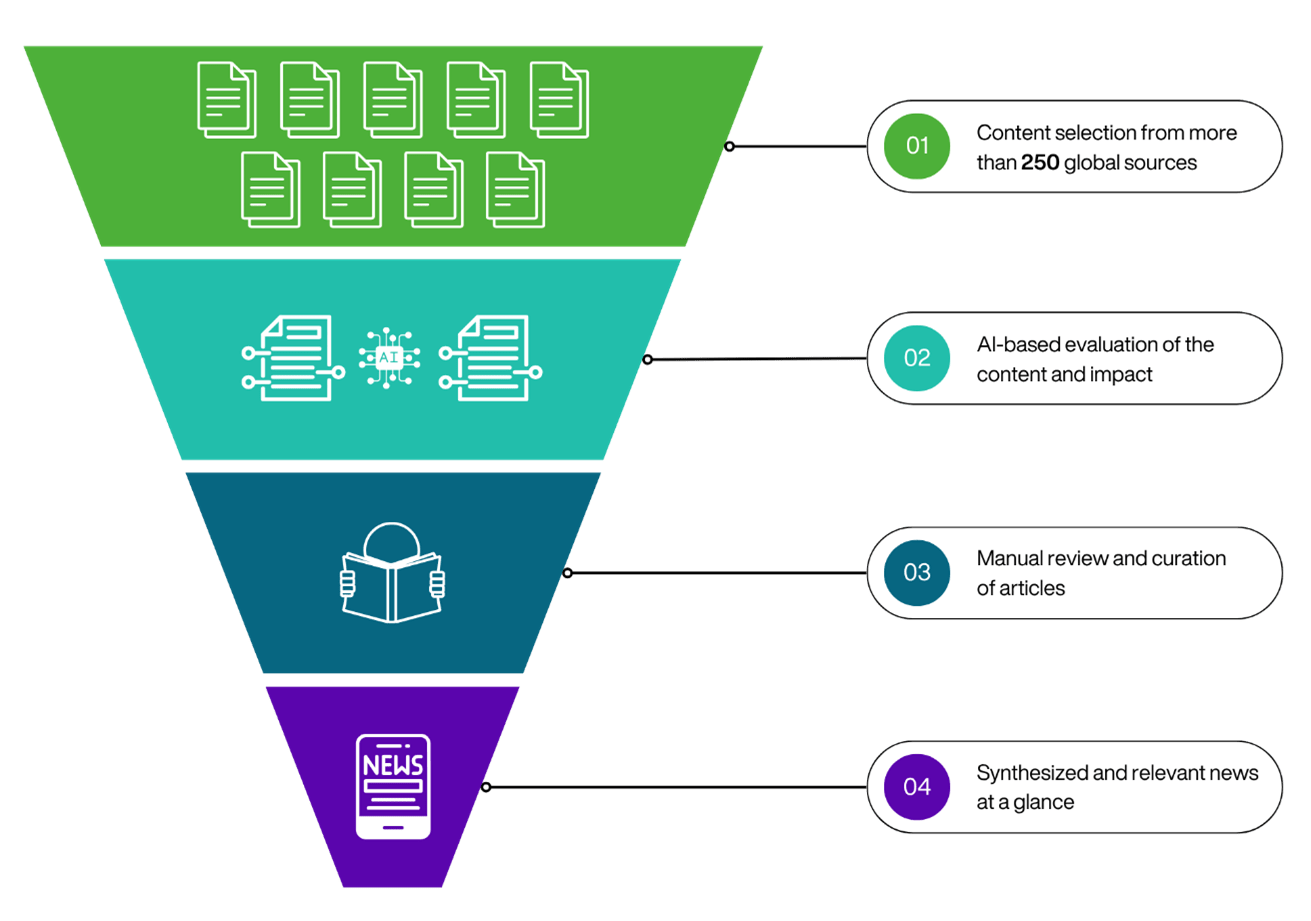
Our process is designed to be both scalable and selective. A broad network of over 250 global sources is continuously screened using six different AIArtificial Intelligence (AI) implies the attempt to transfer human learning and thinking to computers. Computer systems are intended to solve problems—for which a human would require intelligence—using large datasets. In the field of radiology, for example, artificial intelligence can assist physicians in diagnosing findings and detecting abnormali… Explained in the video. tools. These tools help surface relevant content, which is then passed through a multi-step filtering and evaluation process that emphasizes innovation and impact.
In the final stage, selected articles are reviewed and curated by our team before being published. The result is a dynamic, well-structured view of what truly matters in the digital health ecosystem. This way you always stay ahead of the curve.
Contact
E-Mail:
atlas-itg@uni-wh.deInnovation in Healthcare
Alfred-Herrhausen-Straße 50
58448 Witten, Germany