

From Glitch to Harm: Building a System for Reporting AI Incidents
As artificial intelligenceArtificial Intelligence (AI) implies the attempt to transfer human learning and thinking to computers. Computer systems are intended to solve problems—for which a human would require intelligence—using large datasets. In the field of radiology, for example, artificial intelligence can assist physicians in diagnosing findings and detecting abnormali… Explained in the video. (AI)Artificial Intelligence (AI) implies the attempt to transfer human learning and thinking to computers. Computer systems are intended to solve problems—for which a human would require intelligence—using large datasets. In the field of radiology, for example, artificial intelligence can assist physicians in diagnosing findings and detecting abnormali… Explained in the video. systems become increasingly embedded in daily life the need to track and respond to their failures becomes urgent. While much of the policy conversation has focused on defining risks associated with AIArtificial Intelligence (AI) implies the attempt to transfer human learning and thinking to computers. Computer systems are intended to solve problems—for which a human would require intelligence—using large datasets. In the field of radiology, for example, artificial intelligence can assist physicians in diagnosing findings and detecting abnormali… Explained in the video. systems, we must also ask: What happens when they go wrong?
Incidents associated with AIArtificial Intelligence (AI) implies the attempt to transfer human learning and thinking to computers. Computer systems are intended to solve problems—for which a human would require intelligence—using large datasets. In the field of radiology, for example, artificial intelligence can assist physicians in diagnosing findings and detecting abnormali… Explained in the video. systems are increasing
Recent incidents — such as image-generating tools distorting historical facts about the Holocaust — show how AIArtificial Intelligence (AI) implies the attempt to transfer human learning and thinking to computers. Computer systems are intended to solve problems—for which a human would require intelligence—using large datasets. In the field of radiology, for example, artificial intelligence can assist physicians in diagnosing findings and detecting abnormali… Explained in the video. can cause significant social and psychological harm. This is by no means a single incident.
Besides Musk´s AIArtificial Intelligence (AI) implies the attempt to transfer human learning and thinking to computers. Computer systems are intended to solve problems—for which a human would require intelligence—using large datasets. In the field of radiology, for example, artificial intelligence can assist physicians in diagnosing findings and detecting abnormali… Explained in the video. “Grok” spewing antisemitic content (Wired, 2025), deepfake footage purportedly showed the Ukrainian president capitulating (Reuters, 2022), a Chatbot was blamed for teenage suicide (New York Times, 2024), and Meta identified (and deleted) 10 million AI-generated FacebookSocial media channels, or social media, are computer-mediated technologies that facilitate the sharing of ideas, thoughts, and information through the creation of virtual networks and communities. Users engage with social media via computer, tablet, or smartphone through web-based software or applications, often for messaging and communication. Eac… accounts, which were launched to spread misinformation (OECD, 2025). The health care industry is particularly vulnerable to AIArtificial Intelligence (AI) implies the attempt to transfer human learning and thinking to computers. Computer systems are intended to solve problems—for which a human would require intelligence—using large datasets. In the field of radiology, for example, artificial intelligence can assist physicians in diagnosing findings and detecting abnormali… Explained in the video. incidents, due to the sensitive nature of health care data, privacy issues and the confidentiality of the doctor-patient relationship (Kahn et al 2025, Li 2023).
With the quick spread and embedding of AIArtificial Intelligence (AI) implies the attempt to transfer human learning and thinking to computers. Computer systems are intended to solve problems—for which a human would require intelligence—using large datasets. In the field of radiology, for example, artificial intelligence can assist physicians in diagnosing findings and detecting abnormali… Explained in the video. systems in all aspects of daily life, the number of incidents associated with these systems is increasing exponentially (AIArtificial Intelligence (AI) implies the attempt to transfer human learning and thinking to computers. Computer systems are intended to solve problems—for which a human would require intelligence—using large datasets. In the field of radiology, for example, artificial intelligence can assist physicians in diagnosing findings and detecting abnormali… Explained in the video. Index Report, 2025).
Figure 1: Number of reported AIArtificial Intelligence (AI) implies the attempt to transfer human learning and thinking to computers. Computer systems are intended to solve problems—for which a human would require intelligence—using large datasets. In the field of radiology, for example, artificial intelligence can assist physicians in diagnosing findings and detecting abnormali… Explained in the video. incidents, 2012–24
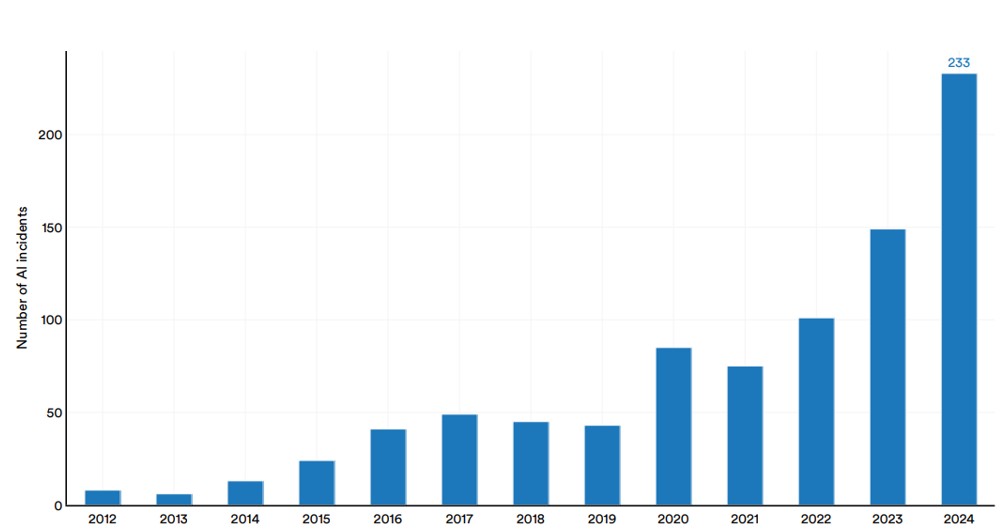
Source: 2025 AIArtificial Intelligence (AI) implies the attempt to transfer human learning and thinking to computers. Computer systems are intended to solve problems—for which a human would require intelligence—using large datasets. In the field of radiology, for example, artificial intelligence can assist physicians in diagnosing findings and detecting abnormali… Explained in the video. Index report, p. 169
Yet, these events often go undocumented in any systematic way. Unlike sectors such as aviation or – to a lesser extent – healthcare, where incident reporting is well established (WHO, 2005), AIArtificial Intelligence (AI) implies the attempt to transfer human learning and thinking to computers. Computer systems are intended to solve problems—for which a human would require intelligence—using large datasets. In the field of radiology, for example, artificial intelligence can assist physicians in diagnosing findings and detecting abnormali… Explained in the video. lacks a unified, enforceable framework for reporting harm.
Who Reports AIArtificial Intelligence (AI) implies the attempt to transfer human learning and thinking to computers. Computer systems are intended to solve problems—for which a human would require intelligence—using large datasets. In the field of radiology, for example, artificial intelligence can assist physicians in diagnosing findings and detecting abnormali… Explained in the video. Failures?
Currently, the burden of identifying harmful AIArtificial Intelligence (AI) implies the attempt to transfer human learning and thinking to computers. Computer systems are intended to solve problems—for which a human would require intelligence—using large datasets. In the field of radiology, for example, artificial intelligence can assist physicians in diagnosing findings and detecting abnormali… Explained in the video. behavior falls on journalists, whistleblowers, and civil society. High-profile examples such as Algorithmic Justice League (AJL, 2025) or Mozilla’s YouTubeSocial media channels, or social media, are computer-mediated technologies that facilitate the sharing of ideas, thoughts, and information through the creation of virtual networks and communities. Users engage with social media via computer, tablet, or smartphone through web-based software or applications, often for messaging and communication. Eac… Regrets campaign (Mozilla Foundation, 2021) have helped expose hidden harms. But without a structured, mandatory approach, these efforts remain ad hoc.
Article 62, Section 1-3 of the EU AIArtificial Intelligence (AI) implies the attempt to transfer human learning and thinking to computers. Computer systems are intended to solve problems—for which a human would require intelligence—using large datasets. In the field of radiology, for example, artificial intelligence can assist physicians in diagnosing findings and detecting abnormali… Explained in the video. Act (2024) introduces mandatory incident reporting for “high-risk AIArtificial Intelligence (AI) implies the attempt to transfer human learning and thinking to computers. Computer systems are intended to solve problems—for which a human would require intelligence—using large datasets. In the field of radiology, for example, artificial intelligence can assist physicians in diagnosing findings and detecting abnormali… Explained in the video. systems”, including requirements for providers to log and report serious incidents within 15 days (EU 2024). Yet key questions remain:
- What qualifies as a “serious” incident?
- How should incidents be documented and followed up?
- Can we trust companies to self-regulate?
How can AIArtificial Intelligence (AI) implies the attempt to transfer human learning and thinking to computers. Computer systems are intended to solve problems—for which a human would require intelligence—using large datasets. In the field of radiology, for example, artificial intelligence can assist physicians in diagnosing findings and detecting abnormali… Explained in the video. incidents be defined, classified and documented?
For incidence reporting systems to be effective, taxonomies to standardize how harms are classified are needed. Such harms need to be registered in a responsible AIArtificial Intelligence (AI) implies the attempt to transfer human learning and thinking to computers. Computer systems are intended to solve problems—for which a human would require intelligence—using large datasets. In the field of radiology, for example, artificial intelligence can assist physicians in diagnosing findings and detecting abnormali… Explained in the video. database, with both public and confidential entries. A global oversight body to coordinate across jurisdictions is needed and harms should be monitored by independent bodies, such as aviation safety boards.
To build a meaningful reporting framework two basic definitions must be distinguished:
- Hazard: A potential source of harm, such as a flawed large language model that generates toxic outputs.
- Incident: A specific occurrence where that harm materializes, like a chatbot offering instructions for illegal activities or discriminatory recruitment decisions based on algorithmic bias.
This distinction, inspired by safety-critical industries like aviation, helps regulators differentiate between latent risks and active failures. Health care industry in turn took inspiration from aviation, the patient safety movement led to a better recognition and reporting of hazards and incidents, the establishment of an evidence-based for patient safety practices, and improvements in patient care (Shekelle et al 2013).
There’s growing consensus that AIArtificial Intelligence (AI) implies the attempt to transfer human learning and thinking to computers. Computer systems are intended to solve problems—for which a human would require intelligence—using large datasets. In the field of radiology, for example, artificial intelligence can assist physicians in diagnosing findings and detecting abnormali… Explained in the video. incident reporting needs to be formalized and globalized. A number of initiatives, such as the Partnership on AI’s Incident Database – tracking real-world AIArtificial Intelligence (AI) implies the attempt to transfer human learning and thinking to computers. Computer systems are intended to solve problems—for which a human would require intelligence—using large datasets. In the field of radiology, for example, artificial intelligence can assist physicians in diagnosing findings and detecting abnormali… Explained in the video. failures across sectors (PAI, 2024) – or OECD’s Framework for the Classification of AIArtificial Intelligence (AI) implies the attempt to transfer human learning and thinking to computers. Computer systems are intended to solve problems—for which a human would require intelligence—using large datasets. In the field of radiology, for example, artificial intelligence can assist physicians in diagnosing findings and detecting abnormali… Explained in the video. Incidents (OECD, 2025) are laying the groundwork. The OECD framework, for instance, includes 8 dimensions and 29 criteria for incident documentation—7 mandatory, 22 optional—plus a tiered system to classify the severity of incidents (e.g. minimal, moderate, critical). OECD´s Database provides insight into the evolution of incidents and hazards by industry (OECD AIArtificial Intelligence (AI) implies the attempt to transfer human learning and thinking to computers. Computer systems are intended to solve problems—for which a human would require intelligence—using large datasets. In the field of radiology, for example, artificial intelligence can assist physicians in diagnosing findings and detecting abnormali… Explained in the video. Incidents Monitor, an evidence base for trustworthy AIArtificial Intelligence (AI) implies the attempt to transfer human learning and thinking to computers. Computer systems are intended to solve problems—for which a human would require intelligence—using large datasets. In the field of radiology, for example, artificial intelligence can assist physicians in diagnosing findings and detecting abnormali… Explained in the video. – OECD.AI),
Figure 2: Evolution of incidents and hazards by industry
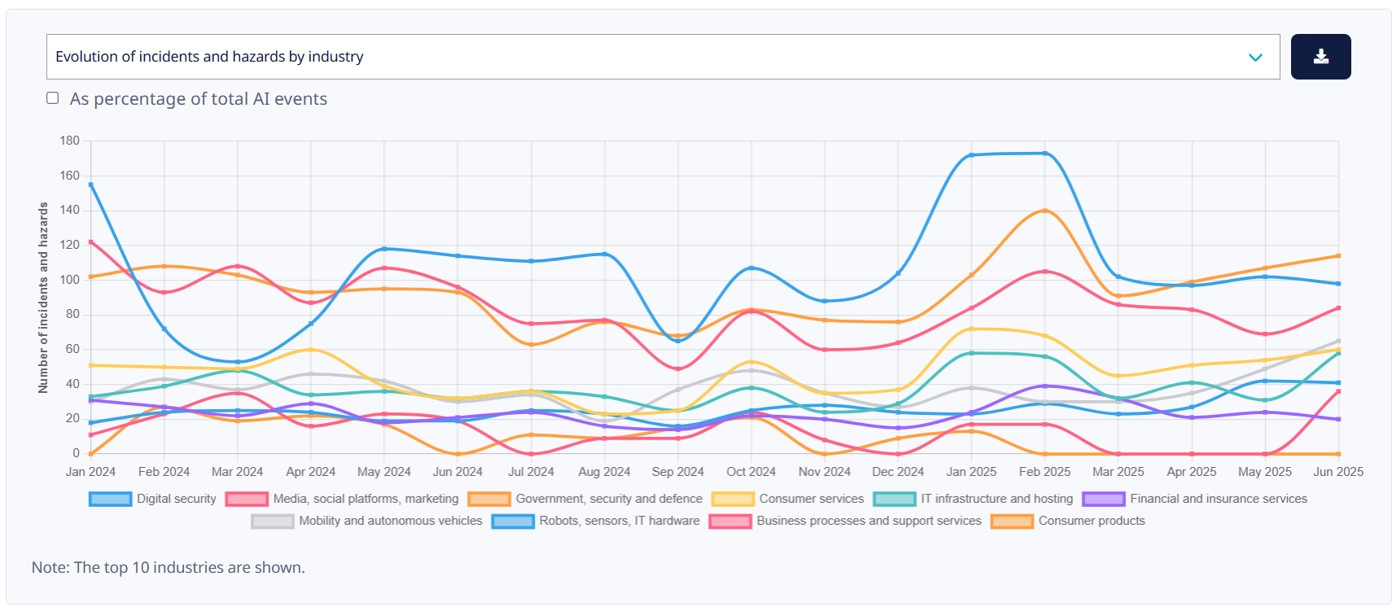
Source: OECD AIArtificial Intelligence (AI) implies the attempt to transfer human learning and thinking to computers. Computer systems are intended to solve problems—for which a human would require intelligence—using large datasets. In the field of radiology, for example, artificial intelligence can assist physicians in diagnosing findings and detecting abnormali… Explained in the video. Incidents Monitor, an evidence base for trustworthy AIArtificial Intelligence (AI) implies the attempt to transfer human learning and thinking to computers. Computer systems are intended to solve problems—for which a human would require intelligence—using large datasets. In the field of radiology, for example, artificial intelligence can assist physicians in diagnosing findings and detecting abnormali… Explained in the video. – OECD.AI
Closing the Loop: From Reporting to Learning
Reporting must lead to learning. In healthcare, near-miss reporting systems help prevent future errors without assigning blame (IOM, 2000). Could AIArtificial Intelligence (AI) implies the attempt to transfer human learning and thinking to computers. Computer systems are intended to solve problems—for which a human would require intelligence—using large datasets. In the field of radiology, for example, artificial intelligence can assist physicians in diagnosing findings and detecting abnormali… Explained in the video. adopt a similar “just culture”?
Documentation should be followed by investigation, remediation, and—where appropriate—enforcement. But above all, it should serve a learning purpose. Public trust in AIArtificial Intelligence (AI) implies the attempt to transfer human learning and thinking to computers. Computer systems are intended to solve problems—for which a human would require intelligence—using large datasets. In the field of radiology, for example, artificial intelligence can assist physicians in diagnosing findings and detecting abnormali… Explained in the video. systems will depend not just on how well they perform, but on how transparently they fail—and recover.
If we want safe, trustworthy AI,Artificial Intelligence (AI) implies the attempt to transfer human learning and thinking to computers. Computer systems are intended to solve problems—for which a human would require intelligence—using large datasets. In the field of radiology, for example, artificial intelligence can assist physicians in diagnosing findings and detecting abnormali… Explained in the video. we must start treating harm as not just a regrettable byproduct, but a crucial data point in system governance. Only then can we build AIArtificial Intelligence (AI) implies the attempt to transfer human learning and thinking to computers. Computer systems are intended to solve problems—for which a human would require intelligence—using large datasets. In the field of radiology, for example, artificial intelligence can assist physicians in diagnosing findings and detecting abnormali… Explained in the video. that not only performs, but protects.
But, the key question remains how these complex issues can be addressed in the global race to advance AIArtificial Intelligence (AI) implies the attempt to transfer human learning and thinking to computers. Computer systems are intended to solve problems—for which a human would require intelligence—using large datasets. In the field of radiology, for example, artificial intelligence can assist physicians in diagnosing findings and detecting abnormali… Explained in the video. systems? In health care, will the benefits of AIArtificial Intelligence (AI) implies the attempt to transfer human learning and thinking to computers. Computer systems are intended to solve problems—for which a human would require intelligence—using large datasets. In the field of radiology, for example, artificial intelligence can assist physicians in diagnosing findings and detecting abnormali… Explained in the video. outweigh the risks?
Further Reading
AIArtificial Intelligence (AI) implies the attempt to transfer human learning and thinking to computers. Computer systems are intended to solve problems—for which a human would require intelligence—using large datasets. In the field of radiology, for example, artificial intelligence can assist physicians in diagnosing findings and detecting abnormali… Explained in the video. Incident Database via AIArtificial Intelligence (AI) implies the attempt to transfer human learning and thinking to computers. Computer systems are intended to solve problems—for which a human would require intelligence—using large datasets. In the field of radiology, for example, artificial intelligence can assist physicians in diagnosing findings and detecting abnormali… Explained in the video. Index (2025) – with minor processing by Our World in Data. “Global annual number of reported artificial intelligenceArtificial Intelligence (AI) implies the attempt to transfer human learning and thinking to computers. Computer systems are intended to solve problems—for which a human would require intelligence—using large datasets. In the field of radiology, for example, artificial intelligence can assist physicians in diagnosing findings and detecting abnormali… Explained in the video. incidents and controversies” [dataset]. AIArtificial Intelligence (AI) implies the attempt to transfer human learning and thinking to computers. Computer systems are intended to solve problems—for which a human would require intelligence—using large datasets. In the field of radiology, for example, artificial intelligence can assist physicians in diagnosing findings and detecting abnormali… Explained in the video. Incident Database via AIArtificial Intelligence (AI) implies the attempt to transfer human learning and thinking to computers. Computer systems are intended to solve problems—for which a human would require intelligence—using large datasets. In the field of radiology, for example, artificial intelligence can assist physicians in diagnosing findings and detecting abnormali… Explained in the video. Index, “AI Index Report” [original data]. Retrieved July 17, 2025 from https://archive.ourworldindata.org/20250624-125417/grapher/annual-reported-ai-incidents-controversies.html (archived on June 24, 2025).
Algorithmic Justice League: https://www.ajl.org/
Institute of Medicine. 2000. To Err Is Human: Building a Safer Health System. Washington, DC: The National Academies Press. https://doi.org/10.17226/9728.
Mohsin Khan M, Shah N, Shaikh N, Thabet A, Alrabayah T, Belkhair S. Towards secure and trusted AIArtificial Intelligence (AI) implies the attempt to transfer human learning and thinking to computers. Computer systems are intended to solve problems—for which a human would require intelligence—using large datasets. In the field of radiology, for example, artificial intelligence can assist physicians in diagnosing findings and detecting abnormali… Explained in the video. in healthcare: A systematic review of emerging innovations and ethical challenges. Int J Med Inform. 2025 Mar;195:105780.
Li J. Security Implications of AIArtificial Intelligence (AI) implies the attempt to transfer human learning and thinking to computers. Computer systems are intended to solve problems—for which a human would require intelligence—using large datasets. In the field of radiology, for example, artificial intelligence can assist physicians in diagnosing findings and detecting abnormali… Explained in the video. Chatbots in Health Care. J Med Internet Res. 2023 Nov 28;25:e47551.
Maslej N et al. The AIArtificial Intelligence (AI) implies the attempt to transfer human learning and thinking to computers. Computer systems are intended to solve problems—for which a human would require intelligence—using large datasets. In the field of radiology, for example, artificial intelligence can assist physicians in diagnosing findings and detecting abnormali… Explained in the video. Index 2025 Annual Report, AIArtificial Intelligence (AI) implies the attempt to transfer human learning and thinking to computers. Computer systems are intended to solve problems—for which a human would require intelligence—using large datasets. In the field of radiology, for example, artificial intelligence can assist physicians in diagnosing findings and detecting abnormali… Explained in the video. Index Steering Committee, Institute for Human-Centered AI,Artificial Intelligence (AI) implies the attempt to transfer human learning and thinking to computers. Computer systems are intended to solve problems—for which a human would require intelligence—using large datasets. In the field of radiology, for example, artificial intelligence can assist physicians in diagnosing findings and detecting abnormali… Explained in the video. Stanford University, Stanford, CA, April 2025. https://hai.stanford.edu/assets/files/hai_ai_index_report_2025.pdf
Mozilla Foundation, YouTubeSocial media channels, or social media, are computer-mediated technologies that facilitate the sharing of ideas, thoughts, and information through the creation of virtual networks and communities. Users engage with social media via computer, tablet, or smartphone through web-based software or applications, often for messaging and communication. Eac… Regrets A crowdsourced investigation into YouTube’s recommendation algorithm,An algorithm is a solution procedure in the form of a systematic rule or approach. A problem is solved by means of a defined sequence of procedural steps. In computer science, algorithms form a fundamental basis of programming. Examples of algorithms include the calculation of the Body Mass Index (BMI), instruction manuals, or rules of … Con… 2021 https://assets.mofoprod.net/network/documents/Mozilla_YouTube_Regrets_Report.pdf
New York Times. Can A.I.Artificial Intelligence (AI) implies the attempt to transfer human learning and thinking to computers. Computer systems are intended to solve problems—for which a human would require intelligence—using large datasets. In the field of radiology, for example, artificial intelligence can assist physicians in diagnosing findings and detecting abnormali… Explained in the video. be blamed? NYT, 2024/10/23/, https://www.nytimes.com/2024/10/23/technology/characterai-lawsuit-teen-suicide.html
OECD. OECD AIArtificial Intelligence (AI) implies the attempt to transfer human learning and thinking to computers. Computer systems are intended to solve problems—for which a human would require intelligence—using large datasets. In the field of radiology, for example, artificial intelligence can assist physicians in diagnosing findings and detecting abnormali… Explained in the video. Incidents Monitor, an evidence base for trustworthy AIArtificial Intelligence (AI) implies the attempt to transfer human learning and thinking to computers. Computer systems are intended to solve problems—for which a human would require intelligence—using large datasets. In the field of radiology, for example, artificial intelligence can assist physicians in diagnosing findings and detecting abnormali… Explained in the video. – OECD.AI OECD, Paris: 2025, OECD AIArtificial Intelligence (AI) implies the attempt to transfer human learning and thinking to computers. Computer systems are intended to solve problems—for which a human would require intelligence—using large datasets. In the field of radiology, for example, artificial intelligence can assist physicians in diagnosing findings and detecting abnormali… Explained in the video. Incidents Monitor, an evidence base for trustworthy AIArtificial Intelligence (AI) implies the attempt to transfer human learning and thinking to computers. Computer systems are intended to solve problems—for which a human would require intelligence—using large datasets. In the field of radiology, for example, artificial intelligence can assist physicians in diagnosing findings and detecting abnormali… Explained in the video. – OECD.AI
OECD. OECD AIArtificial Intelligence (AI) implies the attempt to transfer human learning and thinking to computers. Computer systems are intended to solve problems—for which a human would require intelligence—using large datasets. In the field of radiology, for example, artificial intelligence can assist physicians in diagnosing findings and detecting abnormali… Explained in the video. Incidents Monitor, OECD, Paris: 2025, Meta Deletes 10 Million AI-Generated FacebookSocial media channels, or social media, are computer-mediated technologies that facilitate the sharing of ideas, thoughts, and information through the creation of virtual networks and communities. Users engage with social media via computer, tablet, or smartphone through web-based software or applications, often for messaging and communication. Eac… Accounts in Crackdown on Spam – OECD.AI
OECD. Towards a common reporting framework for AIArtificial Intelligence (AI) implies the attempt to transfer human learning and thinking to computers. Computer systems are intended to solve problems—for which a human would require intelligence—using large datasets. In the field of radiology, for example, artificial intelligence can assist physicians in diagnosing findings and detecting abnormali… Explained in the video. incidents. OECD ARTIFICIAL INTELLIGENCEArtificial Intelligence (AI) implies the attempt to transfer human learning and thinking to computers. Computer systems are intended to solve problems—for which a human would require intelligence—using large datasets. In the field of radiology, for example, artificial intelligence can assist physicians in diagnosing findings and detecting abnormali… Explained in the video. PAPERS, February 2025 No. 34, https://www.oecd.org/en/publications/towards-a-common-reporting-framework-for-ai-incidents_f326d4ac-en.html#:~:text=Through%20its%2029%20criteria%2C%20the,on%20people%20and%20the%20planet.
Reuters, 2022 https://www.reuters.com/world/europe/deepfake-footage-purports-show-ukrainian-president-capitulating-2022-03-16/
Shekelle PG, Wachter RM, Pronovost PJ, Schoelles K, McDonald KM, Dy SM, Shojania K, Reston J, Berger Z, Johnsen B, Larkin JW, Lucas S, Martinez K, Motala A, Newberry SJ, Noble M, Pfoh E, Ranji SR, Rennke S, Schmidt E, Shanman R, Sullivan N, Sun F, Tipton K, Treadwell JR, Tsou A, Vaiana ME, Weaver SJ, Wilson R, Winters BD. Making health care safer II: an updated critical analysis of the evidence for patient safety practices. Evid Rep Technol Assess (Full Rep). 2013 Mar;(211):1–945.
WHO. World Alliance for Patient Safety: WHO Draft Guidelines for Adverse Event Reporting and Learning Systems: From Information to Action. WHO, Geneva: 2005 World alliance for patient safety: WHO draft guidelines for adverse event reporting and learning systems: from information to action
WIRED. Grok Is Spewing Antisemitic Garbage on X, Wired, Jul 8, 2025 7:32 PM.Process Mining (PM) focuses on extracting knowledge from data generated and stored in corporate information systems in order to analyze executed processes. Over the past decade, Process Mining has been applied as a new technique for business process management across many sectors, including manufacturing, supply chain, government, healthcare, and s… Explained in the video. Grok Is Spewing Antisemitic Garbage on X | WIRED

Contact
E-Mail:
atlas-itg@uni-wh.deInnovation in Healthcare
Alfred-Herrhausen-Straße 50
58448 Witten, Germany