

Using AI in emergency room triage
For most of the general public, the term “triage” had entered their vocabulary during the height of the COVID-19 pandemic, when it was mentioned on the News on, what felt like, a daily schedule. However, for most health professionals, the assessment and prioritization of patients based on the urgency of their need for treatment represents business as usual. It being such an integral aspect of daily emergency operations, it is worth asking if artificial intelligenceArtificial Intelligence (AI) implies the attempt to transfer human learning and thinking to computers. Computer systems are intended to solve problems—for which a human would require intelligence—using large datasets. In the field of radiology, for example, artificial intelligence can assist physicians in diagnosing findings and detecting abnormali… Explained in the video. (AI)Artificial Intelligence (AI) implies the attempt to transfer human learning and thinking to computers. Computer systems are intended to solve problems—for which a human would require intelligence—using large datasets. In the field of radiology, for example, artificial intelligence can assist physicians in diagnosing findings and detecting abnormali… Explained in the video. technologies could increase accuracy and efficiency gains in the triage process. With its ability to quickly compute large and complex data inputs, AIArtificial Intelligence (AI) implies the attempt to transfer human learning and thinking to computers. Computer systems are intended to solve problems—for which a human would require intelligence—using large datasets. In the field of radiology, for example, artificial intelligence can assist physicians in diagnosing findings and detecting abnormali… Explained in the video. can be a powerful and effective resource and decision support tool, both on a daily basis and particularly in high-stress scenarios.
AIArtificial Intelligence (AI) implies the attempt to transfer human learning and thinking to computers. Computer systems are intended to solve problems—for which a human would require intelligence—using large datasets. In the field of radiology, for example, artificial intelligence can assist physicians in diagnosing findings and detecting abnormali… Explained in the video. in the emergency department
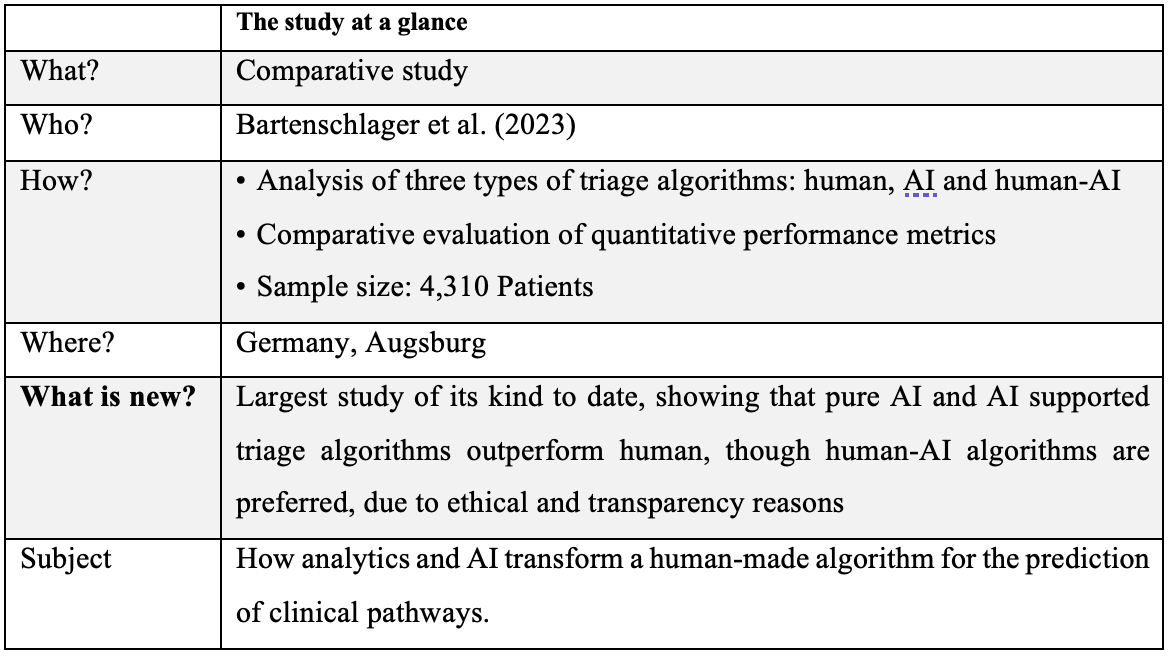
Bartenschlager et al. (2023) compared a standard triage algorithmAn algorithm is a solution procedure in the form of a systematic rule or approach. A problem is solved by means of a defined sequence of procedural steps. In computer science, algorithms form a fundamental basis of programming. Examples of algorithms include the calculation of the Body Mass Index (BMI), instruction manuals, or rules of … Con… recommended by the German Society for Interdisciplinary Emergency and Acute Medicine (DGINA) [1] an analytics-based extended triage algorithmAn algorithm is a solution procedure in the form of a systematic rule or approach. A problem is solved by means of a defined sequence of procedural steps. In computer science, algorithms form a fundamental basis of programming. Examples of algorithms include the calculation of the Body Mass Index (BMI), instruction manuals, or rules of … Con… [2], three AIArtificial Intelligence (AI) implies the attempt to transfer human learning and thinking to computers. Computer systems are intended to solve problems—for which a human would require intelligence—using large datasets. In the field of radiology, for example, artificial intelligence can assist physicians in diagnosing findings and detecting abnormali… Explained in the video. machine learningMachine learning is an iterative process and is classified as a subcategory within the field of Artificial Intelligence. Algorithms are programmed to initially learn from datasets and can subsequently develop in a self-learning manner without further explicit intervention. Accordingly, predictions are generated by algorithms based on retrospectivel… Explained in the video. (ML)Machine learning is an iterative process and is classified as a subcategory within the field of Artificial Intelligence. Algorithms are programmed to initially learn from datasets and can subsequently develop in a self-learning manner without further explicit intervention. Accordingly, predictions are generated by algorithms based on retrospectivel… Explained in the video. triage algorithms (Multi-Layer Perceptron, Random Forest, and Extreme Gradient Boosting) and an integrated human-AI triage algorithm.An algorithm is a solution procedure in the form of a systematic rule or approach. A problem is solved by means of a defined sequence of procedural steps. In computer science, algorithms form a fundamental basis of programming. Examples of algorithms include the calculation of the Body Mass Index (BMI), instruction manuals, or rules of … Con… Based on data from the Lean European Open Survey on SARS-CoV-2 infected patients (LEOSS), their study encompassed over 4,000 patients, significantly surpassing prior studies in scale [2].
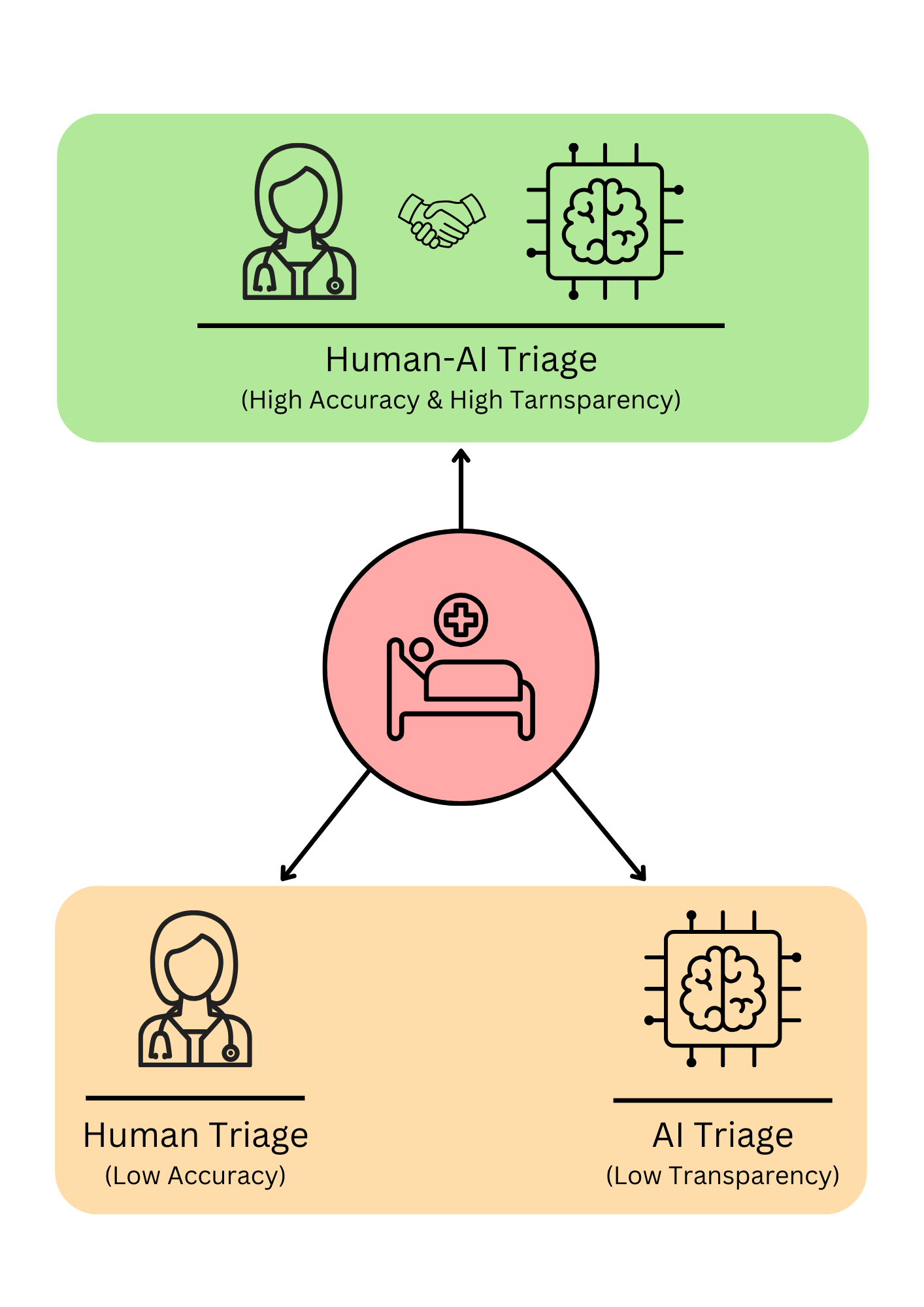
The results show that AIArtificial Intelligence (AI) implies the attempt to transfer human learning and thinking to computers. Computer systems are intended to solve problems—for which a human would require intelligence—using large datasets. In the field of radiology, for example, artificial intelligence can assist physicians in diagnosing findings and detecting abnormali… Explained in the video. and integrated human-AI algorithms generally exceed both standard and extended triage algorithms in most performance metrics (accuracy, sensitivity, precision, specificity). Accuracy ranged from 27% for the standard triage algorithm,An algorithm is a solution procedure in the form of a systematic rule or approach. A problem is solved by means of a defined sequence of procedural steps. In computer science, algorithms form a fundamental basis of programming. Examples of algorithms include the calculation of the Body Mass Index (BMI), instruction manuals, or rules of … Con… 51% for the extended triage algorithm,An algorithm is a solution procedure in the form of a systematic rule or approach. A problem is solved by means of a defined sequence of procedural steps. In computer science, algorithms form a fundamental basis of programming. Examples of algorithms include the calculation of the Body Mass Index (BMI), instruction manuals, or rules of … Con… 73% for the integrated human-AI algorithm,An algorithm is a solution procedure in the form of a systematic rule or approach. A problem is solved by means of a defined sequence of procedural steps. In computer science, algorithms form a fundamental basis of programming. Examples of algorithms include the calculation of the Body Mass Index (BMI), instruction manuals, or rules of … Con… and up to 78% for the AIArtificial Intelligence (AI) implies the attempt to transfer human learning and thinking to computers. Computer systems are intended to solve problems—for which a human would require intelligence—using large datasets. In the field of radiology, for example, artificial intelligence can assist physicians in diagnosing findings and detecting abnormali… Explained in the video. MLMachine learning is an iterative process and is classified as a subcategory within the field of Artificial Intelligence. Algorithms are programmed to initially learn from datasets and can subsequently develop in a self-learning manner without further explicit intervention. Accordingly, predictions are generated by algorithms based on retrospectivel… Explained in the video. algorithms. Results for sensitivity, precision, and specificity overall followed this trend, if with some variation [2]. However, it should be noted that the MLMachine learning is an iterative process and is classified as a subcategory within the field of Artificial Intelligence. Algorithms are programmed to initially learn from datasets and can subsequently develop in a self-learning manner without further explicit intervention. Accordingly, predictions are generated by algorithms based on retrospectivel… Explained in the video. algorithms where operating within a “black box”, making their decisions non-traceable and -transparent and thereby creating ethical concerns.
Limitations of the Study
Some limitations exist within the LEOSS dataset. There is a bias toward inpatients, incomplete values for some patients (addressed through approximations during imputation), and its representation of a predominantly European, particularly German, sample. Therefore, these findings mainly represent emergency room situations in developed countries. Additional diverse data is necessary, to extend these conclusions to ambulatory care settings and nations with differing healthcare standards [2].
Challenges for the implementation of AIArtificial Intelligence (AI) implies the attempt to transfer human learning and thinking to computers. Computer systems are intended to solve problems—for which a human would require intelligence—using large datasets. In the field of radiology, for example, artificial intelligence can assist physicians in diagnosing findings and detecting abnormali… Explained in the video. in triage decision-making processes
It is shown that AI-driven emergency room triage surpasses humans in all measured aspects. However, ethically, AIArtificial Intelligence (AI) implies the attempt to transfer human learning and thinking to computers. Computer systems are intended to solve problems—for which a human would require intelligence—using large datasets. In the field of radiology, for example, artificial intelligence can assist physicians in diagnosing findings and detecting abnormali… Explained in the video. lacks transparency and traceability in results, potentially perpetuating health disparities among different demographics. A lack of shared ethical standards in AIArtificial Intelligence (AI) implies the attempt to transfer human learning and thinking to computers. Computer systems are intended to solve problems—for which a human would require intelligence—using large datasets. In the field of radiology, for example, artificial intelligence can assist physicians in diagnosing findings and detecting abnormali… Explained in the video. complicates addressing these issues [3]. Nonetheless, steps are taken to approach these challenges. For example, Hopster and Maas (2023) propose a triadic model integrating values, technology, and regulations to guide moral and legal responses to such disruptive technologies [4]. With such concerns in mind, the study at hand suggests the use of the integrated human-AI triage algorithm,An algorithm is a solution procedure in the form of a systematic rule or approach. A problem is solved by means of a defined sequence of procedural steps. In computer science, algorithms form a fundamental basis of programming. Examples of algorithms include the calculation of the Body Mass Index (BMI), instruction manuals, or rules of … Con… as it performs similarly to the AIArtificial Intelligence (AI) implies the attempt to transfer human learning and thinking to computers. Computer systems are intended to solve problems—for which a human would require intelligence—using large datasets. In the field of radiology, for example, artificial intelligence can assist physicians in diagnosing findings and detecting abnormali… Explained in the video. MLMachine learning is an iterative process and is classified as a subcategory within the field of Artificial Intelligence. Algorithms are programmed to initially learn from datasets and can subsequently develop in a self-learning manner without further explicit intervention. Accordingly, predictions are generated by algorithms based on retrospectivel… Explained in the video. triage algorithms, however, with less transparency and traceability problems.
Once ethical concerns are addressed, implementation remains challenging. Data protection and ownership questions remain, especially in collaborations between tech giants and health professionals [5]. Furthermore, integrating these technologies with hospital systems presents significant challenges. Nonetheless, advances in healthcare digitalization in many countries, for example, Germany’s Hospital Future Act, may facilitate the adoption of digital decision support tools [2].
Conclusion
The study highlights AI’s potential in emergency room triage, aiding physicians’ decision-making. With technological and regulatory advancements, implementing these tools will likely be feasible in the near future. Addressing ongoing ethical concerns will likely involve integrated human-AI solutions [2, 6]. These approaches will help physicians in the emergency rooms expedite decision-making and enhance accuracy by swiftly processing and preparing data while allowing for human intervention if needed.
Further readings in German: Maschinelle Lernalgorithmen als neuer Screening-Ansatz für Patientinnen mit Endometriose
Contact
E-Mail:
atlas-itg@uni-wh.deInnovation in Healthcare
Alfred-Herrhausen-Straße 50
58448 Witten, Germany