

Raising data privacy awareness in healthcare organizations
The human factor significantly contributes to healthcare data privacy breaches, emphasizing the need for everyone’s involvement in cybersecurity. But how can cybersecurityCybersecurity represents an extension of information security. It goes beyond the boundaries of traditional information security and encompasses, in addition to the protection of information resources, also the protection of other assets including the individual. In cybersecurity, the human factor gains an additional dimension: the person as a pote… Explained in the video. and data privacy awareness be effectively raised?
Human factors in connected cybersecurityCybersecurity represents an extension of information security. It goes beyond the boundaries of traditional information security and encompasses, in addition to the protection of information resources, also the protection of other assets including the individual. In cybersecurity, the human factor gains an additional dimension: the person as a pote… Explained in the video. environments
The healthcare industry is increasingly digitalized, introducing benefits for patient care [1], like real-time decision support for clinicians [2]. However, this shift heightens cybersecurityCybersecurity represents an extension of information security. It goes beyond the boundaries of traditional information security and encompasses, in addition to the protection of information resources, also the protection of other assets including the individual. In cybersecurity, the human factor gains an additional dimension: the person as a pote… Explained in the video. risks as data exchange volume and points increase [1]. Healthcare data is highly valued on the black market, even more than credit card data [3], making healthcare a prime target for cybercriminals [4].
Research shows the human factor is a primary contributor to cybersecurityCybersecurity represents an extension of information security. It goes beyond the boundaries of traditional information security and encompasses, in addition to the protection of information resources, also the protection of other assets including the individual. In cybersecurity, the human factor gains an additional dimension: the person as a pote… Explained in the video. risks in healthcare [5]. Therefore, using network devices requires sufficient security controls, sophisticated usability, and adequate training and awareness programs for healthcare staff [6].
Another critical topic are social engineering attacks, particularly phishing attempts [7], with one in seven phishing attempts in hospitals succeeding [8]. Additionally, high workloads for clinical staff increase the likelihood of human errors [9]. Given the priority of the human factor in cybersecurity, there is broad consensus on the need for cybersecurityCybersecurity represents an extension of information security. It goes beyond the boundaries of traditional information security and encompasses, in addition to the protection of information resources, also the protection of other assets including the individual. In cybersecurity, the human factor gains an additional dimension: the person as a pote… Explained in the video. training for healthcare professionals. However, limited research exists on how hospital-implemented cybersecurityCybersecurity represents an extension of information security. It goes beyond the boundaries of traditional information security and encompasses, in addition to the protection of information resources, also the protection of other assets including the individual. In cybersecurity, the human factor gains an additional dimension: the person as a pote… Explained in the video. controls influence employee behavior [10].
Cyber hygiene methodology in healthcare data privacy
Cyber hygiene is a principle organizations use to maintain cybersecurity, by raising employee awareness through continuous campaigns, constantly evaluating risks, and implementing optimized cybersecurityCybersecurity represents an extension of information security. It goes beyond the boundaries of traditional information security and encompasses, in addition to the protection of information resources, also the protection of other assets including the individual. In cybersecurity, the human factor gains an additional dimension: the person as a pote… Explained in the video. measures and controls [11]. In their study, Argyridou et al. used a five-step cyber hygiene methodology similar to classic risk management methodologies (illustrated in Figure 1) [10].
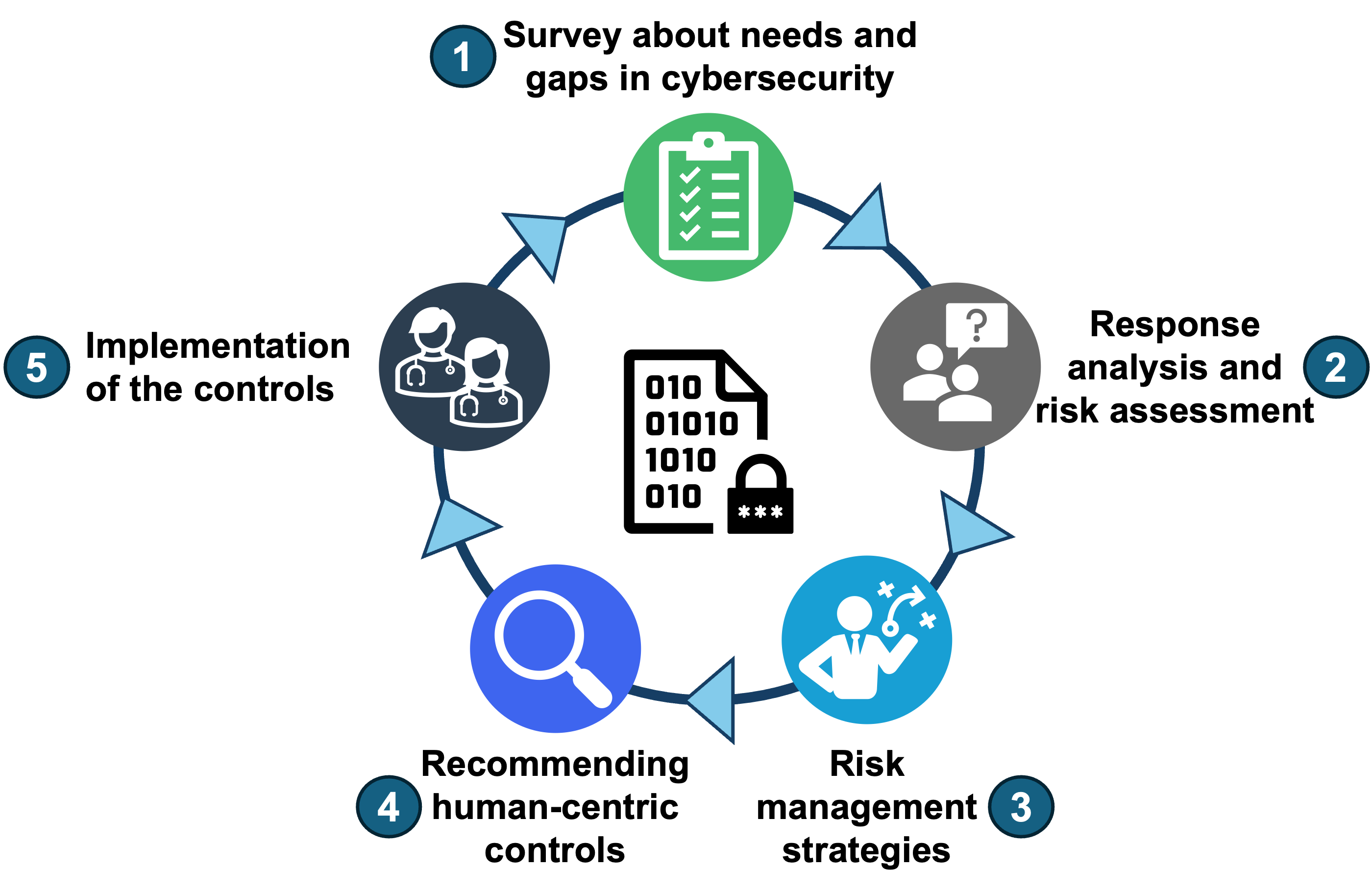
They tested their methodology in three different European healthcare institutions. The baseline was a survey, in which they investigated the employee’s cybersecurityCybersecurity represents an extension of information security. It goes beyond the boundaries of traditional information security and encompasses, in addition to the protection of information resources, also the protection of other assets including the individual. In cybersecurity, the human factor gains an additional dimension: the person as a pote… Explained in the video. education and awareness. Based on the survey results, risk profiles were created and mitigation strategies, for example for phishing risks, were developed. These strategies focused on promoting desirable employee behaviors through human-centric controls in the areas of training, awareness, motivation, and reward [10].
Observed risk areas and proposed controls in healthcare data privacy
The survey in the three healthcare institutions revealed a general medium to high-risk profile across all institutions. Argyridou et al. observed that employees from the IT and technical personnel group showed high awareness about cyber hygiene but also exhibited a higher risk in secure connections and device usage, indicating they were not following or not aware of policies for secure device connection. To address these issues, the authors proposed integrating human-centric controls focused on data privacy awareness, training in authentication methods, data handling, and prevention of unintentional data exposure [10].
The medical and clinical group across all monitored healthcare institutions displayed high risks in the category of communication channels, indicating they used a limited number of channels and exchanged information with IT professionals on a limited basis. The authors recommended establishing controls focused on cybersecurityCybersecurity represents an extension of information security. It goes beyond the boundaries of traditional information security and encompasses, in addition to the protection of information resources, also the protection of other assets including the individual. In cybersecurity, the human factor gains an additional dimension: the person as a pote… Explained in the video. and data privacy awareness programs, as well as introducing champions for these areas within the group [10].
Potential of incorporating cyber hygiene in healthcare institutions
As cybersecurityCybersecurity represents an extension of information security. It goes beyond the boundaries of traditional information security and encompasses, in addition to the protection of information resources, also the protection of other assets including the individual. In cybersecurity, the human factor gains an additional dimension: the person as a pote… Explained in the video. risks, particularly those involving human factors, continue to grow in importance, the cyber hygiene methodology presented could assist healthcare organizations in strengthening their cybersecurityCybersecurity represents an extension of information security. It goes beyond the boundaries of traditional information security and encompasses, in addition to the protection of information resources, also the protection of other assets including the individual. In cybersecurity, the human factor gains an additional dimension: the person as a pote… Explained in the video. strategies and fostering a cybersecurityCybersecurity represents an extension of information security. It goes beyond the boundaries of traditional information security and encompasses, in addition to the protection of information resources, also the protection of other assets including the individual. In cybersecurity, the human factor gains an additional dimension: the person as a pote… Explained in the video. culture. The survey, serving as the foundation for this methodology, primarily focused on phishing attacks. To broaden the approach to a wider range of cyber risks, the survey questions should be appropriately adjusted. For further research, it should be evaluated whether the risk situation in the analyzed healthcare organizations changes upon implementing the proposed controls.
References
10. Argyridou E, Nifakos S, Laoudias C, Panda S, Panaousis E, Chandramouli K, et al. Cyber Hygiene Methodology for Raising CybersecurityCybersecurity represents an extension of information security. It goes beyond the boundaries of traditional information security and encompasses, in addition to the protection of information resources, also the protection of other assets including the individual. In cybersecurity, the human factor gains an additional dimension: the person as a pote… Explained in the video. and Data Privacy Awareness in Health Care Organizations: Concept Study. J Med Internet Res 2023. doi:10.2196/41294. 11. Review of cyber hygiene practices. Heraklion: ENISA; 2016.

Contact
E-Mail:
atlas-itg@uni-wh.deInnovation in Healthcare
Alfred-Herrhausen-Straße 50
58448 Witten, Germany