

A Ray of Hope: Innovations for Low- and Middle-Income Countries
How can inclusive innovation overcome infrastructure barriers to transform global healthcare?
At a time when digital innovations in healthcare are emerging and changing the face of healthcare, the question is whether low- and middle-income countries (LMICs) are reaping the benefits. Statistically, half of the world’s population had limited access to basic health services in 2017 (1), such as the access to safe and affordable surgical care (2). One reason for this is the limited health workforce in LMICs (3), as shown in Figure 1.
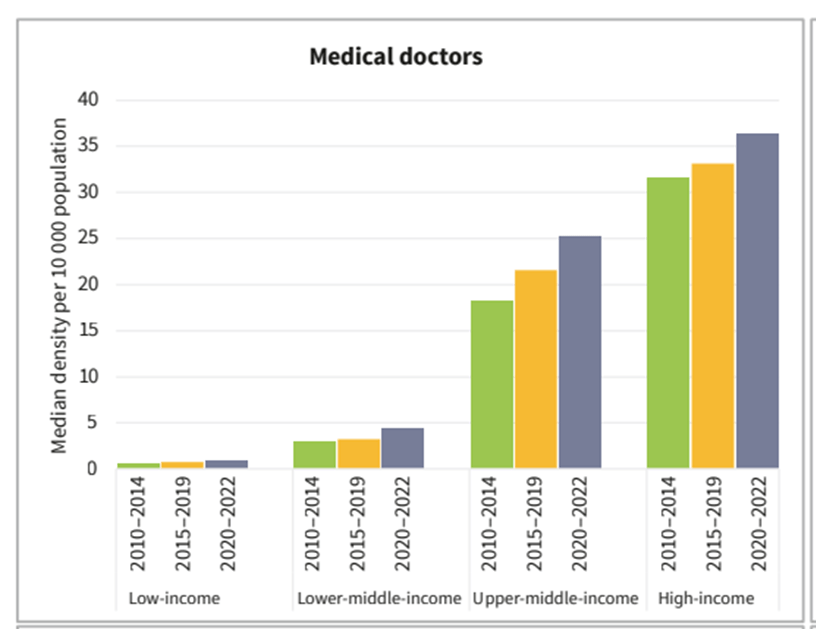
This highlights the need for technologies such as telemedicine services to address workforce shortages as telemedicine solutions can increase efficiency and therefore availability. However, this is easier said than done. Most LMICs lack the critical and stable infrastructure required for common telehealth innovations such as virtual consultations (3, 5–7). Electricity and a good internet connection are just two examples of many (3, 8) that hinder, if not prevent, the adoption of digital tools.
As a result, digital health innovations must be designed and implemented taking into account the social, economic, and infrastructural conditions that shape their feasibility and impact (8).
News from Science
Recognising these barriers, Protserov et al (2024) have developed a web-based, AI-driven telemedicine application that runs on any edge device and can improve outcomes when things get complicated or when doctors are at a loss during surgery. This application was developed for one of the most common surgeries in the world: the laparoscopic cholecystectomy – a minimally invasive surgery (5). However, Protserov et al.’s scope is much broader, as this study should be seen as a role model for how to develop healthcare technologies that take into account social, economic and infrastructural differences. Their solution takes into account power supply (for edge devices that run on batteries) internet connectivity, and the availability of financial resources.
What did they do?
They set up a panel of experts who scored every frame of 314 videos of the operation. Based on these results, they trained two deep learningDeep Learning ist ein Teilbereich des maschinellen Lernens, der neuronale Netzwerke zur Analyse verschiedener Faktoren mit einer Struktur verwendet, die dem menschlichen neuronalen System ähnlich ist. Der Vorteil von künstlichen neuronalen Netzen ist die tiefgehende Abstraktion von Zusammenhängen zwischen Eingabe-Daten und zwischen den abstrahierte…zum Glossar models to predict safe and dangerous areas of dissection based on video frames. The result was a web-based, camera-linked operating room application, that can provide live guidance during surgery and runs on edge devices (5).
Once the development process was complete, Protserov et al. (2024) conducted several tests. They tested the application with different frame rates, round-trip delays and network bandwidth speeds, taking into account the infrastructure available in LMICs. Digital solutions, especially those with potential benefits for LMICs, such as this specific real-time surgical decision support application, should be developed with consideration of differences in infrastructure and resources to ensure adaptability (5).
Implications for innovators
As the world moves faster and healthcare innovations advance rapidly, it is important to remember that most high-end technologies cannot be used everywhere in the world due to infrastructural differences. Innovators who care about the social aspects of their innovations, and people who care about a healthier and more equitable world, should always consider whether their innovations are globally applicable or limited to specific markets.
It is time to rethink the way we innovate, prioritising those who struggle to adopt new technologies or keep pace with rapid advancements. The study by Protserov et al. is the ray of hope that the healthcare sector needs and should be seen as a use case for innovators.
Verwandte Artikel
Lesen Sie auch: AI-Based Symptom Checkers in Medical Self-Diagnosis
Literatur
- World Health Organization and International Bank for Reconstruction. Tracking universal health coverage: 2017 global monitoringDer Begriff Monitoring bezeichnet insbesondere in der Intensiv- und Notfallmedizin das kontinuierliche Beobachten oder Überwachen von Vitalfunktionen. Weiter gefasst sind jegliche Formen der diagnostischen Überwachung gemeint. Ein digitales Anwendungsbeispiel ist das Smartphone-gestützte Gesundheits-Monitoring von Parametern wie Blutdruck und Körpe…zum Glossar report; 2017 [cited 2025 Jan 21]. Available from: URL: https://iris.who.int/bitstream/handle/10665/259817/9789241513555-eng.pdf?sequence=1.
- Alkire BC, Raykar NP, Shrime MG, Weiser TG, Bickler SW, Rose JA et al. Global access to surgical care: a modelling study. Lancet Glob Health 2015; 3(6):e316-23. [https://doi.org/10.1016/S2214-109X(15)70115-4]
- Yi S, Lo Yam EY, Cheruvettolil K, Linos E, Gupta A, Palaniappan L et al. Perspectives of Digital Health Innovations in Low- and Middle-Income Health Care Systems From South and Southeast Asia. J Med Internet Res 2024; 26:e57612. [https://doi.org/10.2196/57612]
- World Health Organization. World health statistics 2024: monitoringDer Begriff Monitoring bezeichnet insbesondere in der Intensiv- und Notfallmedizin das kontinuierliche Beobachten oder Überwachen von Vitalfunktionen. Weiter gefasst sind jegliche Formen der diagnostischen Überwachung gemeint. Ein digitales Anwendungsbeispiel ist das Smartphone-gestützte Gesundheits-Monitoring von Parametern wie Blutdruck und Körpe…zum Glossar health for the SDGs, Sustainable Development Goals; 2024 [cited 2025 Jan 21]. Available from: URL: https://iris.who.int/bitstream/handle/10665/376869/9789240094703-eng.pdf?sequence=1.
- Protserov S, Hunter J, Zhang H, Mashouri P, Masino C, Brudno M et al. Development, deployment and scaling of operating room-ready artificial intelligenceKünstliche Intelligenz (KI) impliziert den Versuch menschliches Lernen und Denken dem Computer anzueignen. Problemstellungen sollen von Computersystemen mit Hilfe großer Datenbestände gelöst werden, für die ein Mensch seine Intelligenz benötigt. Im Bereich der Radiologie beispielsweise kann die künstliche Intelligenz Ärzte bei der Befundung unterst… Im Video erklärt.zum Glossar for real-time surgical decision support. NPJ Digit Med 2024; 7(1):231. [https://doi.org/10.1038/s41746-024-01225-2]
- Yu J, Meng S. Impacts of the Internet on Health Inequality and Healthcare Access: A Cross-Country Study. Front Public HealthPublic Health, im Deutschen öffentliche Gesundheit, hat den Anspruch, ein gesundes Umfeld für die Bevölkerung zu schaffen. Hierzu gehören Einflüsse durch beispielsweise Umwelt, Verhalten und Gesundheitssystem. Der Begriff beschreibt sowohl eine interdisziplinäre Wissenschaft, die eine optimale bevölkerungsweite Gesundheitsversorgung erforscht und d…zum Glossar 2022; 10:935608. [https://doi.org/10.3389/fpubh.2022.935608]
- Labrique AB, Wadhwani C, Williams KA, Lamptey P, Hesp C, Luk R et al. Best practices„Best Practices“ sind evidenzbasierte Erfolgsmethoden und bewährte Verfahren in Form von Dienstleistungen oder Prozessen, die am besten geeignet für die Strategie, für die Patienten oder die Gemeinschaft sind. Mittels kontinuierlichem Monitoring und Evaluation wird festgestellt, ob der Evidenz-Praxis-Transfer der Best Practices wirklich eine qualit…zum Glossar in scaling digital health in low and middle income countries. Global Health 2018; 14(1):103. [https://doi.org/10.1186/s12992-018-0424-z]
- cyberHui CY, Abdulla A, Ahmed Z, Goel H, Monsur Habib GM, Teck Hock T et al. Mapping national information and communication technology (ICT) infrastructure to the requirements of potential digital health interventions in low- and middle-income countries. J Glob Health 2022; 12:4094. [https://doi.org/10.7189/jogh.12.04094]

Kontakt
E-Mail:
atlas-itg@uni-wh.deInnovation im Gesundheitswesen
Alfred-Herrhausen-Straße 50
58448 Witten, Deutschland