
Value Creation with AI Business Models in Health Care

Artificial intelligence (AI) is opening new and innovative approaches to value creation. Where are new avenues to generate value in healthcare using such developing technologies?
Introduction
The number of use cases for artificial intelligence in the healthcare sector is staggering. For example, an international Review identified eight central applications for AI in healthcare, including medical imaging, virtual patient care and administrative applications [1]. A study from Finland, furthermore, identified 34 cases for AI healthcare, ranging from mobile solutions for home care and cognitive computing for advanced triage to optimizing operating room efficiency [2]. Finally, particularly inpatient care has already made significant advances for the use of AI in daily operations, applying it, amongst other use cases, in diagnosis’, chronic disease management and logistics optimization [3]. However, questions remain as to how specifically these services can create value and to what extent they will be used by the various stakeholders of the international healthcare system. To gather insight as to where this path may lead, it can be helpful to take a closer look at upcoming startups, to analyze which innovations, use cases, and business models may find success in the future and establish themselves in the healthcare system.
Exploring value creation in AI-driven healthcare start-ups – a multiple case study
[ ](https://www.atlas-digitale-gesundheitswirtschaft.de/wp-content/uploads/2024/02/Bildschirmfoto-2024-02-26-um-17.06.06.png)
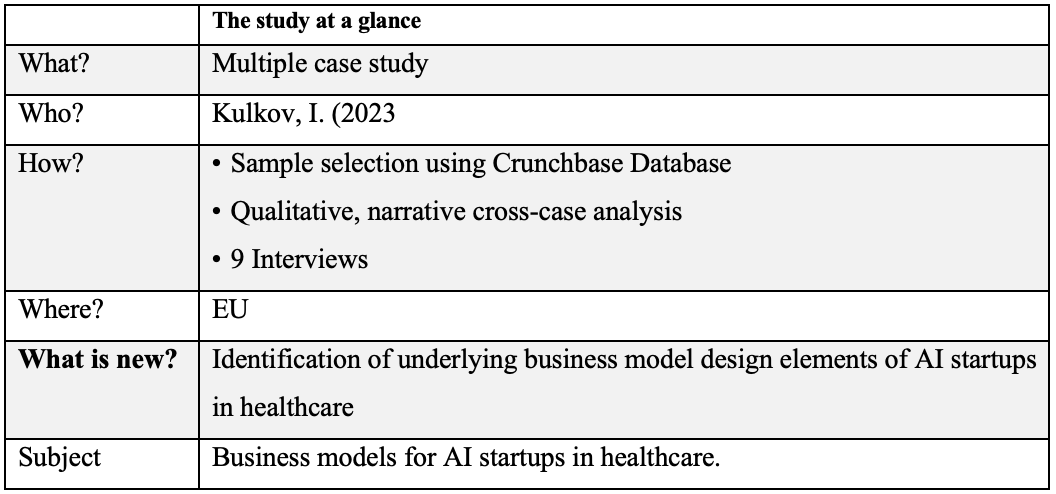
Kulkov (2023) carried out a multiple case study with nine start-ups, founded no more than five years ago, with headquarters in the EU, and specializing in diagnostics, therapeutics, population health management, and drug discovery. The study aimed to determine how emerging startups are finding new approaches for value creation using AI in the healthcare sector [4]. The leadership of these companies was then interviewed, and the results of the interviews analyzed, building on the design approach used by Amit and Zott (2010) to study the creation and capture of value by companies [5].
Business Models in Healthcare AI Start-ups
After conducting interviews with representatives from healthcare AI solution start-ups, the author identified common characteristics, which were then categorized into three distinct design elements. The emerging business models of AI startups in healthcare are described to be based on narrow specialization in healthcare, consulting, and platform services, connected through Software- or Platform-as-a-Service offers and increasingly focusing on B2C and B2B2C approaches, and largely carried out by physicians, patients, and hospitals. Furthermore, the results uncovered three dominant value creation drivers, that characterize the start-up companies: improved access to healthcare, responsiveness, and privacy. These drivers, in turn, are built on
- creating new solutions, reliability, convenience, and speed of service for patients,
- load reduction, reliability, and convenience for physicians,
- cost reduction and fraud detection for hospitals,
- more speed and greater reliability of results at reduced costs in drug discovery and R&D for pharma- and bio-tech companies [4].
Limitations
The small sample size may limit the generalizability of conclusions. More importantly, the study deviated from Amit & Zott’s model by aggregating insights across multiple companies and developing different design themes than those suggested by the original authors, warranting some caution in its interpretation.
Implications
The results of this study are quite interesting considering prior work by Weber et al. (2022), who have suggested four archetypical business model patterns of AI start-ups in general [6]. Comparing these to the present results, most healthcare AI start-ups are, in the grand scheme of things, relatively specialised on AI -charged Product/Service provision and data analytics. In comparison, almost none seem to address AI development facilitation and deep tech research. However, as development facilitation startups often offer services across industries, they may simply have slipped through the sampling of Kulkov’s study, due to being non-specific to healthcare, even if potentially relevant. It would, therefore, be premature to conclude that healthcare has no need for such value propositions. Deep tech research, on the other hand, may be more likely to be found in existing institutions and corporations within healthcare, for example niche contexts, such as drug-development. For startups, however, revenue streams are hard to come by for such business models and, hence, comparatively few exist [6], before even starting to speak of the healthcare industry to begin with.
Conclusion
The study suggests that the roles and working procedures of all stakeholders including patients, nurses, physicians, and managers will change drastically. At the core of this study is the idea that patients, through the sharing of data, are becoming a source of value, thereby facilitating more cost-effective treatment. As a result, patients could play a more active role in healthcare (for example, by using wearables with AI applications), while nurses and physicians might be less required for routine procedures and check-ups but rather activities involving more interaction, support, and empathy.
References
- Al Kuwaiti A, Nazewr K, Al-Reedy A, Al-Shehri S, Al-Muhanna A, Subbarayalu A V, A Muhanna D & Al-Muhanna F A. A Review of the Role of Artificial Intelligence in Healthcare. Journal of Personalized Medicine 2023; 13(6), 1-22. DOI: 10.3390/jpm13060951
- Tyrväinen P, Silvennoininen M, Talvitie-Lamberg K, Ala-Kuitula A & Kuoremäki R. Identifying Opportunities for AI applications in Healthcare – Renewing the National Helathcare and Social Services. 2018 IEEE 6th International Conference on Serious Games and Applications for Health (SeGAH); 2018; 1-7. DOI: 10.1109/SeGAH.2018.8401381
- Klumpp M, Hintze M, Immonen M, Ródenas-Rigla F, Pilati F, Aparicio-Martínez F, Çelebi D, Liebig T, Jirstrand M, Urbann O, Hedman M, Lipponen J A, Bicciato S, Radan, A-P. Valdivieso B, Thronicke W, Gunopulos D & Delgado-Gonzalo R. Artificial Intelligence for Hospital Care: Application Cases and Answers to Challenges in European Hospitals. Healthcare 2021; 9(8), 1-24. DOI: 10.3390/healthcare9080961
- Kulkov I. Next-Generartion Business Models for Artificial Intelligence Start-Ups in the Healthcare Industry. International Jouirnal of Entrepreneurial Behaviour & Research 2023; 29(4), 1355-2554. DOI: 10.1108/IJEBR-04-2021-0304
- Zott C, Amit R. Business Model Design: An Activity System Perspective. Long Range Planning 2010; 43(1-2), 216-226. DOI: 10.1016/j.lrp.2009.07.004
- Weber M, Beutter M, Weking J, Böhm M, Krcmar. AI Startup Business Models. Business & Information Systems 2022,64(1), 91-109. DOI: 10.1007/s12599-021-00732-w
- Osterwalder & Pigneur. Business model generation: a handbook for visionaries, game changers, and challengers. Hoboken, NJ: Wiley; 2010