Blockchain Technology in Healthcare: Paving the Way for Data Security and Privacy
Providing patients and health professionals with comprehensive access to health information is part of ensuring high-quality care. How can a BlockchainDie Blockchain ist eine digitale, dezentrale Datenbank zum Erfassen und Speichern von Transaktionsdatensätzen, sog. Blöcke. Die Datensätze können u.a. Gesundheitsinformationen oder Informationen zu Lieferketten von Arzneimittel enthalten. Die Technologie ermöglicht einen gesicherten, fälschungssicheren und transparenten Datenaustausch. Im Video erklärt.zum Glossar solution help in data management?
The Challenge: Fragmented Health Information Systems
Patient health information is traditionally stored in institution-specific systems, leading to fragmented and siloed healthcare data that limit transparency and hamper the efficiency of healthcare provision. Centralizing this information could resolve these issues but introduce heightened security risks, as centralized databases are increasingly vulnerable to cyberattacks and IT breaches [1, 2]. BlockchainDie Blockchain ist eine digitale, dezentrale Datenbank zum Erfassen und Speichern von Transaktionsdatensätzen, sog. Blöcke. Die Datensätze können u.a. Gesundheitsinformationen oder Informationen zu Lieferketten von Arzneimittel enthalten. Die Technologie ermöglicht einen gesicherten, fälschungssicheren und transparenten Datenaustausch. Im Video erklärt.zum Glossar technology offers an alternative solution to patient data management by distributing data across a vast network of computers, thus enhancing the safe storage and transfer of health data between patients and various healthcare entities, such as hospitals, laboratories, or pharmacies [3-6].
What is a Blockchain? BlockchainDie Blockchain ist eine digitale, dezentrale Datenbank zum Erfassen und Speichern von Transaktionsdatensätzen, sog. Blöcke. Die Datensätze können u.a. Gesundheitsinformationen oder Informationen zu Lieferketten von Arzneimittel enthalten. Die Technologie ermöglicht einen gesicherten, fälschungssicheren und transparenten Datenaustausch. Im Video erklärt.zum Glossar is a decentralized node network for storing and exchanging data, consisting of individual data blocks linked together in a chain and operating without requiring third-party control, such as an administrator [5, 6]. Key features such as high reliability and robust tamper-resistance not only facilitate a wide range of innovative use cases but can also further enhance the security of health information [4, 7]. The following graphic illustrates the blockchainDie Blockchain ist eine digitale, dezentrale Datenbank zum Erfassen und Speichern von Transaktionsdatensätzen, sog. Blöcke. Die Datensätze können u.a. Gesundheitsinformationen oder Informationen zu Lieferketten von Arzneimittel enthalten. Die Technologie ermöglicht einen gesicherten, fälschungssicheren und transparenten Datenaustausch. Im Video erklärt.zum Glossar transaction process:
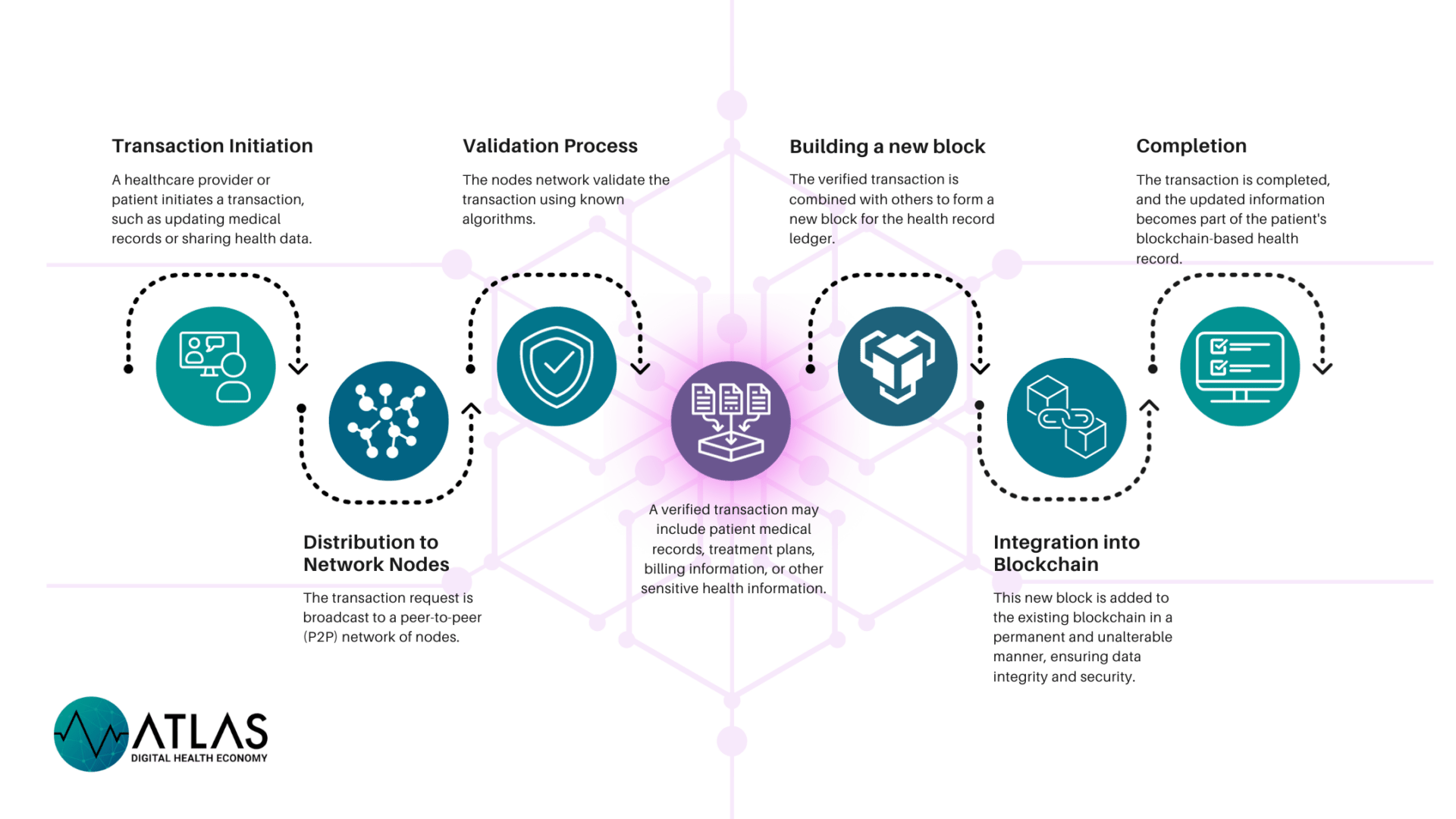
How BlockchainDie Blockchain ist eine digitale, dezentrale Datenbank zum Erfassen und Speichern von Transaktionsdatensätzen, sog. Blöcke. Die Datensätze können u.a. Gesundheitsinformationen oder Informationen zu Lieferketten von Arzneimittel enthalten. Die Technologie ermöglicht einen gesicherten, fälschungssicheren und transparenten Datenaustausch. Im Video erklärt.zum Glossar Operates: An Insight into the Transaction Process
MediLinker: A Showcase of Blockchain-based patient-centric identity management
MediLinker, developed at the University of Texas in several Research and Development phases, addresses fragmented health data and patient ID management by enabling patients to control their data and digitize identity credentials. This healthcare appAls mobile Applikationen (Apps) zählen digitale Anwendungen bzw. Programme, welche nicht an stationäre Geräte wie PC’s gebunden, sondern komprimiert auf mobilen Endgeräten wie beispielsweise Smartphones oder Tablets ausführbar sind. Da es sich bei Apps um eigenständige, in sich geschlossene Software handelt, die mobil anwendbar ist, sind die von Nu…zum Glossar streamlines record keeping and ensures data security using Blockchain, allowing information sharing between patients and clinics [8]. The user base of MediLinker includes patients and healthcare staff, such as nurses, physicians, and health administrators [9].
To assess the utility of MediLinker, Abdul-Moheeth et al. (2022) conducted a simulation approach with 20 patient use cases in an outpatient setting. Medical students from the University of Texas participated, adopting patient personas within a simulated healthcare ecosystem to execute key patient care transition tasks [9].
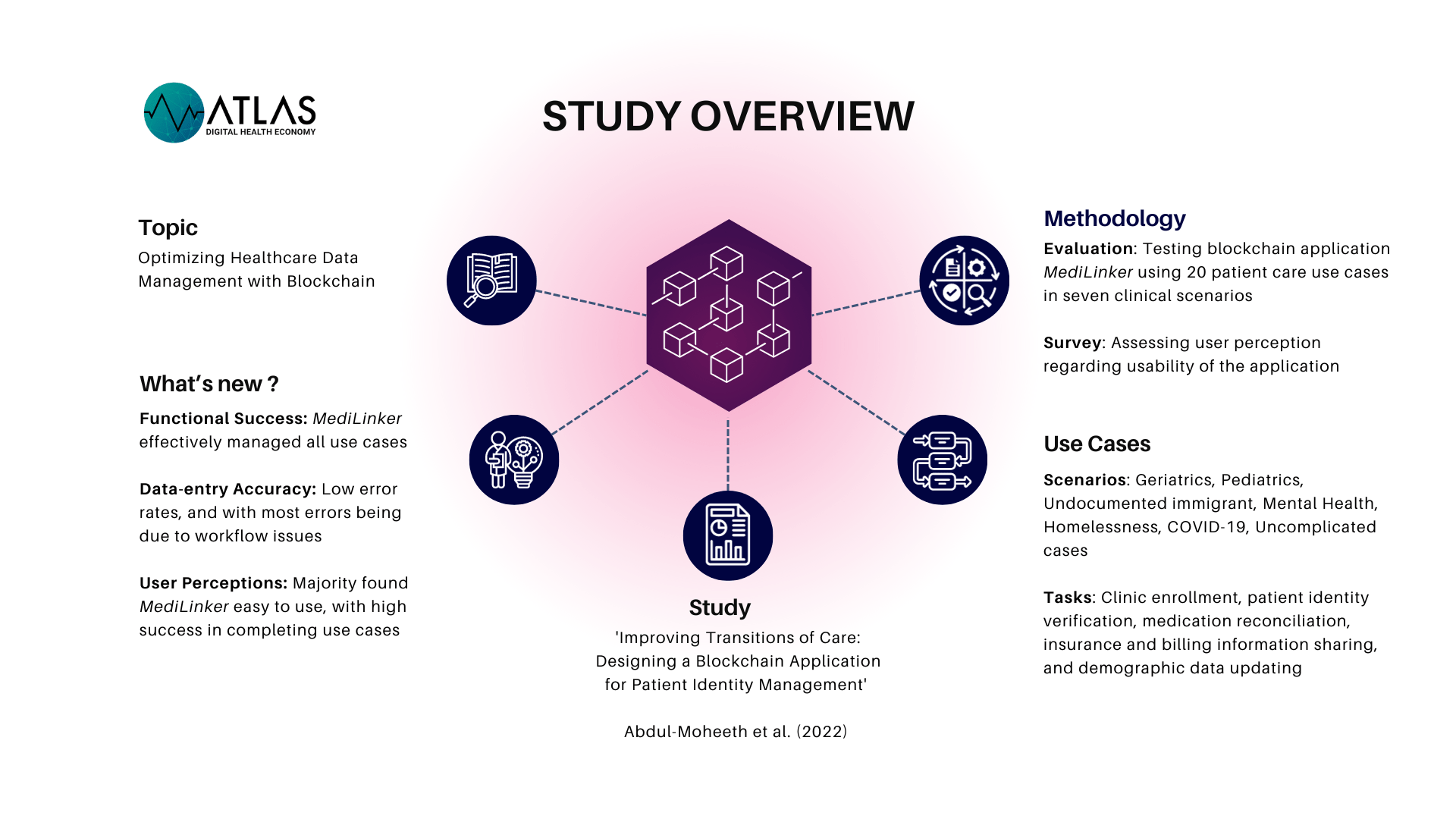 The application successfully managed all tested real-world scenarios and tasks, as outlined in the above figure, demonstrating effective patient-centered interoperability and minimal data-entry errors. User feedback highlighted increased trust in blockchainDie Blockchain ist eine digitale, dezentrale Datenbank zum Erfassen und Speichern von Transaktionsdatensätzen, sog. Blöcke. Die Datensätze können u.a. Gesundheitsinformationen oder Informationen zu Lieferketten von Arzneimittel enthalten. Die Technologie ermöglicht einen gesicherten, fälschungssicheren und transparenten Datenaustausch. Im Video erklärt.zum Glossar with more exposure. However, the study involved only highly educated participants and synthetic data which may limit its real-world applicability [9].
Future directions
MediLinker’s feasibility in enhancing care coordination and data management has been evaluated using simulated scenarios and synthetic patient data [9, 10]. The ongoing phase is dedicated to preparing the platform for real-world use in primary care settings. Future development will involve live patient data, prioritizing data safety and study integrity, and aiming to commercialize MediLinker while broadening its user base to additional healthcare stakeholders and enhancing computing capabilities [8].
Conclusion
BlockchainDie Blockchain ist eine digitale, dezentrale Datenbank zum Erfassen und Speichern von Transaktionsdatensätzen, sog. Blöcke. Die Datensätze können u.a. Gesundheitsinformationen oder Informationen zu Lieferketten von Arzneimittel enthalten. Die Technologie ermöglicht einen gesicherten, fälschungssicheren und transparenten Datenaustausch. Im Video erklärt.zum Glossar solutions, like MediLinker, offer a decentralized framework for managing health data, enhancing patient autonomy and the integrity of medical records. By enabling secure, real-time sharing of health information between patients and healthcare providers, blockchainDie Blockchain ist eine digitale, dezentrale Datenbank zum Erfassen und Speichern von Transaktionsdatensätzen, sog. Blöcke. Die Datensätze können u.a. Gesundheitsinformationen oder Informationen zu Lieferketten von Arzneimittel enthalten. Die Technologie ermöglicht einen gesicherten, fälschungssicheren und transparenten Datenaustausch. Im Video erklärt.zum Glossar technology streamlines care coordination, improves the accuracy of medical data, and reduces the risk of data breaches. However, its implementation is not without challenges, such as general mistrust, potentially high initial costs, or integration with existing infrastructures [5, 9]. BlockchainDie Blockchain ist eine digitale, dezentrale Datenbank zum Erfassen und Speichern von Transaktionsdatensätzen, sog. Blöcke. Die Datensätze können u.a. Gesundheitsinformationen oder Informationen zu Lieferketten von Arzneimittel enthalten. Die Technologie ermöglicht einen gesicherten, fälschungssicheren und transparenten Datenaustausch. Im Video erklärt.zum Glossar solutions are in their early stages and require further technological exploration and research to advance its capabilities.
Further readings: BlockchainDie Blockchain ist eine digitale, dezentrale Datenbank zum Erfassen und Speichern von Transaktionsdatensätzen, sog. Blöcke. Die Datensätze können u.a. Gesundheitsinformationen oder Informationen zu Lieferketten von Arzneimittel enthalten. Die Technologie ermöglicht einen gesicherten, fälschungssicheren und transparenten Datenaustausch. Im Video erklärt.zum Glossar in Electronic Health Records: Increasing willingness to share health information through patient empowermentUnter Patient oder Patienten-Empowerment wird eine Stärkung der Rolle des Patienten im Kontext seine Gesundheit(-sversorgung) verstanden. Mithilfe von Information und Partizipation erlebt der Patient mehr Eigenverantwortung und kann durch besseres Verständnis mehr Einfluss auf seinen Gesundheitszustand ausüben.zum Glossar

Kontakt
E-Mail:
atlas-itg@uni-wh.deInnovation im Gesundheitswesen
Alfred-Herrhausen-Straße 50
58448 Witten, Deutschland